



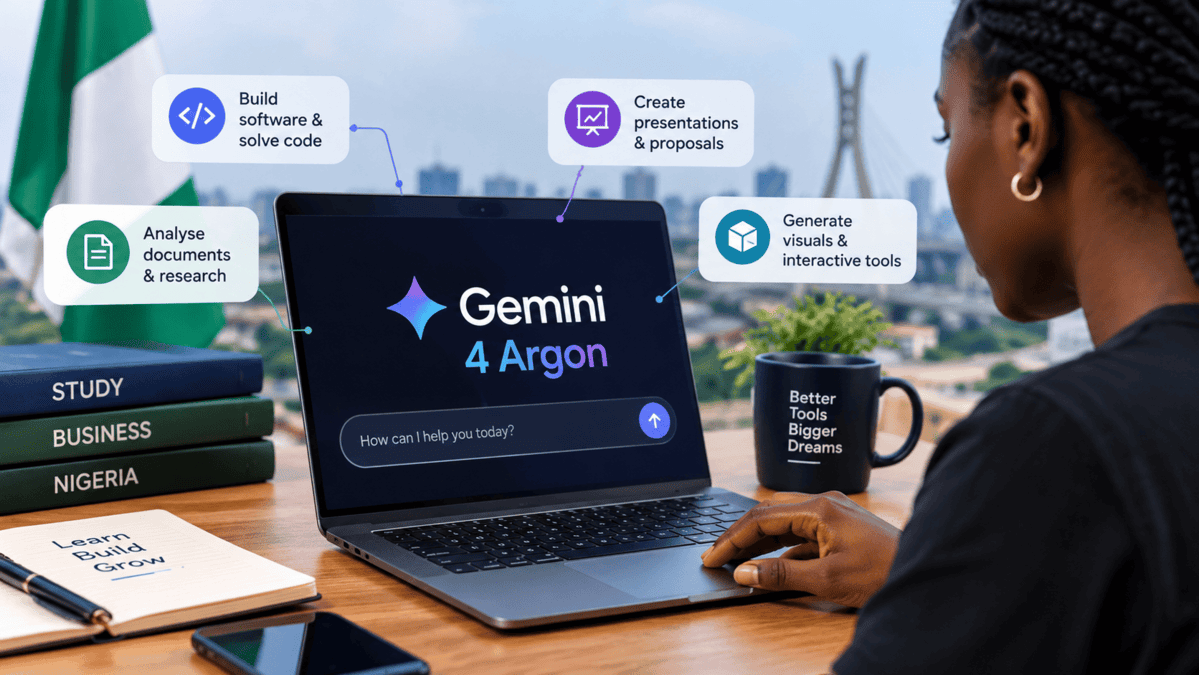
Google has expanded access to Gemini 4 Argon, its latest artificial intelligence (AI) model, allowing eligible users to tackle complex tasks ranging from building software and analysing documents to creating interactive visual tools.
The model, announced on October 13, is available to Google AI Pro and Ultra subscribers through the Gemini app and AI Mode in Search, while developers can access it through Google’s application programming interface (API) and AI Studio.
Google is also offering 10,000 scientists and researchers six months of access to its highest usage tier on Google Antigravity, subject to eligibility and selection.
Can Nigerians use Gemini 4 Argon for free?
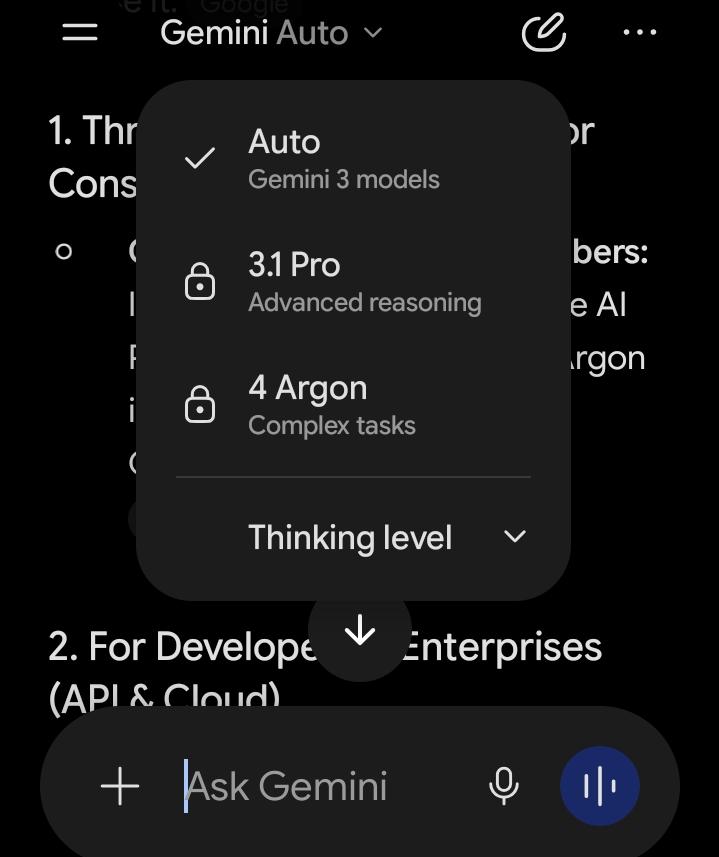
No. Google’s announcement does not say whether free users get Argon, and a check of the Gemini app showed that while Gemini 4 Argon appears in the model list, it is locked for free accounts.
In Nigeria, Google AI Pro costs ₦28,500 a month, while Ultra costs ₦89,000 to ₦289,000 depending on the tier. Google also offers a local Google AI Plus plan, a lower-tier consumer plan available for ₦7,700 per month and a student discount for eligible Nigerian university and polytechnic students to access Google AI Plus free for 12 months, or upgrade to Google AI Pro at a 75% discount for ₦7,100 per month.
Read more: Google launches Gemini 4 Argon for advanced coding but restricts access over cybersecurity risks
Developers can use the model through the Gemini API, with introductory pricing of $2 per million input tokens and $10 per million output tokens. Google says the introductory rates will rise to $4 and $20, respectively, after November 30, 2026, while cached input tokens receive a 95% discount during the introductory period.
API pricing is based on the volume of information processed and generated, not a flat monthly fee, so the cost of building an application will depend on usage and any additional infrastructure required.
What Nigerians can use it for
One of Argon’s main selling points is its ability to handle tasks that require several connected steps rather than simply answering a question. Google says the model can work across large collections of documents, generate code and support interactive visual projects.
For students and researchers, this could mean organising lengthy academic materials, comparing findings across documents and building visual explanations of difficult subjects. A student could, for example, ask an AI assistant to compare several course materials, identify recurring themes and prepare revision questions.
Researchers could use it to examine complex datasets and explore hypotheses, although its findings would still require independent verification.
Developers could use Argon to examine existing code, identify errors and suggest improvements, while journalists could use it to organise information from multiple reports and documents.
How small businesses and freelancers could benefit
Small businesses, independent professionals and freelancers could use Argon to reduce the time spent on repetitive work. Google says the model can turn information scattered across documents into structured proposals and presentations.
A Nigerian caterer, for instance, could provide customer requirements, a budget and service details and ask the model to organise them into a proposal, draft a client email and prepare a cost breakdown.
A freelancer could use similar capabilities to structure a project plan, review a spreadsheet or develop an initial website prototype. A small business owner could ask it to organise sales figures, compare expenses and prepare a cash flow forecast. Business owners would still need to check quotations, market prices, tax obligations and financial projections before acting on the results.
Free access for researchers
Google is also offering 10,000 scientists and researchers six months of access to the highest usage tier on Google Antigravity, its AI-powered development platform.
The programme is intended to support research in areas such as scientific problem-solving, software development and data analysis. Google says access is subject to eligibility, available capacity and selection, so acceptance is not guaranteed.
The offer could be relevant to Nigerian university researchers and independent scientists who need advanced AI tools for research projects. Researchers can apply through Google’s application form.
What users should know before relying on Argon
AI-generated information still needs checking. A model can produce convincing but inaccurate answers, make mistakes in calculations or generate code that requires debugging, particularly in academic research, legal documents, medical information and financial decisions.
Users should also be careful about uploading sensitive business records, personal information or confidential research materials.
For Nigerian users, the practical value of Gemini 4 Argon will depend on whether its capabilities are accessible at a manageable cost and whether they solve a genuine problem. For now, the most capable version of Google’s AI sits behind a paywall.
