


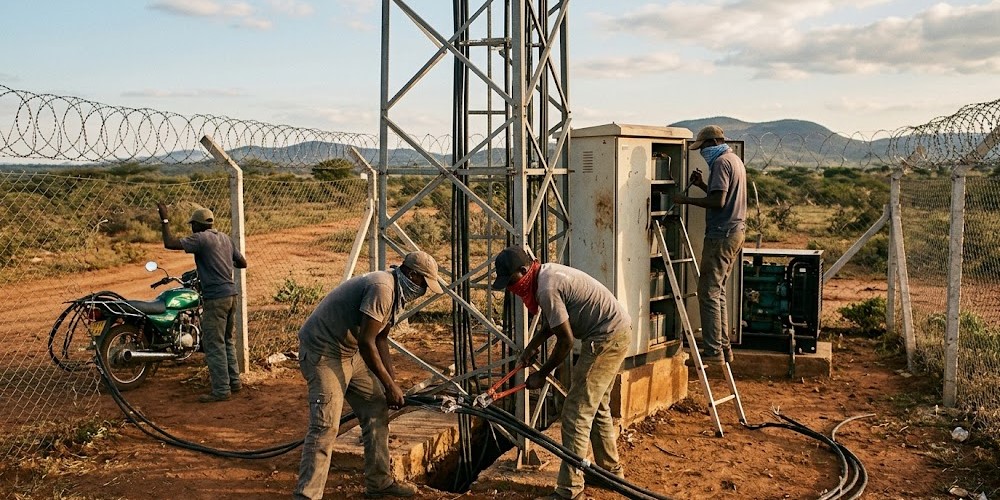
Latest industry data has revealed that Rivers, Imo, and Abia states top the list of states most affected by telecoms equipment theft in 2025.
According to the Nigerian Communications Commission’s (NCC) Quality of Experience data, which profiles telecom equipment theft by month, Rivers state recorded the highest number of incidents in 2025, with 556. This includes equipment such as battery/rectifier, cable, diesel, generator, multiple thefts, and other forms.
Imo state recorded 391 incidents, followed by Abia state with 319. Also in the top five are Enugu, 306 and Edo, 291.
The data indicates that the states have become hunting grounds for thieves, where they steal and resell telecom equipment.
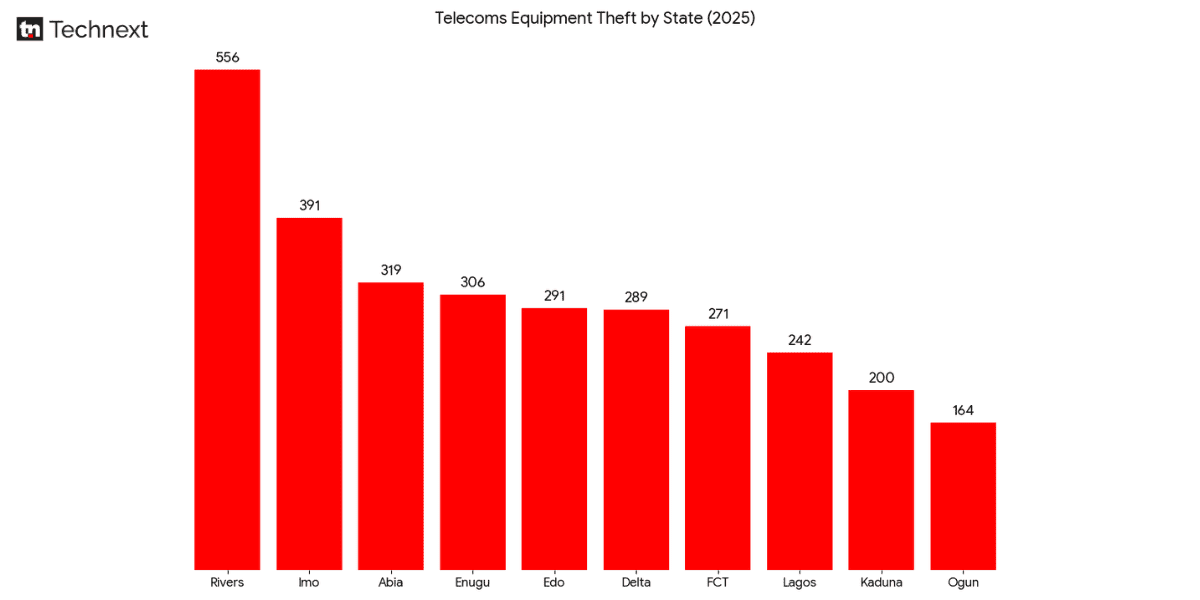
Completing the top ten list are Delta (289), FCT Abuja (271), Lagos (242), Kaduna (200), and Ogun (164). At the other end of the table, Borno saw the least theft in 2025 with 11 incidents, followed by Jigawa with 16, and Zamfara with 17.
The highest hit month was September, with 572 recorded incidents, followed by August with 460. January recorded the least with 303 incidents.
A pattern exists
For the targeted states in 2025, there’s a clear pattern in the concentration of incidents.
Rivers, Imo, Abia, Enugu, and Edo are major commercial hubs in the South-South and South-East region, meaning lots of base stations, fibre routes, generators, and batteries will be concentrated in those areas.
Meanwhile, many rural sites or those situated in areas that link cities to towns mostly lack fencing, adequate guards, or CCTV, making them soft targets for thieves.
Also, vandals and cartels have their base in the Niger-Delta region, specifically across Rivers, Delta, Bayelsa, Abia, Imo, Edo, and Cross River. Vandals/Cartels who engage in pipeline vandalism and organised oil bunkering across these areas are susceptible to acts of telecom theft.
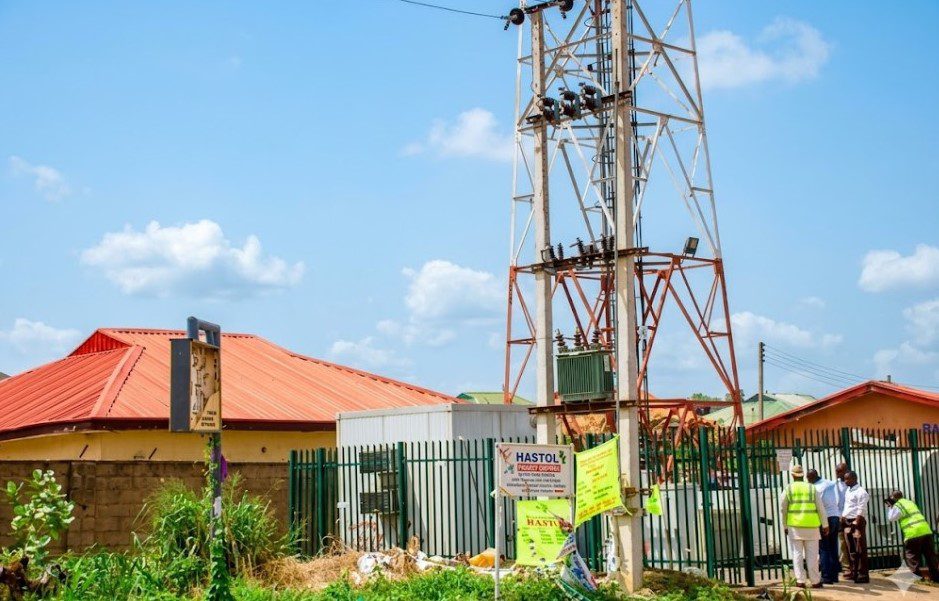
It reflects how Nigeria’s worsening security issues are taking a huge hit on the telecommunications industry, raising alarms over the need for heightened security and strategic monitoring deployment
General overview
Nigerian telecom operators recorded equipment loss as 152 generators and 504 batteries were stolen from mobile sites last year.
More data shows that telcos recorded 1,344 separate incidents of diesel theft during the year. Also, fibre cut incidents were rampant, resulting in an average of 1,100 fibre cut cases every week around the fourth quarter of 2025.
The development continued in 2026, as data shows that in January and February, thieves made away with 64 batteries and 17 generators. Cable theft increased to 160 cases in January, from 74 a year earlier, while February saw 151 cases compared to last year’s 73.
Diesel theft also increased by 222 incidents in the two months.
While telecoms infrastructure has been designated as critical national infrastructure by the federal government, the data reveals that the industry is still in the midst of fibre cuts, thefts and vandalism.
Also Read: Nigerian telcos recorded 577 network outages, 361 fibre cuts in Q1 2026.
A disturbing trend
The latest NCC data brings an organised, yet disturbing trend of how Nigerian telcos are battling to keep up with the quality of service amid threats posed by thieves and vandals.
Recent history tells of that struggle.
According to the NCC Executive Vice-Chairman, Dr Aminu Maida, telcos recorded 19,384 fibre cuts from January to August 2025. MTN Nigeria alone reported 5,478 cuts in the first seven months of that year, with June seeing the highest at 1,016 incidents. MTN later reported a total of 9,218 fibre cuts for the entire year.

Latest data from the NCC uptime portal shows that telcos suffered 577 network outages in the first three months of 2026, further signalling persistent disruptions in the quality of voice and internet experience for Nigerian subscribers.
Breakdown shows 238 outages in January, 189 in February and 150 in March. Fibre cuts and power outages were the leading causes with 361 and 144 incidents, respectively.
Telcos face increased operational costs and network failures
Every single network outage reflects a drop in voice and internet quality, and how Nigerians struggle to make do with primary smartphone operations. While subscribers and device penetration continue to increase, users are left to battle with an unreliable network experience.
At the other end of the market impact are telcos.
The theft increases operational costs, causing telcos to redirect part of the capital expenditure (CAPEX) set for new equipment to repairing or purchasing a damaged/stolen infrastructure. Telcos will incur additional costs on backup power equipment, such as batteries and generators.
For players, trying to sustain and increase network quality is not only a concern of funds but is now dependent on external forces that can hardly be controlled.

Telcos such as MTN Nigeria, which spent N1 trillion in 2025 and already set aside N800 billion for 2026, will be diverting part of the funds to repairs and recycling equipment.
The extra costs hindered investment expansion, impacting operators’ earnings and return on investment, making it harder to keep expanding service.
