




The National Bureau of Statistics (NBS), Nigeria’s primary agency for data collection, analysis, and dissemination, has announced that its official website was hacked.
The agency made this disclosure through its verified X account on Wednesday, urging the public to disregard any messages or reports posted on the compromised platform until it is fully restored.
“This is to inform the public that the NBS Website has been hacked, and we are working to recover it. Please disregard any message or report posted until the website is fully restored. Thank you,” the NBS stated in its official announcement.
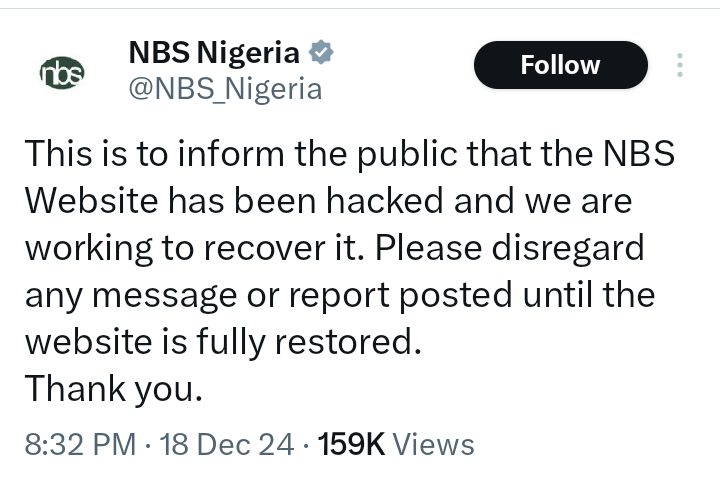
The bureau reassured Nigerians that efforts are underway to recover the site and restore normal operations. The incident has, however, raised concerns about the integrity of one of Nigeria’s most critical repositories of socio-economic data.
Meanwhile, the hacking incident comes on the heels of the NBS publishing several high-profile reports that have been pivotal in shaping public discourse.
For instance, in a Crime Experience and Security Perception Survey (CESPS) report released Tuesday, the NBS revealed that Nigerians paid a staggering ₦2.23 trillion in ransom to kidnappers between May 2023 and April 2024. This alarming figure underscores the growing insecurity in the country.
The report also highlighted that within the same period, households nationwide experienced an estimated 51,887,032 crime incidents.
The North-West region recorded the highest number of crimes, with over 14.4 million incidents, followed by the North-Central region at 8.8 million. In contrast, the South-East recorded the fewest incidences, with 6.18 million cases.
The reports highlights that rural areas were more affected by crime than urban areas, with rural households experiencing a total of 26.53 million crime incidents, compared to 25.36 million in urban settings.
A major highlight of the CESPS was the alarming number of kidnapping incidents – approximately 4.14 million households in Nigeria fell victim to home robbery.
Also, a significant 65% of households affected by kidnapping were forced to pay a ransom to secure the release of their loved ones.
The average ransom paid was ₦2.67 million, contributing to the total sum of ₦2.23 trillion spent by Nigerians on kidnappers’ demands during the 12-month period.
The report also found that only 36.3% of those affected by home robbery reported the incident to the police, while the reporting rate for kidnappings was similarly low.
As stated by the NBS: “Nationally, an estimated 51,887,032 crime incidences were experienced by households. The North-West (14,402,254) reported the highest incidences of crime at household level, followed by North-Central (8,771,400), while South-East (6,176,031) reported the least.
“The result also shows that the crime incidence in the rural area (26,526,069) was higher than that of the urban area (25,360,963).
“In Nigeria, 4,142,174 households experienced home robbery. Less than half (36.3%) of the households who were victims of home robbery reported their experience to the police.
“Among households that experienced kidnapping incidents, 65.0% paid a ransom. The average amount paid as ransom was ₦2,670,693, with an estimated total ransom of ₦2,231,772,563,507 paid within the reference period.”
On an individual level, the report revealed that 21.4% of Nigerians reported being victims of crime. The most common crime was phone theft, which affected 13.8% of Nigerians.
The survey also highlighted the prevalence of sexual offences, with an estimated 1.4 million Nigerians falling victim. A significant portion of these incidents occurred in the homes of others (27.7%) or within the victim’s own home (22.2%). Alarmingly, only 22.7% of sexual offence victims reported the crime to the police.
Its latest report, drawn from X, considering the website isn’t currently functional, The NBS estimated that total internally displaced population (IDPs) stands at 1,134,828, comprising 251,082 displaced households.
Borno State recorded the highest number of displaced households at 206,753.
These reports are not only central to understanding Nigeria’s socio-economic realities but are also key to informing policy decisions, both in the public and private sectors.
Why this hack matters to you
The NBS’s role as the custodian of Nigeria’s statistical data cannot be overstated. Its reports influence critical decisions by governments, businesses, and international organisations. With its website hacked, there are risks of misinformation, data manipulation, and potential erosion of trust in the agency’s output.
The CESPS report on ransom payments and crime incidents has already drawn significant attention. A compromised website could be used to mislead the public or dilute the impact of such vital findings.
The breach also raises broader concerns about cybersecurity in Nigeria.
More public institutions are underway in digitising their operations, and ensuring robust security measures is crucial to protect sensitive information and maintain public confidence.
As the NBS works to resolve the breach, stakeholders and the general public will be closely watching for updates, to understand if the hack affected the recent reports.
