




Nigerians do not joke with their beverages, from alcoholic ones like wines, spirits and beers, to non-alcoholic ones like sodas, malts and tonics. Indeed, Nigeria is the highest beer-consuming nation in Africa with the average Nigerian responsible for at least 8 litres per year.
Unsurprisingly, it is also the largest beer-producing nation in Africa with an annual output of 17.72 million hectoliters (hl).
Nigerian Breweries remains the largest producer of this beverage class, responsible for 51.1 per cent of the production. But around these precious beverages are (mostly) glassy containers, or bottles, that not only preserve their freshness but also give them the packaging such that even without their labels, one could tell what kind of beverage they are.
One company, Beta Glass, is responsible for 70 per cent of these bottles.
Founded 51 years ago, in 1974, Beta Glass has become an undisputed market leader, servicing many beverage and pharmaceutical companies. The company operates two state-of-the-art plants in Agbara, Ogun State and Ughelli in Delta State.
Famous for precision engineering, right-weight solutions and outstanding quality, Beta Glass currently produces more than 2 million glass containers daily and more than 650 million yearly.
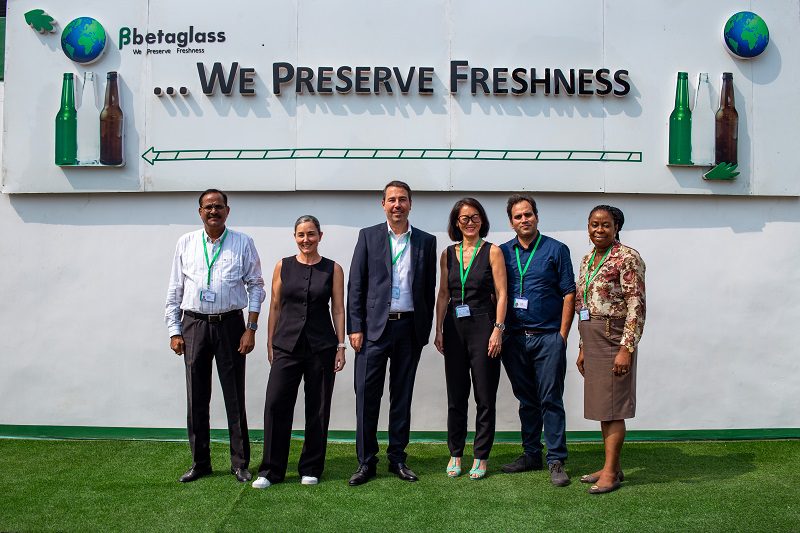
Its Chief Operating Officer, Jagdish Agarwal told Technext that this capacity is driven by an expansion of its Guinea plant in Agbara and an investment of 4 million euros in upgrading its automated processes yearly.
These include a recently upgraded GF1 furnace, which was cold-repaired within a record 32 days and now supports an additional 30 tons of daily production. This upgrade will extend the furnace’s lifecycle by 8 to 10 years, emphasising Beta Glass’ commitment to technological advancement and operational efficiency.
From dust to glass: a journey through Beta’s production process under the power of automation
At the inception of the tour, CEO, Alexander Gendis and his team wished us a memorable experience and that was exactly what we got.
First, there are 9 processes involved in glass manufacturing: materials assembly, batching, melting, feeders, forming, annealing, cold-end spray, inspection and packaging.
Mr Agarwal told me all these processes are fully automated and backed by cutting-edge technology in the industry. This technology, directly linked to systems of the original equipment manufacturers (OEMs) across Europe, has brought about a 90 per cent efficiency rate, increased outputs, and led to about 8 per cent growth in glass exports.
It takes about 38 hours to produce a glass container. The major raw materials required for glass production are silica sand, limestone, soda ash and cullet, which is essentially recycled glass. Indeed, the company said it uses 50 per cent recycled material for its glass. Other raw materials include cobalt, selenium which gives it colour, sodium sulphate and feldspar.
Most of these materials are sourced locally. Sand is sourced from Owode, Ifo and Ilaro in Ogun State. Limestone comes from Ogun, Oyo, Edo and Kogi states. Cullet is sourced from across the country and Cotonou. Feldspar is sourced from Ogun, Ekiti, Kaduna and Born.

Soda ash, however, is imported from China, Romania and Turkey. Sodium sulphate is imported from Germany. Iron chromite is also imported from South Africa.
The mixing of raw materials begins at the furnace section where five of the 9 processes occur. They are distributed into four silos from where they are transported into the mixer and onward into a fully automated furnace.
There are specific details that must not be compromised.
For instance, the heat at the furnace level is 1450 degrees. This is the hottest part of the plant where the ingredients are molten into liquid glass. This heat level here is different from the forehearth which is a little lower at 1250 degrees. The forehearth is a conduit through which the molten glass is passed into the forge.
The temperature at the forge begins at 1150 degrees where the forehearth deposits the molten glass and down it to 1000 degrees, where the liquid glass is cast and produced as red-hot bottles. The newly-produced containers would then go through the hot end where a surface treatment awaits. At the hot end, the temperature would have cooled to 600 degrees.
This entire process is controlled from an automated control room equipped with computers and other automation tools.
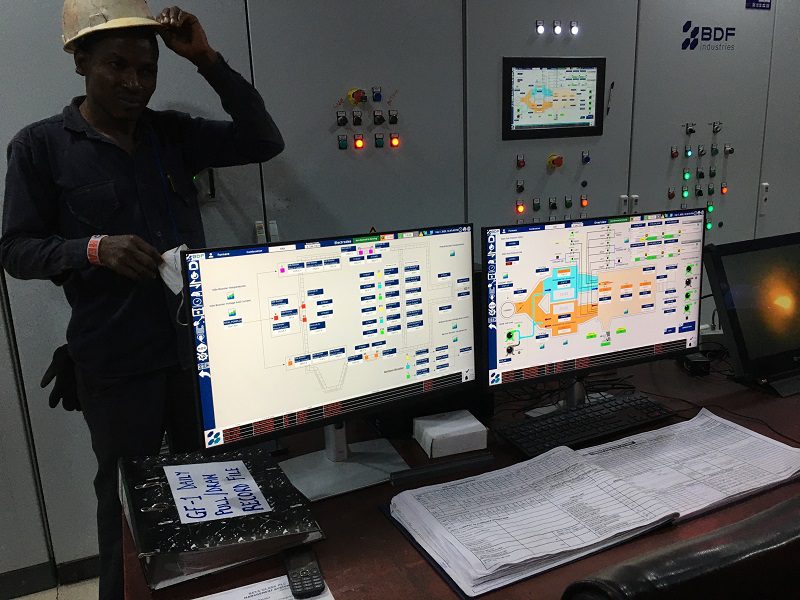
The containers would then go through the annealing lehr, a long box-like structure and emerge at the other end called the cold end at 200 degrees in their true colours.
Then, they will undergo cold-end inspection where defects and contaminations are detected by a fully automated equipment called the online inspection machine. Defects detected include general, neck, shoulder, body and base defects.
From this point, it moves to the fully automated packaging system where they are stacked on pallets and packaged in polythene.
Interestingly, the company said its safety records have greatly improved due to technology and automated processes.
A safety performance board at the plant entrance tells the story of a largely safe environment. Per the information as of February 7, the plant has witnessed 1650 days without any accident. This is nearly 5 accident-free years.
So far in 2025, there have been zero fatalities, first aid cases and lost time incidents.
There has, however, been one near-miss, which is a situation that almost led to an accident. There were 103 unsafe conditions reported and 39 unsafe acts reported. The last date an accident was reported was on the 17th of May 2024.

Asked how the company’s business is navigating the trying time occasioned by the foreign exchange challenges, CEO, Alexander Gendis said more raw materials are being sourced locally. But for those not sourced locally, they try to avoid import duties by seeking companies that import them while Beta Glass pays in the local currency, naira.
He also said the company has adjusted its prices based on the FX realities that are affecting the cost of manufacturing.
Despite these challenges, the CEO says he and his family love it here in Nigeria and it feels like a second home.
“It is vibrant, loud, energetic and it makes life exciting. You can make a difference here. Some amazing people want to learn and develop. You can grow a company to double digits but you can’t do that in other countries and other parts of the world. The amount of knowledge and ability here is amazing,” he told me.
See also: CBN introduces new N100 per N20,000 ATM charges to take effect from March 1
