




The Federal Government of Nigeria is set to invest $2 billion in 90,000 kilometres of submarine cable network across the country. This is to ensure that every Nigerian, irrespective of location, has access to quality connectivity.
Relating the statement during the Submarine Cable Resilience Summit, which begins today in Abuja, the Minister of Communications, Innovation and Digital Economy, Dr. Bosun Tijani noted that as Nigeria continues to push for a stronger digital economy, the government is investing $2 billion in that course to provide millions of connectivity to Nigerians.
Also, in its effort to ensure stronger connections globally, the Nigerian government will lead a global conversation to protect submarine cables and prevent frequent cuts and damage to deep seas.
To this note, 50 countries will be hosted in Nigeria under the International Telecommunication Union (ITU) as it holds its inaugural International Submarine Cable Resilience Summit in Abuja between February 26 and 27.
While reacting to this, Tijani noted that relevant stakeholders must ensure the resilience of cable infrastructure. He described this as “the real backbone for the digital economy.”
“Nigeria is driving our economy towards becoming a $1 trillion economy, which is a commitment that President Bola Tinubu has already made and the entire Cabinet is working towards,” he added.
The Advisory Body is co-chaired by Dr. Bosun Tijani, and Prof. Sandra Maximiano, Chair of the Board of Directors of the National Communications Authority of Portugal (ANACOM). The first virtual meeting of the Body was held in December 2024, ahead of the Submarine Cable Resilience Summit.

The minister explained that the federal government believes that all infrastructures, such as the submarine cable, that strengthen its economic agenda are of great importance. He noted that the Nigerian government is ready to explore ways to accelerate the country’s digital economy, making it a lot more competitive and value-driven.
“There’s no economy that is a stand-alone economy. Every economy in the world today is linked. And because of that, we must also take global leadership, ensuring that we secure a critical part of how we run our economies today,” he said.
About 150 to 200 cable cuts occur globally yearly causing connectivity disruptions across all sectors of the global economy, including banking and telecommunications.
Recall that in January, the United States government awarded Nigeria a $2,095,000 grant to help boost the country’s digital infrastructure. The grant will be invested in deploying 90,000 kilometres of new fibre optic backbone infrastructure across Nigeria.
Read More: US govt awards $2m tech grant to FG for 90,000km new fibre optic backbone across Nigeria.
More on the submarine cable summit
According to the ITU Deputy Secretary-General, Tomas Lamanauskas, he noted over 250 relevant stakeholders will participate in the event to address solutions to global cable disruptions.
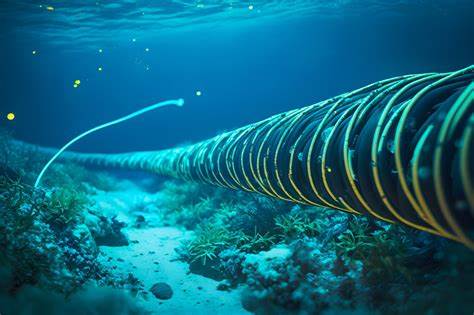
Lamanauskas pointed out that the digital world depends on submarine cables as they carry the bulk of the traffic and ensure that the traffic across the continents is carried around and as well connected digitally.
“Even the traffic that goes up to the satellites goes back to the submarine cables to be fastly carried across the globe because that’s the technology that makes sure that across long distances people can have very fast connections,” he added.
In March 2024, the cuts and undersea disruptions in West Africa affected 13 countries in West Africa and other parts of the world. The cable damage occurred somewhere around Senegal and Ivory Coast, with similar disruptions near Portugal which affected businesses across banks, stock exchanges, and mobile money transactions, among several others.
The Deputy Secretary-General related that the summit was organized as a result of this incident and to prevent future occurrences.
Lamanauskas commended the Nigerian government for showing leadership in this discussion and agreeing to bring the world together to brainstorm on possible solutions to submarine cable infrastructure resilience.
The summit is set to host 50 countries and includes about 250 experts from governments and the private sector, the biggest submarine cable layers, different vendors, academia, and other relevant stakeholders.
Experts and various stakeholders will examine how to respond to disruptions through crisis management, recovery efforts, innovations in technology, and maintenance procedures. ITU will also advise countries not to depend on just one cable so that when disruption happens, they are not fully disconnected from the world.
The International Telecommunication Union (ITU) is the United Nations specialized agency for information and communication technologies (ICTs).
