






Residents of three Nigerian states, Kebbi, Sokoto, and Zamfara, are experiencing network blackouts following simultaneous fibre cuts suffered by MTN and 9mobile. According to a Nairametrics report, the residents have been unable to make voice calls, send SMS, or use mobile internet.
This was indicated by a network status report released by the Nigerian Communications Commission (NCC). It showed that the fibre cuts occurred around 7.09 pm yesterday, Thursday, May 29, 2025, and the impact is still ongoing.
The communities affected include Aliero, Anka, Arewa Dandi, Argungu, Augie, Bagudo, Bakura, Binji, Birnin Kebbi, Bodinga, Dange Shuni, Fakai, and Gada. Others are Goronyo, Gummi, Kebbe, Maiyama, Maru, Rabah, Sakaba, Shagari, Silame, Sokoto North, Sokoto South, Talata-Mafara, Tambuwal, Tangaza, Tureta, Wamako, Wurno, and Yabo.
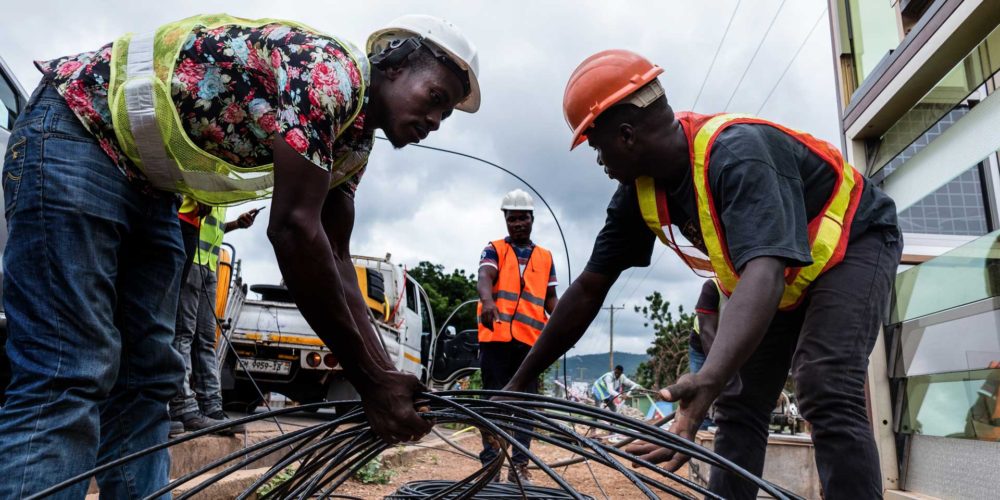
Fibre cuts are perennial causes of poor service quality in the Nigerian telecommunications space. In Nigeria, fibre cuts are largely owing to major construction activities and, in other cases, deliberate acts of vandalism.
Recall that MTN had a similar downtime in February 2024.
The outage made it difficult for subscribers to make calls or access data-enabled services for about six hours. According to a tweet by the company, the prolonged downtime experienced by users on the network was caused by multiple fibre cuts owing to construction, and it promised that its engineers were working assiduously to restore normal services.
A joint committee to solve network fibre cuts in Nigeria
To solve the unending challenge, the Ministry of Works (FMoW) and the Federal Ministry of Communications, Innovation, and Digital Economy (FMoCIDE) have established a Joint Standing Committee on the Protection of Fibre Optic Cables.
The committee will address the persistent issue of cuts and damages caused by road construction and rehabilitation activities, which have significant impacts on telecommunications services across Nigeria.
It is comprised of key staff from the two ministries and the Nigerian Communications Commission (NCC).
The main task of the joint Standing Committee is to establish and maintain clear communication/ coordination channels between the two ministries and the NCC to limit and prevent damage to Telecommunications fibre optic cables during road construction or rehabilitation activities.
At the inauguration of the committee, Permanent Secretary of the FMoW, Engr. Olufunso Adebiyi and his counterpart at the FMoCIDE, Engr Farouk Yusuf, directed the committee to establish modalities to reduce the damage of fibre optic cables from road construction, maintenance activities and vandalism.
Engr. Adebiyi further stated that the committee will work closely with all Federal Controllers of Works (FCW) to give attention to the task of protecting this sensitive infrastructure during the planning and implementation stages of projects across the roads in the country, while aligning with the telecom operators on all ongoing and future projects.
“They are also expected to develop an instant communication mechanism to facilitate prompt communication and dissemination of information amongst all stakeholders,” he said.

Then, the EVC/CEO of NCC, Dr. Aminu Maida, emphasised the significance of the move: “Last year, we experienced over 50,000 fibre cut incidents across the country, of which around 30,000 were attributed to Federal and State Road construction activities. A key contributor to the increasing number of fibre cuts attributed to road construction activities is the lack of an efficient handshake mechanism between road construction companies and operators of the fibre infrastructure.“
“I am optimistic that the work of this Committee will lead to a significant reduction in fibre cuts attributed to road construction, which would then reduce network outages, avoid unnecessary expenditure on repair works and reduce the need to put redundant routes in place”, he concluded.
He assured that going forward, the Ministry will ensure that the placement of fiber cables will be considered in the planning, design and construction of the country’s road networks, and would include providing for ducts during construction.
