


Nigeria’s technology landscape experienced a surge of activity from January 2024 to May 2025. Federal government agencies, driven by a shared vision for national development, launched numerous initiatives.
These efforts aimed to expand digital access, boost local manufacturing, enhance cybersecurity, and cultivate a thriving innovation ecosystem, among others. The collective drive represents a significant push towards a more digitally empowered and economically diversified nation.
On the occasion of the second year of President Bola Tinubu’s tenure, and with a particular focus on the tenure of Ministers Bosun Tijani and Uche Nnaji, we compiled a comprehensive list of initiatives launched by tech-oriented government agencies.
The year in review [January 2024-May 2025]…

USPF: Expanding digital access and modernising services
In May 2025, the Universal Service Provision Fund (USPF) launched the USPF Impact Alliance. This new coalition aims to accelerate the delivery of inclusive communication technologies to underserved communities.
USPF reportedly deployed approximately 1,259 kilometres of optical fibre Cables. It also deployed 682 Base Transceiver Stations and connected 3,785 institutions with bandwidth aggregation.
The agency provided rural broadband connectivity across 72 communities.
In February 2025, USPF handed over a new Emerging Technologies Centre (ETC) to the Ogun State Institute of Technology (OGITECH). The centre was equipped with 100 desktop computers, emerging technology applications, and connectivity tools.
Nigerian Postal Service (NIPOST)’s full transition to a cashless system
From July 1, 2025, all NIPOST counters will no longer accept cash payments. NIPOST also reported a 275% increase in revenue in 2024. It achieved this by plugging revenue leakages and deploying Point of Sale (PoS) terminals.
NIPOST also promised to start licensing logistics companies from Q2 2025. It also reportedly renewed its International Money Transfer Operator (IMTO) licence and Super Agent authorisation with the CBN.

The postal agency began signing bilateral agreements with countries such as Benin and Togo for cross-border payments.
The agency also partnered with KLM Royal Dutch Airlines in May 2025 to improve international mail delivery. It also sought collaboration with the Lagos State Government in January 2025. This aimed to boost e-commerce and last-mile delivery.
NIMC’s advanced digital identity and cybersecurity
The National Identity Management Commission (NIMC), on May 6, 2025, launched NINAuth. The services suite provides secure and seamless identity authentication and verification across all government services.
The agency also proposed a new National Identity Card that citizens can use for payments, financial services, and government services.
Similarly, it incorporates ICAO standards for e-passport information. Applicants will request the card with their NIN through online portals, physical offices or banks. It will be issued through their respective banks.
In January, NIMC expanded its database capacity to host 250 million identities. It distributed more enrollment systems to all states and reported a 40% reduction in extortion and corruption related to NIN registration.
The agency also collaborated with the Federal Ministry of Agriculture and Food Security (FMAFS). This was for a NIN-Enabled Farmer Registry.
In April, it also sought stronger collaboration with the Universal Basic Education Commission (UBEC) to integrate national identity management within the education sector.
CPN and NDPC
Recall that in 2024, the Computer Professionals Registration Council of Nigeria (CPN) set a goal to equip 1.5 million Nigerians with digital skills by 2025. In May, it launched its Digital Skill Trainer Certification Programme. The programme will equip digital skill trainers.
The Nigeria Data Protection Commission (NDPC)? Well, NDPC announced partnerships with the International Organisation for Migration (IOM) for capacity building in Nigeria’s Immigration Data Management.

To advance scientific frontiers: research and development
The National Biotechnology Development Agency (NABDA), which became the National Biotechnology Research and Development Agency (NBRDA) on March 6, 2024, continued active commercialisation efforts for TELA Maize, released in January 2024.
NBRDA has at least five other biotech crops in developmental stages. These include rice, cassava, sorghum, and potato.
In March 2024, NABDA unveiled indigenous technology for producing hospital gadgets. This includes a test kit. It reportedly actively collaborates with universities to foster innovation and commercialisation. The agency issued an invitation to tender for its 2025 capital projects.
The Sheda Science and Technology Complex (SHESTCO)‘s Artificial Intelligence Enhanced Hemoparasites Detection (AIEHD) Model won a silver award in the AI category.
SHESTCO’s notable project is the construction of an Applied Mathematics and Simulation of Advanced Research Centre and ICT building within the SHESTCO complex. It also includes the construction of a solar car park.
To foster startups and technology transfer
The National Office for Technology Acquisition and Promotion (NOTAP) launched “NOTAP Project NOVA “ to establish Technology and Innovation Hubs across all six geopolitical zones. The project aims to build a talent pool of tech-savvy youth.
NOTAP signed a strategic agreement with Revass Systems Limited in May 2025 to enhance technology acquisition compliance and bolster local capacity development. In September 2024, it also commissioned its 65th IPTTO.
The National Board for Technology Incubation (NBTI) launched its “NextGen Innovation Challenge 2025.” It officially launched in May 2025 to identify and support grassroots innovators across Nigeria’s 774 local government areas. It provides access to funding, markets, mentorship, and technical support.
NBTI is launching a global digital portal and mobile app to host innovators. It also created a framework for patent registration. It established and commissioned an incubation centre in Mabudi, Plateau State, in May 2024.
Building the future: Science and Engineering infrastructure
The National Agency for Science and Engineering Infrastructure (NASENI) launched the Innovate Naija program to take prototypes from indigenous innovators and provide funding for commercialisation.
NASENI actively assembles electric tricycles and motorbikes. It also assembles solar-powered cargo tricycles. Plans are underway for a full green mobility ecosystem. In light of this, NASENI unveiled a hybrid Hilux vehicle.
NASENI reportedly launched Africa’s most advanced Rapid Diagnostic Kit Factory.
NASENI produces Made-in-Nigeria products, including NASENI Laptops, Android Smartphones, Smart TVs, and Lithium Batteries. It operates Foundry Centres and Fabrication Workshops.
NASENI’s Solar Energy Company Ltd (NSEL) upgraded its production capacity to 50 megawatts in 2024. It plans to expand to over 100 megawatts in 2025.

In 2024, NASENI signed an MoU with the Rural Electrification Agency (REA) to deploy off-grid solar systems.
NASENI launched the “Irrigate Nigeria” project around March 2025 in Bauchi State to revolutionise farming with solar irrigation systems. The project will boost food production and enable multiple farming cycles. It will also stabilise commodity prices by pooling repayments into a strategic food reserve.
NASENI launched “Developing Engineering Leaders Through Her (DELT-Her) Phase II” in May 2025 to double the number of female engineers.
The NASCAV Programme trains female drone engineers.
NASENI signed an MoU with NABTEB in May 2025 to digitise examination processes. This should prevent issues as experienced with UTME 2025 and WASSCE 2025.
The National Centre for Technology Management (NACETEM) conducted numerous training and empowerment programs.
Though vague and typical of projects National Assembly members usually pen down to undertake, these included training youths and women in welding and fabrication. It also trained youth and women on basic ICT knowledge. It provided training for teachers in digital transformation.
NACETEM conducted research on technological capability and innovation in the leather industry. This research, presented at its Research Output Conference 2024, highlighted the industry’s potential.
NACETEM launched a key project: the development of NACETEM Remote Electronic Data Acquisition and Data Centre for National STI Statistics. It also focused on digitalisation and networking of Modibbo Adamawa University Teaching Hospital Phase 1.
NACETEM signed an MoU with the Nigerian Institute of Transport Technology (NITT) in June 2024 to operationalise collaboration on technological innovations in transportation.
Nigeria’s research and space adventures
The National Space Research and Development Agency (NASRDA) is preparing to launch at least two of four new satellites within the next six months to one year from May 2025. These replace ageing satellites.
In August 2024, NASRDA partnered with Proforce to develop NigeriaSAT 3, 4, 5, and a Synthetic Aperture Radar (SAR) satellite.
In April 2025, NASRDA announced it would commence its space regulation and licensing mandate. President Bola Tinubu approved a NGN20 billion take-off fund for this. This framework will oversee satellite image providers, GIS operators, and satellite-based telecommunications.
In May 2025, NASRDA’s Director General unveiled plans to train 200,000 Nigerian youths annually. Subsequently, it secured a seat with Blue Origin for the first Nigerian to go into space. This program expects reality within the next six months to one year from May 2025.

NASRDA signed an MoU with UNICCON Group of Companies in May 2025 to advance space technology and innovation.
On its part, Nigerian Communications Satellite (NIGCOMSAT) tried to reshape broadcasting. The DSO “Big Picture” initiative, launched May 30, 2025, delivered satellite-first TV to 5 million homes.
N2a and N2b satellite projects began in October 2024, with NigComSat-1R replacement planned.
NIGCOMSAT supported Project 774 LG Connectivity in 2024. Partnerships with Eutelsat in January 2025 and Hotspot Network in July 2024 expanded broadband.
Continuing, the National Information Technology Development Agency (NITDA) championed digital literacy. DL4ALL, rolled out in May 2025, targeted 70% literacy by 2027.
The 3MTT program trained 270,000 in 2024.
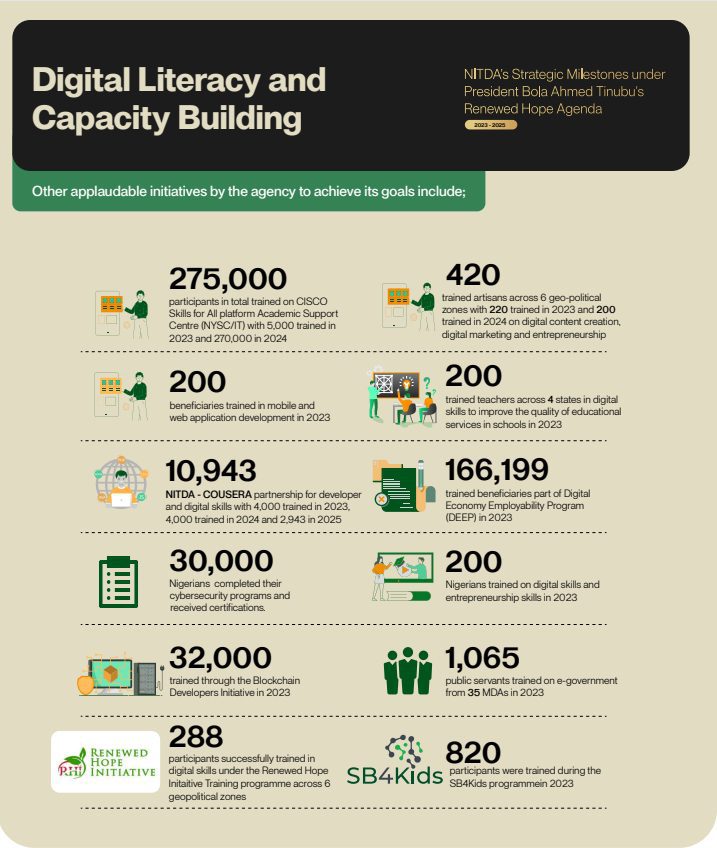
NITDA reportedly built 222 ICT centres and planned 1,600 more. It’s AI roadmap, automated operations, while a blockchain policy, NPKI, E-Trust, and data exchange frameworks are advanced in 2024.
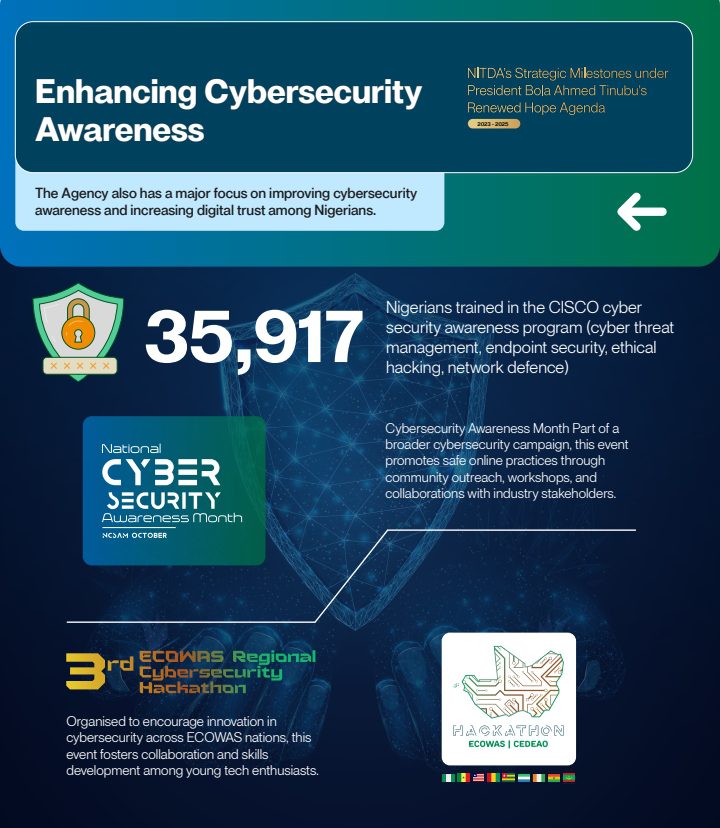
A cybersecurity centre, OAU IT hub, and digital learning centres were commissioned.
NITDA launched a NGN11 million Digital Innovation Competition in September 2024, offered startup incentives, and aimed for 50% cross-border trade growth by 2025.
Nigerian Communications Commission (NCC) collaborated with IXPN and formed a committee to protect fibre cables in 2024, which should end or reduce incidents of fibre cuts across the country, which affect connectivity.
NCC simplified tariffs, audited data depletion, mandated outage notifications, and linked 153 million SIMs to NINs by May 2025.

An e-Health project in Akure, a Digital Village with Globacom, and 4G/5G training with Nokia, was launched in 2024.
The SVP 2023–2025, QoS regulations, and a data protection group with NDPC advanced. Public inquiries on regulatory instruments occurred in May 2025, and telecom research grants were offered (Research Grants). The DBI provided training.
