




Starlink has officially launched its services in the Democratic Republic of Congo (DRC). This marks a significant step toward closing the country’s substantial connectivity gap. The announcement follows the Congolese Postal and Telecommunications Regulatory Authority (ARPTC) granting a telecommunications licence to Starlink DRC S.A., a locally registered subsidiary, on May 2, 2025.
The DRC, with a population of over 111 million, has long grappled with limited internet access, with only 30.6% of its population online as of January 2025, according to DataReportal
The country’s vast geography, coupled with inadequate terrestrial infrastructure and ongoing conflict in eastern regions, has made expanding connectivity a persistent challenge. Starlink’s low Earth orbit (LEO) satellite technology bypasses these barriers by beaming high-speed broadband directly from space, offering a transformative solution for rural and isolated areas.
The ARPTC highlighted that Starlink’s entry aligns with the DRC’s push to improve digital access and infrastructure, with services expected to enhance sectors like education, healthcare, and e-commerce.
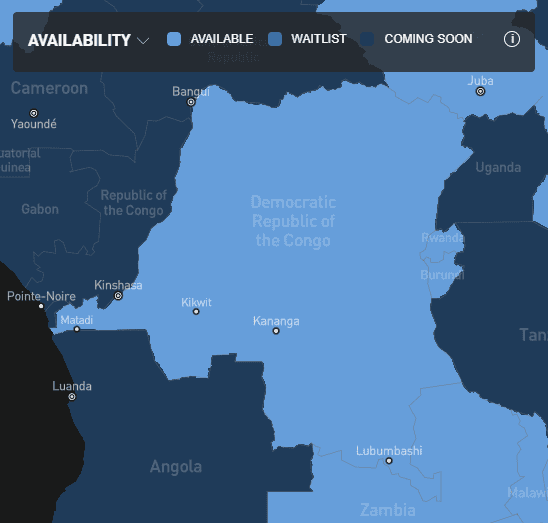
Its launch in the DRC marks its 22nd market in Africa, following recent expansions in Somalia, Lesotho, and Guinea-Bissau in April 2025. The service, which leverages over 7,000 LEO satellites, provides download speeds of 5-50 Mbps and upload speeds of 2-10 Mbps, with unlimited data for its Roam plans.
While the standard hardware kit costs $400 and monthly subscriptions start at $43, affordability remains a concern for widespread adoption in a country where economic challenges are prevalent.
Starlink’s triumph over regulatory hurdles
Starlink’s entry into the DRC follows a significant policy reversal. In March 2024, the ARPTC banned the service, citing national security concerns.
Military officials feared that Starlink’s technology could be exploited by rebel groups, such as the Rwandan-backed M23, which has intensified conflicts in eastern DRC.
The ban included warnings of sanctions for unauthorised use, and attempts to bypass restrictions through re-registering terminals in other countries were thwarted by Starlink’s GPS-enabled dishes and satellite triangulation.
By May 2025, however, the ARPTC reversed its stance, granting Starlink DRC S.A. a licence after the company met regulatory and administrative requirements. While the specifics of these compliance measures remain undisclosed, the shift suggests diplomatic and regulatory negotiations, possibly tied to broader U.S.-DRC talks on a minerals-for-security partnership.

The approval reflects growing recognition of the network’s potential to address the DRC’s connectivity challenges. Christian Katende, ARPTC president, stated that Starlink “will proceed with the launch of its services in the coming days,” emphasising procedural compliance.
Some analysts believe that the move will bolster competition in the country’s telecommunications sector, potentially lowering costs and improving service quality for consumers.
Local operators, however, are wary of Starlink’s extensive coverage and higher speeds, which threaten their terrestrial networks. Some are responding by focusing on value-added services like e-health and supply chain management to remain competitive.
Starlink’s expansion in the DRC is part of its aggressive push across Africa, where it now operates in 22 countries, including Nigeria, Rwanda, Kenya, and Ghana. The satellite company’s ability to deliver broadband in areas with limited infrastructure has sparked optimism about its potential to transform education and economic opportunities.

The DRC’s decision comes amid a competitive satellite internet market, with Amazon’s Project Kuiper set to deploy over 1,600 satellites by mid-2026 and Eutelsat’s OneWeb expanding partnerships in Africa.
Starlink’s first-mover advantage, however, positions it as a leader in the region. Its recent talks with Uganda, where President Yoweri Museveni expressed support for its low-cost internet solutions, signal further growth potential.
Meanwhile, regulatory hurdles persist in markets like South Africa, where local ownership rules and the Independent Communications Authority of South Africa (ICASA) have blocked Starlink’s operations, despite ongoing policy discussions.
