




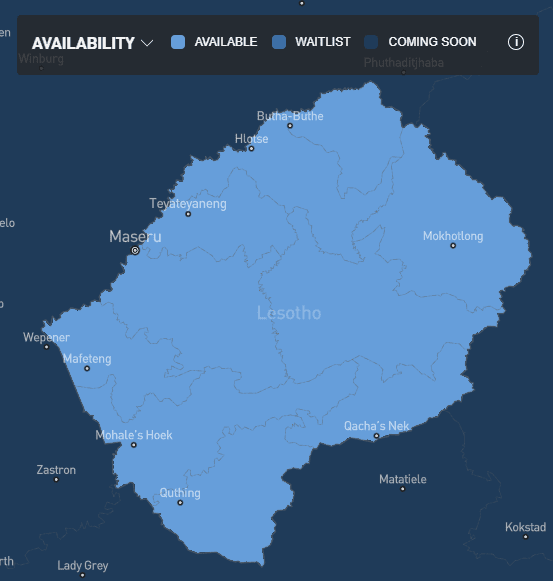
Starlink, the satellite internet service operated by Elon Musk’s SpaceX, has officially launched in Lesotho. The rollout follows the granting of a 10-year operating licence on April 14, 2025, by Lesotho’s communications regulator, enabling high-speed, low-latency internet access across the mountainous southern African nation.
Lesotho’s adoption of Starlink comes barely two months after regulatory approval, reflecting the country’s urgency to enhance connectivity.
With internet penetration at just 47%, the country’s rugged terrain has long posed challenges for traditional terrestrial infrastructure.
Starlink’s constellation of over 7,600 low Earth orbit (LEO) satellites offers a solution, delivering median download speeds of 70–100 Mbps in African markets, far outpacing local ISPs in many cases. T-Connect Lesotho, an authorised Starlink reseller, will officially kick off service offerings today at 16:00 in Maseru, targeting both urban and remote areas.

Starlink live in 24 African countries
The network’s African expansion began in Nigeria in January 2023 and has since reached 23 countries, including major economies and underserved regions.
The service is now live in Nigeria, Kenya, Rwanda, Zambia, Uganda, Mozambique, Malawi, Ghana, Angola, Algeria, Tunisia, Morocco, Egypt, Guinea-Bissau, Benin, Eswatini, South Sudan, Burundi, Sierra Leone, Madagascar, Cape Verde, Niger, Liberia, and Lesotho.
Recent launches in Guinea-Bissau and the Democratic Republic of the Congo highlight Starlink’s focus on West and Central Africa, where internet access remains limited.
Local operators in Lesotho, such as Vodacom Lesotho and Econet Telecom, face new competition. While neither has issued a public statement or comments on Starlink’s launch, regional trends suggest unease among traditional ISPs.
In Kenya, Safaricom, the largest mobile operator, urged regulators in 2024 to impose stricter licencing on satellite providers, citing threats to mobile network quality and national security.
Safaricom’s market share remains dominant at 36.4%, but Starlink’s 8,324 subscriptions by June 2024 reflect rapid adoption.
Similarly, in Nigeria, the Association of Licensed Telecoms Operators (ALTON) has acknowledged Starlink’s role in expanding options but emphasised the need for fair competition.
In Lesotho, where 4G coverage is limited outside urban centres, operators may respond by lowering prices or partnering with satellite providers, as seen with Vodacom’s collaboration with AST SpaceMobile in other markets.
Starlink’s pricing in Lesotho remains unconfirmed but is expected to align with African averages: $28–$50 monthly, with hardware costs of $178–$381. While cheaper than local ISPs in markets like Ghana and Kenya, affordability remains a concern for rural users.
In Guinea-Bissau, where 67.5% of the population is offline, Starlink’s high costs limit its reach among low-income groups, a challenge Lesotho may face given its 27% poverty rate.
A potential impact of Starlink service on Lesotho’s economy
The impact of Starlink in a neighbouring country like Eswatini offers a suggestive projection for Lesotho.
Since launching in 2023, Starlink has delivered median download speeds of 86.18 Mbps in Eswatini, compared to 13.6 Mbps for other ISPs. This has boosted e-commerce, remote education, and telemedicine in rural areas, where 59% of the population lives.
A 2023 World Bank study estimates that a 10% increase in internet access can raise GDP growth by 1.4% annually in sub-Saharan Africa.
In Eswatini, small businesses have leveraged Starlink to access global markets, while schools have integrated online learning.
Lesotho, with its similar rural demographic and reliance on remittances, could see comparable gains. Enhanced connectivity may support its textile industry and tourism sector while enabling digital financial services for unbanked communities. However, regulatory clarity and local partnerships will be critical to maximise impact.

Despite its progress, Starlink faces hurdles in Africa.
Regulatory delays persist in South Africa, where ownership laws requiring 30% historically disadvantaged group equity have stalled rollout. Angola and Mauritius also remain unlicenced in southern Africa.
Capacity issues in urban centres like Lagos and Nairobi have slowed new subscriptions, with speeds dropping to 40–50 Mbps in high-demand areas. Critics, including Nigeria’s Paradigm Initiative, argue that satellite solutions divert focus from terrestrial fibre, which offers long-term scalability.
