




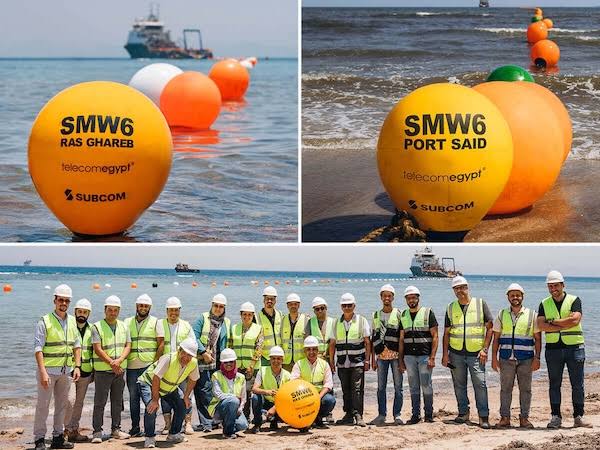
Telecom Egypt, in partnership with SubCom, has completed two landings of the Southeast Asia-Middle East-Western Europe 6 (SEA-ME-WE-6) subsea cable system in Egypt. The landings, announced on July 2, 2025, took place in Port Said on the Mediterranean coast and Ras Ghareb on the Red Sea, marking a pivotal milestone in the project’s development.
This 21,700-kilometre-long cable, connecting 17 landing points across three continents, is poised to revolutionise internet connectivity between Asia, Africa, and Europe, reinforcing Egypt’s role as a critical hub in global telecommunications.
The SEA-ME-WE-6 cable, the sixth iteration of the SEA-ME-WE cable family, stretches from Tuas, Singapore, to Marseille, France, crossing Egypt terrestrially via diverse and resilient routes.
Once operational, expected in the first quarter of 2026, the cable will deliver a design capacity of 126 terabits per second, utilising advanced Space Division Multiplexing (SDM) technology.

This high-capacity system will connect countries including India, Singapore, Malaysia, Indonesia, Thailand, Sri Lanka, Bangladesh, Pakistan, Saudi Arabia, Qatar, Oman, the UAE, Djibouti, Egypt, Turkey, Italy, France, Myanmar, and Yemen, with a consortium of 16 major telecom operators, including Telecom Egypt, Microsoft, Orange, Singtel, and Bharti Airtel.
The project’s completion of landings in Egypt is a critical step, as the country serves as a geographic nexus between the Red Sea and Mediterranean segments.
Telecom Egypt has facilitated this connection by establishing two diversified trans-Egypt terrestrial crossing routes, ensuring resilience against potential disruptions.
Mohamed Nasr, Managing Director and CEO of Telecom Egypt, emphasised the significance of this milestone: “We are thrilled to announce the successful landings of the SEA-ME-WE-6 cable system in Port Said and Ras Ghareb, marking another significant milestone in our journey to expand Telecom Egypt’s global reach and strengthen our subsea infrastructure.”
Why SEA-ME-WE-6 matters
The SEA-ME-WE-6 cable addresses the surging global demand for high-speed, reliable internet connectivity, driven by digital transformation, cloud computing, and data-intensive applications.
The Eurasia route between Southeast Asia and Europe is a vital corridor for global telecommunications, carrying critical traffic for businesses, governments, and consumers.
By adding a new layer of diversity and capacity, SEA-ME-WE-6 enhances the resilience of this route, reducing the risk of outages caused by natural disasters, human activities, or geopolitical tensions, issues that have disrupted undersea cables in the past, such as the 2024 West African outage attributed to seismic activity.
Egypt’s strategic position, with extensive coastlines along the Mediterranean (995 km) and Red Sea (1,941 km), makes it an ideal hub for subsea cable systems.
The country currently hosts 10 cable landing stations, five on each coast, and supports 15 in-service submarine cables, with five more under construction, including SEA-ME-WE-6 and 2Africa.
Telecom Egypt’s WeConnect ecosystem, launched in 2023, further enhances its role by enabling seamless cross-connectivity between these systems, offering service providers flexibility to scale capacity and protect against faults.
Economic and digital implications
The SEA-ME-WE-6 cable is expected to significantly boost Egypt’s digital economy and reinforce its position as a global telecommunications hub. By providing high-capacity, low-latency connectivity, the cable will support the growing needs of enterprises and consumers in Africa, Asia, and Europe.
This aligns with Egypt’s broader strategy to foster digital transformation, as evidenced by its involvement in other major projects like the 2Africa cable, which landed in Port Said and Ras Ghareb in 2023 and aims to connect 33 countries with a capacity of 180 Tbit/s.
For the broader region, SEA-ME-WE-6 will enhance access to digital services, from cloud-based applications to e-commerce and education platforms.
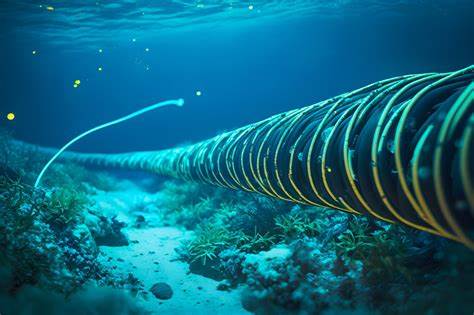
The cable’s consortium, which includes major players like Microsoft and Orange, underscores the collaborative effort to meet rising global bandwidth demands. SubCom, the project’s main contractor, played a vital role in engineering, route design, manufacturing, and installation, ensuring the system’s reliability and scalability.
The successful landings in Egypt mark a critical phase in the SEA-ME-WE-6 project. With landings already completed in France, the Maldives, Sri Lanka, and India as of February 2025. Other landings are expected to be completed before the system becomes operational in Q1 2026.
Once live, the cable will not only enhance global network infrastructure but also support the digital ambitions of countries across three continents. For Egypt, it reinforces its legacy as a telecommunications hub, a role it has played since the deployment of telegraph subsea cables 150 years ago.
As Telecom Egypt’s Mohamed Nasr noted, “These strategic landings underscore our commitment to enabling countries across the region and beyond to realise their digital ambitions by investing in building a robust, resilient, and future-ready network.”
The SEA-ME-WE-6 cable is a testament to the collaborative efforts of global telecom leaders and a cornerstone in the ongoing evolution of the world’s digital infrastructure.
