




The United Arab Emirates (UAE) has officially debunked claims that staking Toncoin, the native cryptocurrency of The Open Network (TON), could serve as a pathway to securing a UAE Golden Visa. The clarification, issued by UAE authorities on July 6, 2025, follows a wave of social media buzz and announcements from TON-related platforms suggesting that a $100,000 staking program could grant investors a 10-year residency visa.
Meanwhile, the news has triggered a 6% dip in Toncoin’s price, highlighting the market’s sensitivity to regulatory clarity in the crypto space.
The controversy began when posts on X and various crypto-focused platforms, including TON’s official website, touted a partnership between TON and UAE officials.
According to these claims, staking $100,000 worth of TON for three years, combined with a $35,000 fee, would unlock a UAE Golden Visa, a 10-year residency permit typically reserved for high-net-worth individuals, property investors, or those contributing significantly to the UAE’s economy. The offer was pitched as a cost-effective alternative to traditional Golden Visa pathways, such as purchasing real estate worth at least $540,000.
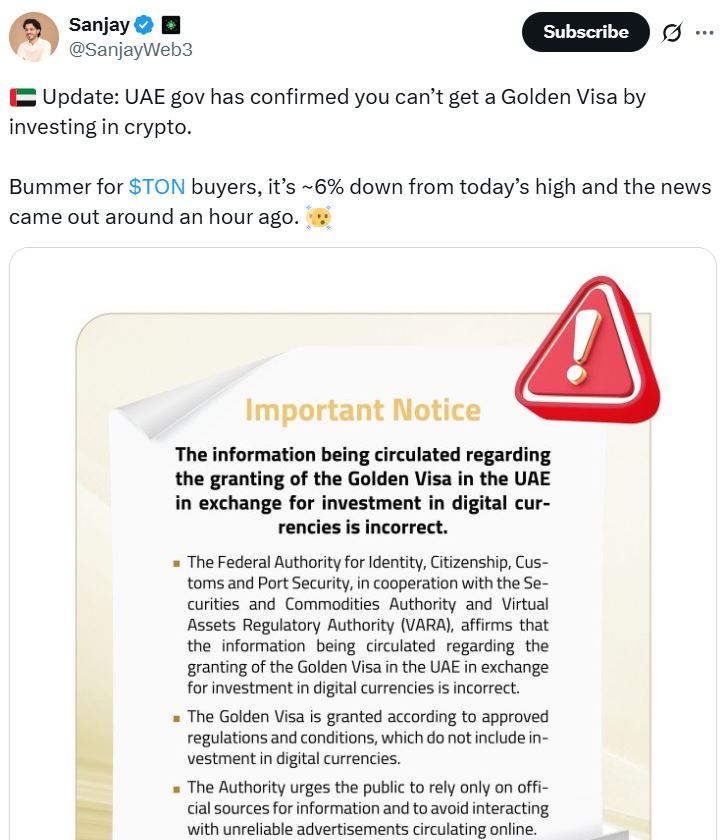
However, the narrative quickly unravelled. On July 6, 2025, the UAE’s Emirates News Agency, alongside regulatory bodies like the Identity, Citizenship, Customs & Port Security (ICP), the Securities and Commodities Authority (SCA), and the Virtual Assets Regulatory Authority (VARA), issued a joint statement denying any such program.
“Claims that the UAE grants golden residency to cryptocurrency investors, circulating on some websites and social media platforms, are false,” the statement read, as reported by Khaleej Times. The authorities clarified that Golden Visas are issued under strict categories, such as real estate investment, business ownership, or exceptional talent, and crypto staking does not qualify.
Market impact and TON’s response
The UAE’s swift rebuttal had an immediate impact on Toncoin’s market performance. Its dropped by 6% within hours of the announcement, reflecting investor uncertainty and the crypto market’s volatility when faced with regulatory pushback. The dip underscores the risks of unverified claims in the crypto space, where hype can drive rapid price movements but also lead to sharp corrections when expectations are unmet.
TON’s official website had initially promoted the Golden Visa staking program, but following the UAE’s statement, the page was removed or updated to reflect the regulatory clarification.
Crypto and residency programs
The TON Golden Visa saga taps into a broader trend of cryptocurrencies seeking real-world utility. The UAE has positioned itself as a global hub for blockchain and crypto innovation, with Dubai’s VARA establishing a robust regulatory framework for virtual assets. However, the country maintains stringent controls over residency and investment programs to ensure economic stability and compliance.
The Golden Visa, introduced in 2019, has attracted global talent and investors by offering long-term residency without the need for a local sponsor. Yet, the program’s eligibility criteria are tightly regulated, and the UAE’s quick response to The Open Network claims signals its commitment to maintaining clarity and authority over such initiatives.

Crypto projects like Toncoin are increasingly exploring ways to bridge digital assets with tangible benefits, such as residency or citizenship programs. For example, other jurisdictions, like Portugal and Malta, have previously explored crypto-friendly investment pathways, though none have directly tied staking to residency.
The Open Network, if legitimate, would have marked a significant milestone in blending Web3 with real-world privileges. However, the UAE’s firm stance suggests that such integrations require rigorous governmental oversight and approval, something the project lacked at the moment.
No official statement from the TON Foundation was available at the time of filing this report, leaving open questions about whether the announcement was a marketing misstep or a deliberate attempt to generate buzz.
Industry experts suggest that crypto projects must navigate regulatory landscapes carefully before making bold claims to avoid reputational damage.
If this will further do more damage to Toncoin’s price is what the crypto community is observing with a keen interest.
