


The latest admission cut-off marks into tertiary institutions released by the Joint Admissions and Matriculation Board (JAMB) on Tuesday have sparked renewed conversations on the quality of the country’s education and how the standard continues to fall under the pressure of keeping students at bay.
In the latest minimum admissible scores for tertiary institutions in Nigeria for the 2025/2026 academic session, stakeholders, comprising heads of tertiary institutions, set benchmarks for university admission at 150, polytechnics and colleges of education at 100, while colleges of nursing sciences have a slightly higher threshold of 140.
While the new score reflects a shift in balancing access to education and its quality, more concerns hinge on the highest minimum threshold – 150 – being below the average JAMB score of 200.

In its reaction, JAMB explained that the decision to keep the minimum score for universities, polytechnics, and colleges of education aims to broaden access to technical and teacher education and address the nation’s demand for skilled professionals in these sectors.
In line with the broader move to accommodate equity, especially catering to access to higher education for underserved communities, JAMB is further extending its commitment to reforming the admission processes for tertiary institutions.
However, critics posit that this could negatively impact Nigeria’s educational strength, most especially in competitive fields.
Jamb cut-off mark YoY shows 2025 isn’t the worst
While the 2025 UTME results have been the best since 2017, according to statistics released by JAMB, issues relating to the poor academic performance of students and the future of education in Nigeria seem to attract a loud ovation due to unforgettable occurrences such as the technical glitch in this year’s results.
However, a quick look at JAMB’s cut-off marks across tertiary institutions since 2013 (when CBT was introduced) revealed that 2025’s benchmark is the highest in 5 years, beating that of 2024, 2023, 2022, 2018, and 2017. In fact, in the last 13 years, 2017 recorded the lowest benchmark of 120 for universities and 100 for polytechnics and colleges of education.
| Comparison of Jamb Cut-off marks since the Inception of CBT in 2013 | |||||||
| 2025 | 2024 | 2023 | 2022 | 2021 | 2020 | 2019 | |
| Universities | 150 | 140 | 140 | 140 | No cut-off mark: Set at the discretion of institutions | 160 | 160 |
| Polytechnics | 100 | 100 | 100 | 100 | 120 | 120 | |
| Colleges of Education | 100 | 100 | 100 | 100 | 100 | 100 | |
| 2018 | 2017 | 2016 | 2015 | 2014 | 2013 | ||
| Universities | 140 | 120 | 180 | 180 | 180 | 180 | |
| Polytechnics | 120 | 100 | 150 | 150 | 150 | 150 | |
| Colleges of Education | 120 | 100 | 150 | 150 | 150 | 150 | |
Although the 2025 benchmark surpassed its last three precedents, the trends since 2013 reveal a disturbing fall in cut-off marks, where minimum admission from 2013 to 2016 for universities was pegged at 180, and polytechnics and colleges of education at 150.
However, the drop in value from 2023 to 2025 birthed various concerns about the falling education standard in Nigeria across various levels, which has been attributed to the rise in social media usage, low education funding, and the shift in financial priorities among teenagers and youths.
An X user said:
“Setting the university cutoff mark at 150 is a glaring sign that the standard of education in Nigeria is crumbling. It’s a wake-up call for a total overhaul. These days, people like *** place more value on social media fame than on formal education because it brings in faster money than what many Master’s degree holders earn. The system is clearly broken.”
Also Read: 2025 UTME: Did over 70% candidates truly fail, or was there a systemic manipulation?
Meanwhile, a breakdown of UTME results since 2013 reveals that 2025 showed a remarkable result.
Out of 1,931,467 total released results, 17,025 candidates (0.88%) scored 300 and above, 117,373 candidates (6.08%) scored 250 and above, and 565,698 candidates (29.3%) scored 200 and above. This performance surpasses all years since 2017, when 19,889 candidates (0.12%) scored 300 and above out of 1,698,577 total results.
The data further reveals that in terms of candidates that scored 250 and above, 2025 is still the best in 13 years. JAMB’s data shows that 117,373, representing 6.08% of the candidates, scored 250 and above this year.
In 2024, only 77,070, representing 4.18% of the candidates, scored within the range of 250 and above, while in 2023, the number was lower at 56,736, which represents 3.73% of the candidates. 2022 recorded 65,336 candidates, representing 3.8%.
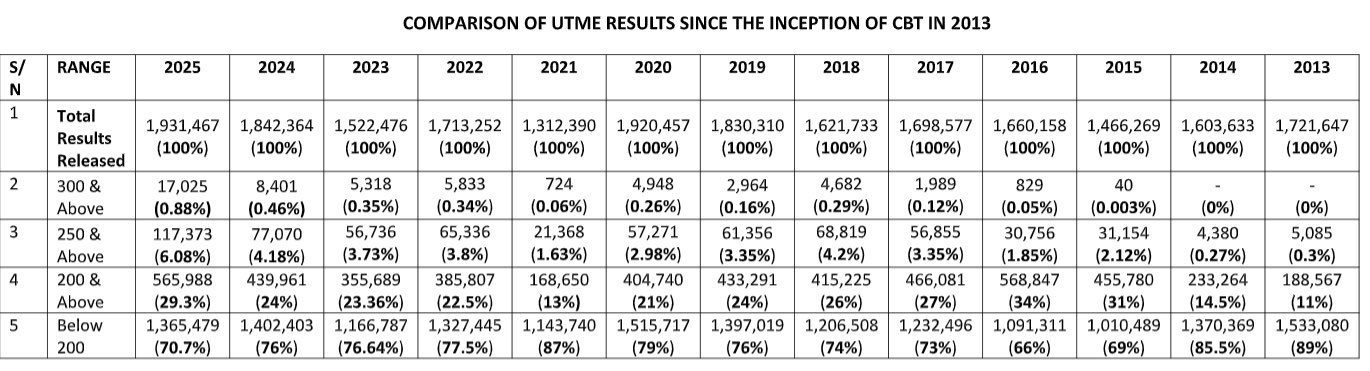
For those that scored 200 and above, 2025 still recorded the highest number as 565,988 (29.3%) scored within the range, while in 2024, only 439,961 (24%) candidates were in that range. In 2023, the performance was poorer as only 355,689, representing 23.36% of the candidates, scored 200 and above. Year 2022 likewise recorded a poor result of 385,807 candidates (22.5%).
Overall, 17,025, representing 0.88% of the candidates that sat for the UTME in 2025, scored 300 and above, the highest percentage since 2013.
Higher education standards
As JAMB’s benchmark represents a minimum threshold, institutions are allowed to set above the mark, but not below. For most federal universities, such as the University of Ibadan (UI), Obafemi Awolowo University (OAU), University of Lagos (UNILAG), the cut-off mark for post-UTME application has always been 200.
These institutions, and others, have always remained committed to maintaining the standards and ensuring that they admit the best of the best.
However, previous trends have shown that there seems to be a direct connection between the UTME performance of candidates, JAMB cut-off marks, and a drop in education standards.
For instance, the admission cut-off mark for UNILAG’s Medicine and Surgery dropped from 86.825 points in 2022/2023 to 84.675 points in 2023/2024 and then 82.125 points in 2024/2025. Also, the Department of Law’s cut-off mark dropped from 80.375 points to 84.675 points and 76.025 points within the periods in review.
For UI, its Medicine and Surgery department cut-off mark increased from 76.25 to 79 points, but decreased to 78.125 points in 2024/2025. The Law department rose from 65.37 to 67.25 points in 2023/2024 but remained unchanged in 2024/2025.

Again, the poor performance extends to the global representation as no Nigerian university made it into the top 1000 in the 2026 universities ranking by the Quacquarelli Symonds (QS) World University. This is happening for the third straight year. Only UI and UNILAG were placed in the 1001–1200 category, while Ahmadu Bello University (ABU) appeared in the 1201–1400 category.
In Sum,
The Nigerian education system is in a dreadful position, with proof of a persistent drop in candidates’ performance YoY.
While JAMB argues that lower cut-off marks provide more access to higher education, particularly for students from disadvantaged backgrounds, experts contend that it compromises the quality of graduates produced, as the debate surrounds whether to prioritise access or academic rigour.
