





Direct remittances to Nigeria totalled N1.95 trillion in 2024. This is according to data extracted from the Central Bank of Nigeria (CBN) and crunched by BudgIT. The significant financial repatriation numbers had a major impact on Nigeria’s international payments in 2024.
The data, covering the period from December 2023 to December 2024, revealed that Nigeria recorded the highest monthly direct remittance payment of N355.4 billion in May 2024, closely followed by N270.5 billion in June and N230.2 billion in September. Meanwhile, December 2023 and February 2024 recorded the lowest with N38.4 billion and N39.1 billion, respectively.
Direct remittances are received by Nigerians via the International Money Transfer Operators (IMTOs), banks, among others. While remittance encompasses a wider range of channels, including those used by individuals for personal transfers and diaspora, direct remittance is a digital payment or electronic payment used by businesses or government agencies.
Furthermore, while Nigerians received N1.95 trillion directly for the period in review, the balance of payments shows a negative trend. For the 2024 International Repayment, the data show that Nigeria paid N5.72 trillion from international repayment, comprising Letters of Credit of N994.21 billion and Debt Service/Payment of N4.72 trillion, which covers interest and principal repayments on external borrowings.
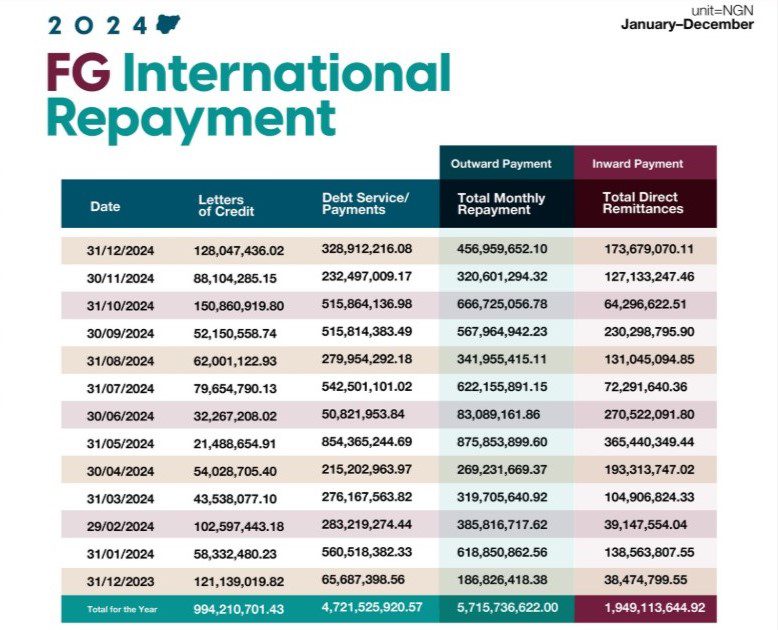
A letter of credit is a financial instrument issued by a Nigerian bank that guarantees a Nigerian’s payment to a seller abroad. It serves as a secure mode of payment in international trade, ensuring that the seller receives payment as long as the outlined terms and conditions are met.
Despite receiving ₦1.95 trillion in direct remittances from Nigerians abroad in 2024, Nigeria’s international financial position is still in need of help. The balance of payment shows a negative trend, attributed to foreign exchange outflows far outweighing the inflows. Most importantly, the imbalance further puts pressure on the naira, which has greatly depreciated against the dollar.
While this also represents a significant economic imbalance, stronger financial forces are needed (than direct remittances) to offset Nigeria’s growing external liabilities.
Also Read: Top 5 remittance apps to send money to Nigeria from US, Canada, UK others in 2025.

Remittance
According to the Central Bank of Nigeria, total remittance inflows rose to $20.93 billion in 2024, reflecting an 8.9% year-on-year increase. It also marked a significant turnaround from deficits of $3.34 billion and $3.32 billion recorded in 2023 and 2022, respectively.
Notably, the 2024 total is the highest in five years, as the last time remittances surpassed this level was in 2019, when it reached $23.80 billion. According to World Bank data, Nigeria’s peak payment inflow over the past decade occurred in 2018 at $24.31 billion, while the lowest was recorded in 2020 at $17.21 billion.
The improvement was attributed to a mix of macroeconomic reforms, stronger trade performance, and renewed investor confidence. The CBN explained that payment inflows remained resilient throughout the year, with inflows through IMTO increasing by 43.5% to $4.73 billion, up from $3.30 billion in the previous year.

On a broader level, Africa received over $95 billion in remittances in 2024, with Nigeria, Egypt, and Morocco leading as top recipients, according to the State of Africa’s Infrastructure Report 2025 by the Africa Finance Corporation (AFC).
This means that Nigeria continued to rank as a key remittance hub, driven by its large and engaged diaspora. The AFC described the surge in remittances as a turning point that offers a more structured and transparent link between African economies and offshore wealth, marking a shift from decades of capital flight.
“In 2024, Africa received over $95 billion in remittances from its global diaspora—an amount roughly equivalent to total FDI inflows to the continent that year. The largest recipients were Egypt, Nigeria, and Morocco, followed by a growing number of mid-sized economies with substantial emigrant populations,” it said.
