


Amidst the prevailing factors of house tenancy and credibility, RentWise aims to build an environment where tenants enjoy transparency and receive the utmost value for their money in the Nigerian rental system.
Imagine finding what you think is your dream apartment in Lagos. The pictures looked great, the agent assured you everything was perfect, and the price seemed fair, at least for Lagos standards.
After you pay and move in, the truth starts to show itself. The ‘modern plumbing’ is a 1970s relic, the water is unhygienic, the soakaway is leaking, and the so-called ‘all-inclusive’ service charges start multiplying like rabbits.
In a matter of months, you realise the house you paid for on paper doesn’t exist in reality.
As a victim of this circumstance, Philips Adepoju believes the Nigerian rental system needs a revival where transparency and reviews are what qualify an apartment as good or bad. Philips recounted how his first rented apartment had a badly sealed sewage system.

In addition, his current apartment was falsely advertised as having a clean water system. In response to his unending complaints, the management increased the rent by 15% and the service charge by 100%, barely 6 months after moving in.
He thinks that it was meant to evict him and get new tenants.
As Nigeria’s first true community-powered rental review platform, Philips believes that RentWise would solve the challenge of transparency in the market and capture a scalable and long-term solution to the problem.
For Philips, building RentWise alone using 1001 brainstorming with ChatGPT and endless code revisions on Cursor wasn’t to undermine the power of collaboration, but the cheapest option, at that time.
“Although it was fun and chaotic building alone, the only reason I built RentWise solo was to experiment with going solo, and secondly, it was the cheapest option considering my earlier belief on whether or not RentWise was economically a business until I was finally able to craft a model and further develop the idea,” he said.
While RentWise is not the first rental listing platform, what sets it apart is the inclusion of reviews of every occupancy of an apartment. The platform is making every house address an archive of past, present and future tenant reviews in a single source.
According to the founder, RentWise seeks to unify a case where “there could be a thousand and one reviews from 1001 individuals for a single property scattered all over.”
As the product is still in its BETA stage, trying to get feedback and user interaction, it’s set for launch by August 18. RentWise is aiming to build a secure system for the Nigerian rental market.
Also Read: The rise of Homely: How a simple idea is transforming short-term rental management in Africa
RentWise mechanisms – How it works
While the platform aims to get honest reviews as possible, the current approach to verifying fake reviews is dependent on manual moderation. Philips explained that with AI incorporation, powered by the RentWise database, to offer a natural and conversational approach to how people find and close a lease, future moderation will see the use of AI in verifications.
To protect tenant identities in terms of reviews, RentWise ensure that the identities are KYC’d and never published or disclosed to landlords or users.
“We require a valid ID and proof of tenancy from each tenant for their reviews to be approved and published. And while we verify authenticity to the best we can, we also continuously emphasise genuine feedback from tenants,” Phillis explained.
In addition, landlords cannot request to remove reviews or manipulate feedback because it’s negative.
They can only respond accordingly, which would be made visible to the public. Such operational process, according to the founder, is a trust factor for tenants, non-dubious landlords and property managers alike.
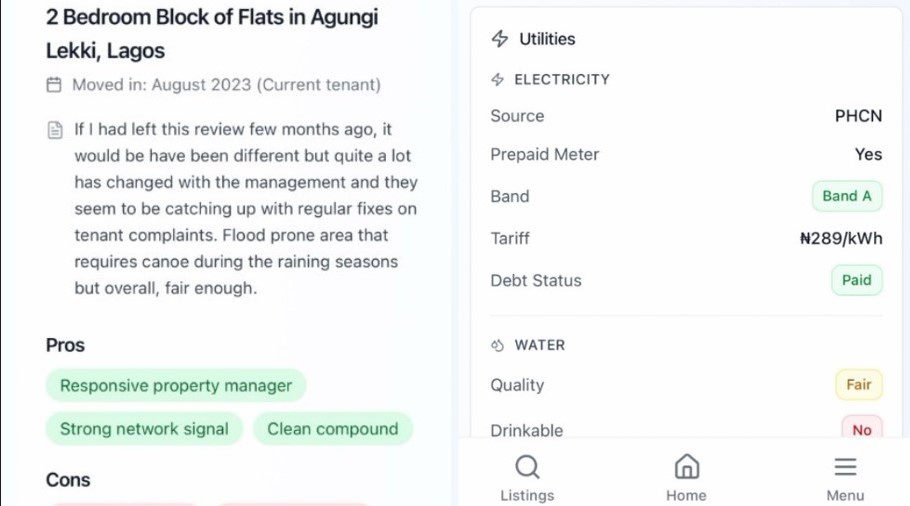
RentWise also promises a fair system where tenants want to know their voices won’t be suppressed because someone paid, and the good landlords want to know that the bad eggs are not able to buy their way out of the current exploitation.
Moreover, stepping into an environment where truth, accountability and transparency can be costly. Philips acknowledged this and explained that there is a legal structure to face backlash and threats from both estate managers and landlords.
“We understand the significance of the war we’re going into, and so our first step, even before going BETA, was to ensure we have proper legal counsel/advice and a legal team to take up such threats. I believe our lawyers are ever ready to take up such cases/threats IF or when they arise,” he added.
Also Read: Like Google Search, Case Radar is using AI to make law accessible to the common man
RentWise and the Nigerian rental system
While the lack of integrity has been a long-standing issue in the industry, transparency is needed to restore confidence and value. With RentWise, Philips believes a secure system will enable landlords, private entities and governments to tackle the problem.
“As a landlord or property manager, you wouldn’t want your property negatively represented on a platform that has secured the trust of the same market/audience you seek, which are the tenants, and that’s our leverage.”
He stressed that Africans underestimate the value of data, and that is one resource RentWise would have to potentially and significantly reshape tenant rights legislation and public housing discourse in Nigeria.
Through this, it aims to become Nigeria’s first structured, data-driven mirror of the rental experience.
By aggregating verified tenant reviews, property condition records, rental pricing history, and landlord behaviour patterns, RentWise builds a layer of public evidence that lawmakers and housing advocates would no longer ignore.
“When hundreds or thousands of reviews point to recurring exploitation from unlivable housing to illegal charges and arbitrary evictions, our data becomes a weapon for reform,” he added.

He emphasised that RentWise isn’t just exposing the flaws, but documenting them at scale, and transforming anecdotal frustrations into actionable public discourse with irrefutable real-time data.
While building solo, Phillips stressed that he didn’t start RentWise to raise venture capital. However, the expansion purpose and the bulk of responsibilities now require strategic investors, but not a priority for now.
“For partnerships, we’re open to working with the good Real estate developers and marketers to better showcase their quality properties to prospective clients who value quality (For a start),” he noted.
When RentWise officially launches on August 18, it intends to create a loud public awareness, as a product is as good as reaching the target audience.
