




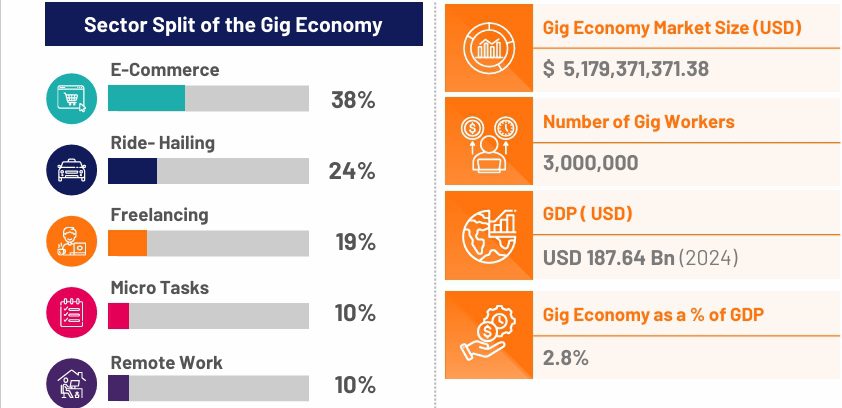
There are currently 3 million Nigerians operating in the country’s gig economy, according to the 2026 Gig Economy Report, launched by the e-hailing company Bolt. The report was carried out in conjunction with the leading research company, Ipsos.
According to the report, the value of Nigeria’s gig economy stood at nearly $5.2 billion as of mid-2025. With the national gross domestic product (GDP) at about $187.6 billion at the time, the contribution of the gig economy to GDP is pegged at 2.8 per cent.
In comparison, Nigeria’s three million operators trump the numbers from Kenya, where 1.55 million gig workers are powering the gig economy to a value of just over $1 billion. It also beats the South African numbers, where 2 million gig workers are driving the economy. It is, however, not clear how much the economy is valued.
According to the report, Nigeria’s economy is experiencing significant growth for several reasons. The first is that it provides accessible income opportunities for youth and underemployed populations. It also absorbs labour displaced from the formal sector amid high unemployment.

Furthermore, the sector acts as a shock absorber during periods of economic volatility and inflation, while also enabling economic participation without rigid entry or registration requirements.
“Nigeria’s gig economy represents a significant and growing source of income, driven by e-commerce and ride-hailing, and shaped by the country’s large informal workforce and digital adoption constraints,” the report noted.
e-Commerce pips ride-hailing as top gig economy contributor
According to the Bolt report, e-commerce emerged as the sector with the most gig workers, making up 38 per cent of the total gig operators in Nigeria. Ride-hailing comes a distant second, with operators in the space making up 24 per cent of the gig work market.
Freelancing is not very far behind, claiming an impressive 19 per cent of the market. Next are micro tasks and remote work, both bringing the rear with 10 per cent market share apiece.
Zeroing in on the ride-hailing sector, the report noted that the sector, led by Bolt, has brought about significant improvements in the standard of living for ride-hailing operators. According to the report, a massive 64 per cent of ride-hailing operators witnessed significant improvements in their standards of living.
While 31 per cent admitted to witnessing some improvement, they are, however, not significant. Three per cent of ride-hailing operators said their standard of living has more or less remained the same since joining the gig economy, while 1 per cent said their standard of living had declined slightly since joining the ride-hailing sector.
“Ride-hailing platforms in Nigeria are increasingly serving as economic lifelines—boosting earnings, enabling flexibility, and generating local economic spillovers in major urban centres,” the report noted.
The drivers pointed to several ways their livelihoods have improved, including earning while learning, location flexibility, easy-to-use platforms that expand access to gigs, and skills that feed career growth.
Others include health coverage, financial access and asset building, flexibility and autonomy, and pride identity.
In conclusion, ride-hailing remains a primary livelihood source for thousands across Kenya, Nigeria, and South Africa. This is particularly so among youth facing limited formal employment options. And while economic volatility and rising operational costs continue to pressure driver earnings, platform innovation (EV adoption, digital payments, flexible hours) offers resilience.

Going forward, e-mobility players are embracing green transportation. There is growing interest in electric motorcycles and vehicles to offset fuel costs. Platforms are also helping to deepen financial Inclusion by exploring micro-lending, savings, and insurance products for drivers.
There is also marked improvement in safety and regulation with increasing collaboration between governments and platforms to formalise driver protection and standardise licensing. Finally, there is major diversification and expansion into parcel delivery, food logistics, and on-demand services, broadening the gig ecosystem.
See also: Bolt introduces discounted health insurance for drivers and their dependents
