


Nigerian startups have a legal problem. Not a shortage of lawyers because Lagos alone has more law firms than most founders will ever need.
The problem is access. Corporate commercial legal support in Nigeria has traditionally been priced for large companies, staffed by lawyers who speak a different language from the founders walking through their doors, and structured in a way that makes getting help feel like a bureaucratic ordeal rather than a business tool.
CrestHall, a Lagos-based law firm, is positioning itself as the firm that fixes this. Its client portal (accessible at client.cresthall.legal) promises a platform where startups can get regulatory compliance support, corporate structuring, and business advisory services at a fraction of what traditional firms charge.
Managing Partner Adebayo Fabamise describes the ambition plainly: everything a growing company needs from a lawyer, packaged and delivered the way Bolt delivers a car.
“Our goal is to provide top-tier corporate commercial legal support at a fractional fee, helping innovators scale through the system as easily as booking a ride,” Fabamise says.

It is a compelling pitch. Whether the platform lives up to it is a harder question to answer and one that matters for the thousands of Nigerian founders who are underserved by the legal market today.
Read also: Nigerian fintechs have a leadership problem and your money shouldn’t pay the price
The problem CrestHall is solving
Most Nigerian startups meet a lawyer for the first time when something goes wrong. A regulatory notice, a co-founder dispute, an investor asking for clean corporate documents during due diligence, and a trademark.
By then, fixing things costs far more than setting them up right from the start would have.
The reasons founders avoid lawyers early are consistent: cost, inaccessibility, and a perception that lawyers are deal-blockers rather than deal-enablers. Fabamise acknowledges this directly.
"We are changing the way people view legal practice, that is, looking at lawyers much more as partners in innovation rather than the clog that prevents it or always comes up with an excuse," he says.
That reframing is significant. With that, CrestHall is selling a different relationship between founders and the legal system. The platform idea follows logically from that. If legal support is a continuous need, like accounting or cloud hosting, then it should be available on a subscription or usage basis, not invoiced per crisis.
What the platform shows
The CrestHall client portal sits behind a paywall, which limits how much of the product experience a prospective user can evaluate before committing.
What is visible upfront signals a structured, professionally designed interface; not a static firm website, but a purpose-built client environment. That alone puts CrestHall ahead of most Nigerian law firms, which still rely on email threads and WhatsApp groups to manage client work.
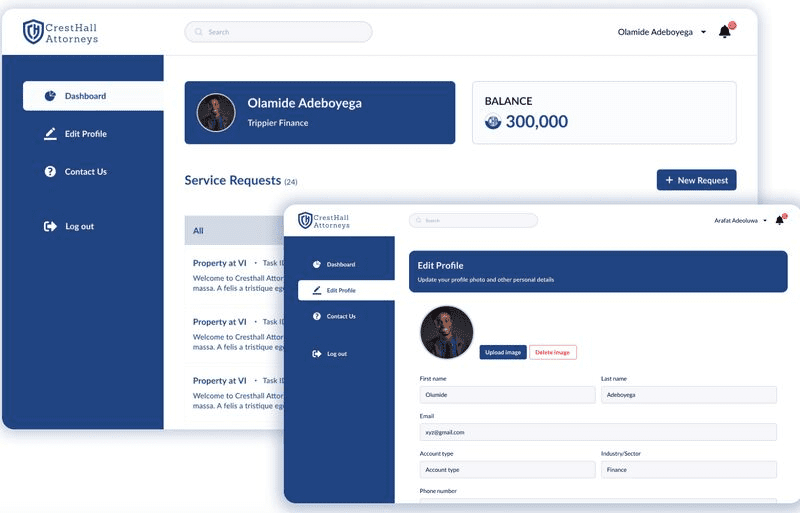
According to Fabamise, the platform covers regulatory compliance, corporate structuring, and business advisory services. That is, the three pillars most relevant to a startup scaling from idea to Series A.
“With the CrestHall app, we provide a holistic 360 support as they scale their businesses,” he says.
The language of “360 support” raises a reasonable question: at what price point, and for which stage of the founder?
A pre-revenue solo operator in Ibadan has different legal needs (and a very different budget) from a Series A fintech in Victoria Island. The platform’s value depends heavily on where it draws that line.
The ride-hailing analogy Fabamise uses is instructive, but it also sets a high bar.
When you book a ride on Bolt, you know the price before you confirm, the time estimate is accurate, and the experience is consistent across trips.
Legal services are harder to commoditise that way. Regulatory compliance work for a fintech looks different from the same work for a healthtech company. Corporate structuring advice depends on funding structure, shareholder dynamics, and the specific investor on the other side of the table.
For CrestHall’s platform promise to hold, it needs to show that it can deliver predictable, consistently priced legal support without sacrificing the quality that sophisticated clients require. That is a product problem as much as a legal one, and it is the kind of problem that takes time, user feedback, and iteration to solve properly.
Fabamise is candid about the origin of the platform.
"How exactly can we then take traditional legal service and bring it into the much more innovative age? That's what prompted us to get an in-house team to start building out solutions — not solutions for everybody, but at least solutions that streamline our practice and make it better."
That honesty matters. This is a firm that built a product to improve its own operations first. Whether it scales into a true self-serve legal platform for the wider startup ecosystem is still an open question.

CrestHall is not alone in this space though.
Modulaw.AI, another Nigerian legaltech company, went fully agentic in 2025, deploying AI systems capable of handling legal research, scheduling, and document drafting.
Globally, Harvey has raised hundreds of millions of dollars to bring AI into law firms. The direction of travel is that legal services are being productised, and firms that do not adapt will lose relevance with the next generation of clients.
What distinguishes CrestHall’s approach is that it is a law firm building a product, rather than a tech company building a legal tool. That comes with credibility. So real lawyers, real liability, real accountability, but also with the structural constraints of a professional services firm trying to move at software speed.
