






For years, the overarching narrative surrounding the African technology sector has been one of unfulfilled, albeit immense, potential. Analysts loved to talk about what could happen. But numbers do not deal in potential; they deal in cold, hard reality. And the reality presented in Hashed Emergent’s second Nigeria Web3 Landscape Report 2025 is stark: Nigeria is no longer just flirting with blockchain technology; it has fully operationalised it.
The country is moving into a more mature, utility-led phase, with stronger funding, deeper usage and a more credible position in Africa’s digital asset economy. The report is built on ecosystem interviews, primary research and platform data, and it positions Nigeria as a key player in global Web3 adoption.
The strongest headline is the rebound in capital. Nigerian Web3 founders raised $43 million in 2025, more than double the $20 million recorded in 2024. That is an important shift, not just because the number is larger, but because the report says the capital became more concentrated in fewer, higher-impact sectors, with early signs of Series A funding returning. In other words, investors were not merely writing more cheques; they were backing businesses with clearer paths to scale.
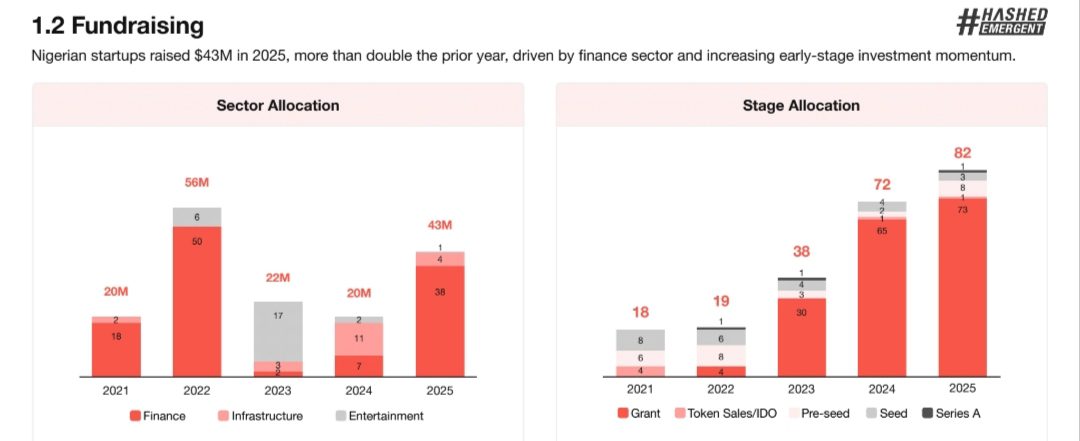
The clearest beneficiary of this capital flow was finance. According to the report, the sector took 89% of total funding, worth $38 million. That matters because it shows where the market believes real demand lives: payments, on- and off-ramps, and B2B cross-border transfers. In Nigeria, crypto is increasingly less about speculation and more about solving practical financial frictions that people and businesses face every day.
Stablecoins leading Nigeria’s quiet financial revolution
The stablecoin numbers are the sharpest proof of that thesis. Hashed Emergent says stablecoin deposits in Nigeria grew by 9,000% between 2018 and 2025, while the country posted the highest 24-hour stablecoin P2P transfer volume on centralised exchanges in 2025, at $48.2 million.
Nigerians are using stablecoins as a functional tool for inflation hedging, remittances, and cross-border settlement, which gives the market a stronger real-world base than many people assume when they hear the word “crypto.”
This reframes Nigeria’s Web3 growth as behavioural and structural, not merely speculative. The country’s on-chain value rose 56% year on year to $92 billion, suggesting that usage is becoming deeper and more persistent.

Tak Lee, CEO and Managing Partner at Hashed Emergent, captures it succinctly: “Nigeria’s momentum in Web3 has evolved beyond early adoption into a mature, utility-driven ecosystem, positioning the country as a key force in shaping both the local and global Web3 economy. With strong fundamentals across talent, stablecoin usage, and real-world applications, Nigeria is not only leading Africa’s Web3 growth but is increasingly defining how the continent participates in the global Web3 economy.”
A surplus of Web3 engineering talent, waiting to plug in
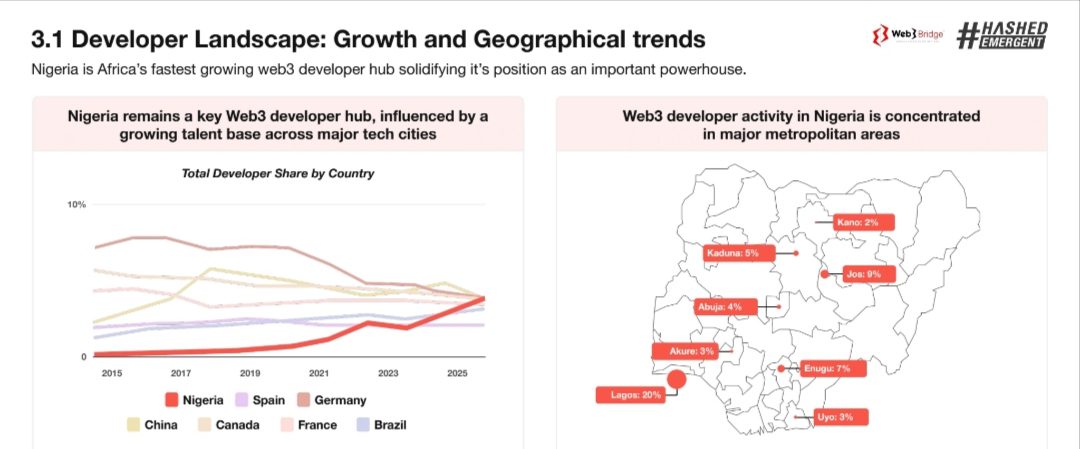
Developer talent remains Nigeria’s most durable competitive edge. The report says the country now accounts for 4% of all global Web3 developers, the highest share in Africa, and that the talent base grew 36% year on year in 2025. That is a strong signal for long-term ecosystem health. Web3 markets are ultimately talent markets, and Nigeria’s developer depth is one reason the country keeps surfacing in global conversations about blockchain adoption.
Still, the report is careful not to romanticise the ecosystem. One of its more useful findings is that 53% of developers have never worked with global teams. That is both a warning and an opportunity. It suggests a pipeline that is growing, but not yet fully plugged into international product standards, global distribution networks, or cross-border incentives. The next phase will focus on retention, integration, and opportunities to build from Nigeria rather than simply train here.
The regulatory outlook is also notable. The report points to the Securities and Exchange Commission Nigeria’s formal recognition of digital assets as securities under the Investment and Securities Act (ISA) 2025, alongside a new tax framework that brings more clarity to digital asset treatment. That is meaningful progress, even if implementation uncertainty and enforcement gaps remain. The report’s tone here is balanced: regulation is no longer the same blunt obstacle it once was, but the market still needs consistency, interpretation and trust-building.
The broader conclusion is that Nigeria’s Web3 story has matured. This is no longer just a story about curiosity, grants or conference noise. It is a market where funding has rebounded, stablecoins are embedded in everyday financial behaviour, developers are multiplying, and policy is slowly catching up.
The report’s strongest value is that it gives the ecosystem texture. It shows both momentum and constraint, which makes it more credible than the usual celebratory market note.
