





To effectively solve Nigeria’s power problems, high-density states like Lagos and Ogun need to be disconnected from the national power grid. This is part of the solutions proposed by a Nigerian tech leader, Mark Essien, in an X post.
This development is coming a day after Nigeria’s power minister, Adebayo Adelabu, resigned his post to vie for the gubernatorial slot of his home state, Oyo. Adelabu’s tenure is widely considered poor, characterised by grid collapses, inadequate supply, and the infamous introduction of Bands, which effectively saw Nigerians paying more for less power supply.
Mark Essien, assuming himself to be the minister, proceeded to outline steps he would take to solve Nigeria’s power problems. For him, the analysis begins with understanding where the population of Nigeria is concentrated.
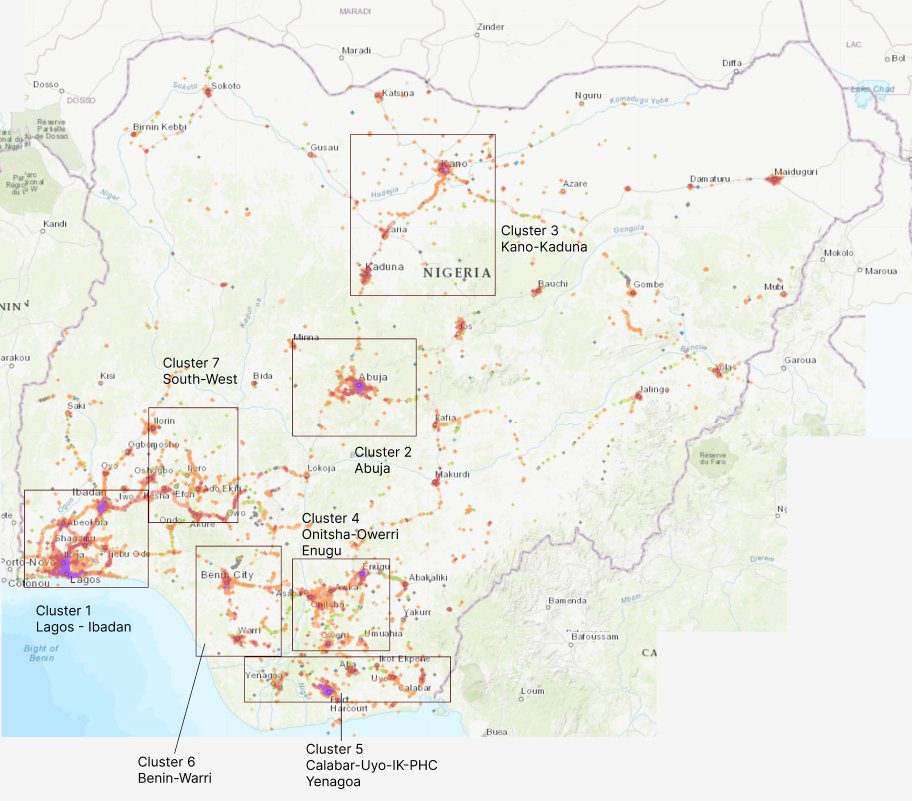
Sharing a map, he pointed out that the population of Nigeria is quite concentrated in particular areas mapped out as clusters. These clusters include the Lagos-Ibadan cluster, the Abuja cluster, the Kano-Kaduna cluster, and the Onitsha-Owerri-Enugu cluster. Others are the Calaba-Uyo-IK-PH-Yenagoa cluster, the Benin-Warri cluster, and the Southwest cluster comprising towns like Ilorin, Akure, Osogbo, Ado-Ekiti, etc.
See also: Nigerians react as national grid celebrates zero power collapse in 3 months
With these clusters in mind, he explained that power must work by priority order, not by “equity”. He also pointed out that existing power plants, mostly gas-powered plants, are mostly clustered in the southern part of the country. Thus, the first step to solving the problem would be ramping up power to Lagos.
“The first step would be to ramp up power to Lagos. Lagos-Ogun would need to disconnect from the national grid and capture all power from Egbin, Olorunsogo, and AES (plants). FG and LASG must immediately invest in 3-5 Gas plants that would power Lagos + South West. Ideally, buy older Russian or Indian Gas plants and fly them in with their full expertise. Set them up in months. No experiments, no long story, just bring in working plants and let them feed the central city of Nigeria,” he proposed.
According to Mr Essien, this step alone will bring steady power to almost 40 per cent of the high-consuming population of Nigeria.

The South-South and South East (Ondo – CRS) would all share one grid, which would be powered by the many regional power plants there. Because the entire area already has gas and pipelines, the only investments will be into building more generating plants, which each state having at least two small ones.
Abuja and the Middle Belt should have their own grid powered by the Geregu Power Company. While there is already a central gas pipeline, Essien recommends the building of at least four more very large power plants that can step in as backup if the northern or South-South-East has any issues.
He also recommends that Abuja and the area around Lake Chad should have massive solar farms that would ensure daytime power at least.
“The main idea would be to achieve quick wins by redirecting power to where the large population is, while rapidly building new plants by using second-hand plants from other countries. No mega projects that take years,” he explained.
For the north, Mr Essien recommends the FG to strike a deal to sell gas to the European Union (EU) on the condition that the EU funds the trans-Saharan gas pipeline. This will lead to rapidly building the gas pipeline going to Katsina with one spur to Maiduguri.
“This work will be done in parallel by at least 6 different construction companies. Complete the Kaduna plant, start a new mega gas plant for Kaduna, and start one for the North East. Have a northern grid from Sokoto to Maiduguri,” he said.
He also recommended that all hydro power be strictly redirected to the northern grid so that power is cheaper there. No more hydro subsidy for the south.
DisCos should be shut down, power should be sold by small companies
On selling and buying power, Mark Essien also recommended that distribution companies (DisCos) be shut down, and power selling should be done by “any small company.”
“Those companies sell meters and collect revenue via dashboards. No meter, no charge. Gencos, transmission and discos would have a digital auction system to pay for power with absolutely no govt intervention or subsidy. You place some MW on the platform, Discos (the new ones) prepay for that power and can tap it off the grid. Price fluctuates based on demand,” he said.
