


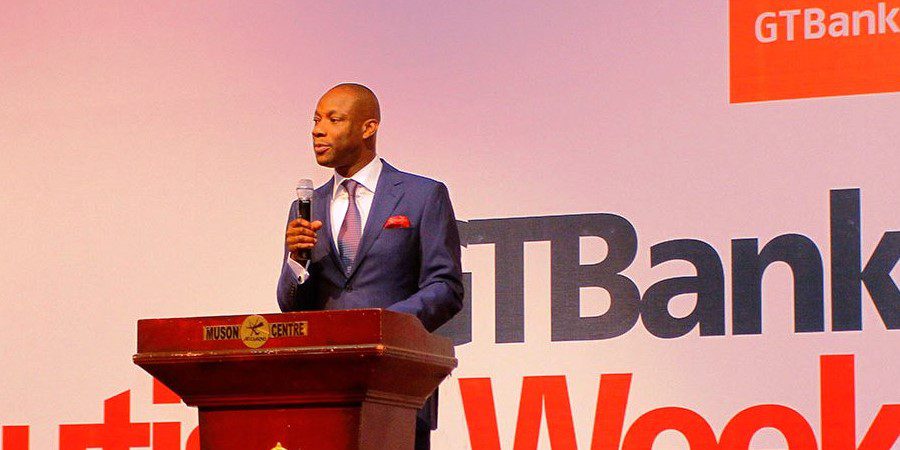
There is something quietly striking about what Guaranty Trust Holding Company (GTCO) did yesterday at its 5th Annual General Meeting. The group paid a record dividend of ₦12.76 per share for the 2025 financial year, the highest dividend declared by any Nigerian bank in history, even as its profits fell.
The bank declared a final dividend of ₦11.76 per share for the financial year ended December 31, 2025, adding to an interim dividend of ₦1.00 per share paid earlier in the year, to bring the full-year total to ₦12.76 per share.
The payment, which landed on April 28, was the same day shareholders gathered in Lagos to ratify the decision and hear from management. By any measure, the room was warm.
At a current yield of nearly 10%, GTCO sits in the top quartile of dividend payers in the Nigerian market, and its payout ratio of around 50% suggests earnings are still comfortably covering dividends. That last point matters because a high dividend funded by borrowing or asset sales is a warning sign.
Bisi Bakare, a prominent shareholder voice and chairman of the Pragmatic Shareholders Association of Nigeria (PSAN), noted that GTCO had made history as the first Nigerian bank to reward investors with that amount and urged the board to sustain that discipline.
The record was not built on a record profit year. That is the tension at the heart of this story.

Read also: GTCO made ₦278.5 billion from transaction fees and commissions in 2025
GTCO recorded a loss in 2025
GTCO reported profit after tax of ₦865.75 billion for 2025, down from ₦1.02 trillion in 2024. The company noted that 2024’s results were partly powered by ₦517.5 billion in fair value gains that did not repeat in 2025.
Beyond that, a higher tax charge of ₦365.33 billion, compared to ₦248.44 billion the previous year, further compressed net profit, and earnings per share fell to ₦25.43 from ₦35.44.
In other words, each share earned less, but each holder was paid more.
The ₦12.76 per share payout represents a 58.9% increase over the ₦8.03 per share paid for the 2024 financial year, which itself was described at the time as a record.
The growth trajectory here is steep. And GTCO is leaning into it. At the AGM, management assured shareholders that dividends would continue to increase in 2026, framing it not as a short-term gesture but as a long-term commitment to balancing capital appreciation with growing returns.
Still, there are reasons to pay attention beyond the celebration.
GTCO earned less in 2025 than it did in 2024, yet it paid shareholders more.
That works for a while, the same way you can spend more than you earn for a few months if your savings account is healthy, but it is not something you can do forever.
At some point, the income has to grow back to match the generosity, and the generosity becomes a problem.
The pressures squeezing GTCO’s profits are not mysterious. The government introduced new taxes on certain investments the bank holds, operating costs went up, and some of the income streams that boosted 2024’s numbers were one-time events that did not repeat. Strip those away and the picture looks leaner.
The good news is that the core business, the everyday lending, the transaction fees, the payments infrastructure, kept growing.
Interest income rose by 23.2% and fee income climbed 25.9%, which means more people borrowed, more transactions were processed, and the group’s non-banking businesses pulled their weight.
Think of it like a market trader whose profit dropped one year because the landlord raised rent and a one-off windfall did not repeat, but whose daily sales volume actually went up. The fundamentals are holding, even if the headline number does not look as clean.
That steady, recurring revenue is what GTCO is banking on to justify the dividend promise it made yesterday, and given the size of its customer base, its payments arm HabariPay, and its asset management and pension businesses, it is not an unreasonable bet to make.
GTCO also became, in 2025, the first financial institution in West Africa to list its ordinary shares on the London Stock Exchange's main market, a milestone that management cited as a structural strengthening of its capital base and shareholder liquidity.
LSE investors receive their dividends in US dollars at the applicable exchange rate, which creates a different conversation altogether for diaspora shareholders and international investors who now have a cleaner route to exposure.

Put all of this in concrete terms
If you own 10,000 GTCO shares, which is not an unusual position for someone who inherited stock, invested steadily through a brokerage account, or held through the GTBank-to-holding-company restructuring, then this year’s dividend just paid you ₦127,600.
Last year, those same 10,000 shares earned you ₦80,300. The year before that, ₦500,000 in shares bought at the right time would have been quietly compounding into a passive income stream that most salary earners cannot replicate.
That is what the ₦12.76 per share means at the street level.
It is not an abstract financial metric. It is school fees. It is a rent contribution. It is the reason a pensioner in Ibadan who handed her stockbroker a cheque in 2015 and mostly forgot about it is better off today than she was twelve months ago, even though the bank technically made less money.
