





Leading telecoms company MTN Nigeria is set to pivot more of its energy mix towards gas, as part of its ambition to reduce dependence on high-cost diesel, its major energy source.
According to the operator’s sustainability report for the year ended 2025, the utilisation of gas-powered Independent Power Producer (IPP) electricity and inverter solutions yielded a joint cost saving of N8.5 billion.
Further breakdown shows that gas energy saved MTN Nigeria about N8.1 billion, while onsite renewables, solar-powered sites, high-efficiency cooling units and the inverter solutions yielded N352.6 million in additional savings.
MTN’s planned shift towards gas and other emerging sources of energy comes amid the increasing cost of diesel, especially at a time when a litre of diesel costs N2,000. For a telecom company serving over 96 million Nigerians with 2,087 base stations, the cost of powering these facilities on diesel is estimated at over N60 billion yearly.

In addition, the progressive shift comes at a time when Nigerian telecoms often face restrictions in access to oil supply owing to industrial strikes and power play. This has resulted in the temporary shutdown of base stations, causing network disruptions to subscribers’ voice and data activities.
Aside from cost, the company is focusing on environmental considerations. In 2025, MTN consumed 1 million gigajoules (down by 0.2% year-on-year) and plans to implement energy efficiency initiatives across key facilities, alongside the deployment of onsite renewables.
To mention, the ambition aims to align with Sustainable Development Goal 13 (Climate Action) by seeking to integrate climate change measures into national policies, strategies and planning. Through what it terms “Project Zero Initiative”, MTN wants to reduce emissions from base stations for environmental sustainability.
“We integrate climate action into our strategy and operations through GHG emissions reduction, resilience initiatives and our biodiversity policy,” it said in the report.
Also Read: MTN Nigeria paid ₦190.9bn in income tax in Q1’26, as data revenue doubled to ₦826bn.
Dependence on diesel
According to the report, 58.11% of MTN Nigeria’s operations were fueled by diesel, highlighting its continued reliance on diesel and the associated cost implications and weight on daily activities.
Gas accounted for 23.63%, followed by electricity (national grid) with 18.04%, then petrol with 0.18% and onsite renewables at 0.05%
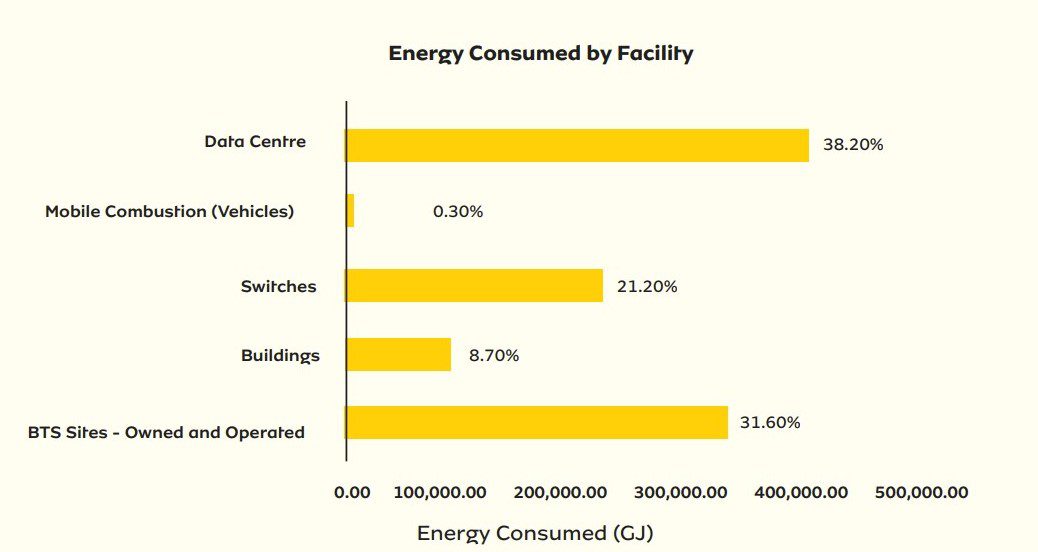
On facility energy consumption, data centres saw the highest with 38.20% and closely followed by base stations with 31.60%. Others are switches (21.20%), buildings (8.70%) and mobile combustion (Vehicles) at 0.30%.
For MTN, reducing emissions and cost are both entangled with its goal of reducing dependence on diesel.
“To support delivery against our emissions reduction trajectory, we will intensify renewable energy deployment, expand the use of gas-powered Independent Power Producer (IPP) electricity, and further reduce diesel dependence across our operations,” MTN said in the report
About 41.4% of MTN Nigeria’s greenhouse gas (GHG) in 2025 was fueled by diesel, followed by gas at 31.19%.
In terms of facilities, data centres saw the highest GHG emissions at 47.61%, followed by base stations at 26.40%. Others are switches (15.02%), buildings (10.80%) and mobile combustion (0.18%).
Project Zero to the rescue
The implementation of the plan is entangled in the company’s Project Zero. In fact, the operator said it spent N10.1 billion, representing 1% of its core capital expenditure, on reducing emissions and dependence on diesel in 2025.
“Our Project Zero is focused on reducing greenhouse gas (GHG) emissions in our operations by enhancing operational efficiencies, reducing energy consumption, and investing in renewable energy sources,” it added.

As part of the project’s impact, MTN said 229 integrated renewable solar-powered rural telephony sites have been installed. It also achieved a CDP rating score of “B-” for climate change, indicating evidence of managing environmental impacts.
