




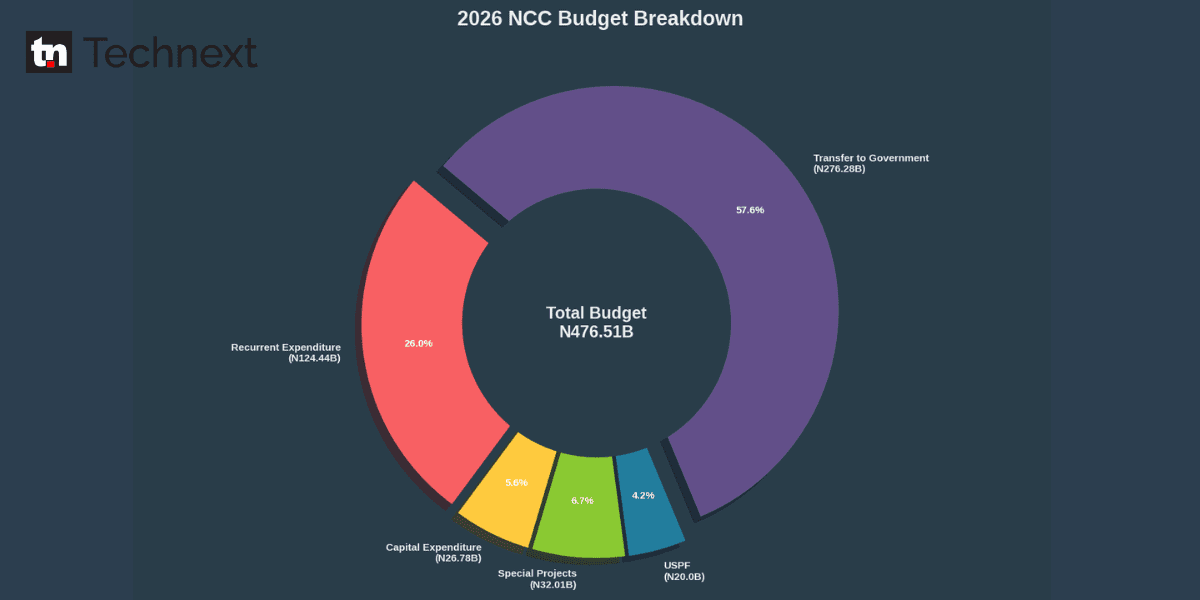
The House of Representatives approved the Nigerian Communications Commission (NCC) budget totalling N476.51 billion for the 2026 fiscal year. But the development raises concerns over NCC’s role beyond a regulator that merely generates revenue for the government.
During Tuesday’s approval of the budget, presented to the House by the Committee on Communications Chairman, Peter Akpatason, it was revealed that the funds will be drawn from the NCC’s internally generated revenue for the year. This shows that the regulator will run a balanced budget where its revenue equals expenditure.
The NCC generates its revenue from licensing fees paid by telecom operators, spectrum fees, annual operating levies (AOL), numbering plan charges and other forms of administrative charges.

However, the bulk of the revenue always comes from its AOL and spectrum fees. For instance, the NCC is expected to record a N250 billion revenue from AOL and N192.89 billion from spectrum fees in 2026, together accounting for 92.4% of its total projected revenue.
In fact, in 2021, the commission surpassed its N36 billion projected revenue from the spectrum license fee after recording over N150 billion from the revenue source. Also in 2024, both sources earned a commission of N195.8, with the buildup generated from licensing radio frequencies to telecom operators for network operations.
Other revenue sources for the 2026 fiscal year include N13.96 billion from type-approval fees, N11.42 billion from numbering plan charges, N8.99 billion from administrative charges, N1.49 billion from licensing fees and sundry Income of N750 million.
The NCC has always been a revenue-generating agency for the Nigerian government, even though it acts as a watchdog on telecom operators.

Commenting in 2025, Yakubu Gontor, NCC’s Director of financial services, noted that the increased slot for 5G network and new technologies like 6G could generate a record of $1 billion in revenue for the commission.
While the NCC continues to be an internally revenue-generating agency, the underlying question remains on what the billions are spent on.
Also Read: NCC’s airtime compensation directive means telcos can no longer play hide and seek – expert.
Where the money goes
During Tuesday’s budget presentation, the Committee on Communications Chairman Peter Akpatason explained that of the total budget for the year, N124.44 billion was slated for recurrent expenditure, which covers personnel and operational costs.
Breakdown of the expenditure includes
- Wages and salaries – N38.53 billion.
- Personnel cost – N29.97 billion.
- Operational cost – N28.45 billion.
- Administrative expenses – N11.53 billion.
- Travel expenses – N7.23 billion.
- Spectrum cost – N6.93 billion.
In terms of key expenditures, Capital expenditure was fixed at N26.78 billion, which includes N23.39 billion for internal projects and N3.39 billion for consultancy services.
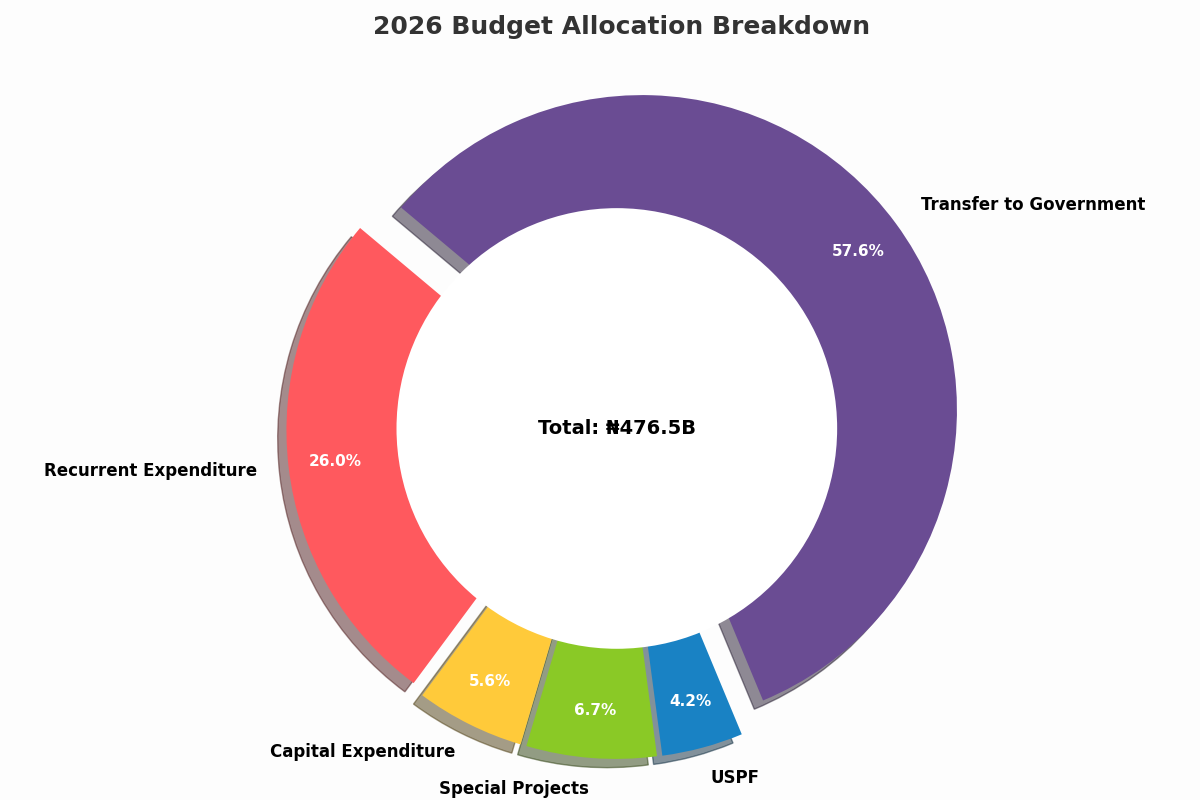
The NCC also has an additional N32.01 billion for special projects such as digital infrastructure and intervention initiatives. Further breakdown includes
- GSM network quality-of-service compliance monitoring – N2.31 billion.
- Emergency communications centre – N6.92 billion.
- Completion of ongoing intervention projects – N7.74 billion.
- Strategic intervention programmes in schools – N10.79 billion.
- Digital skills acquisition – N2.02 billion
- Subscriber database management – N2.23 billion.
Interestingly, the regulator’s spending for the year is less than its projected revenue. This reveals that while it appears as a balanced budget on paper, the real play shows a budget surplus.
To put it in a clearer context, the NCC has a total budget surplus of N296.28 billion, where N20 billion will be transferred to the Universal Service Provision Fund and N276.28 billion for statutory transfer to the federal government.
Not only is the NCC internally generating its own spending, but its total expenditures only account for 38.2% of its total fiscal budget for the year. To the federal government, NCC is the precious child who depends on itself and still gives out from its struggles.
N26b on Capex: Budget well spent?
With 61.8% of the commission budget going outside its jurisdiction, serving as a surplus, one might think the NCC is all-encompassing and has no leaking roof.
Earmarking just 5.5% (N26 billion) of its total budget on capital expenditure reveals a continued pattern of spending less on what really matters. Although there’s an additional N32 billion for special projects, the current issues of the Nigerian connectivity network are more than these funds.
The call comes at a critical time when Nigeria is still lagging in network infrastructure. Recent data by the commission shows that only 3 in every 10 5G-enabled smartphones connect to the 5G network in Nigeria, indicating a range of coverage gaps and a need for more infrastructure.

In the same light, many underserved communities still lack basic 3G/4G network services, which further contributes to the digital divide. For NCC, more funding could be diverted to help operators expand base stations in rural communities and deploy fibre backhaul to reduce congestion.
While the 90,000 km Project Bridge is on course to expand connectivity nationwide, the Nigerian telecoms industry needs coordinated projects from all areas to bring more Nigerians online.
The weight seems heavier on telecom operators, and leaving them to cater for uplifting infrastructure will only leave a percentage of the growing subscriber base outside the coverage gap.
