




Nigerian telecoms operators recorded nearly 500 weekly fibre cuts during the first three months of 2026, a reflection of frequent disruption in voice and internet connections.
Latest industry data by the Nigerian Communications Commission (NCC) revealed that both mobile network operators (MNOs) and internet service providers (ISPs) suffered 5,934 cases of fibre cuts during the first quarter of 2026.
Breakdown for the first 12 weeks of the year shows that in every week, the industry recorded an average of 500 fibre cuts.
For a Nigerian telecom subscriber, every network distribution brings about a significant drop in voice and internet quality, further reflecting the struggle to perform simple activities on their devices.
With a month-on-month increase in both phone users and internet users, subscribers continue to face weekly disruptions that leave many out of the network coverage.
At the other end of the resulting scenario lies the monetary impacts on telcos. This means that a fibre cut case has a financial effect where an operator either incurs more operation cost to repair fibre damage or cuts back its capital expenditure (CAPEX) to purchase new cables.
Operators are now caught in a web where trying to sustain network quality is not only dependent on funds but also determined by external forces that can hardly be controlled.

For subscribers, the compensation for experiencing poor network quality came into light after the NCC directed telecom operators to pay customers for the service lost. While the directive came as the first direct reward for subscribers, the issues remain unsolved.
Also Read: Rivers, Imo, Abia, emerge as telecom theft hotspots in 2025.
Degradation leads fibre cut enabler
Further breakdown shows that March accounted for the highest fibre cuts with 3,855 incidents. February recorded the least at 480 incidents, while January saw 1,599 cases.
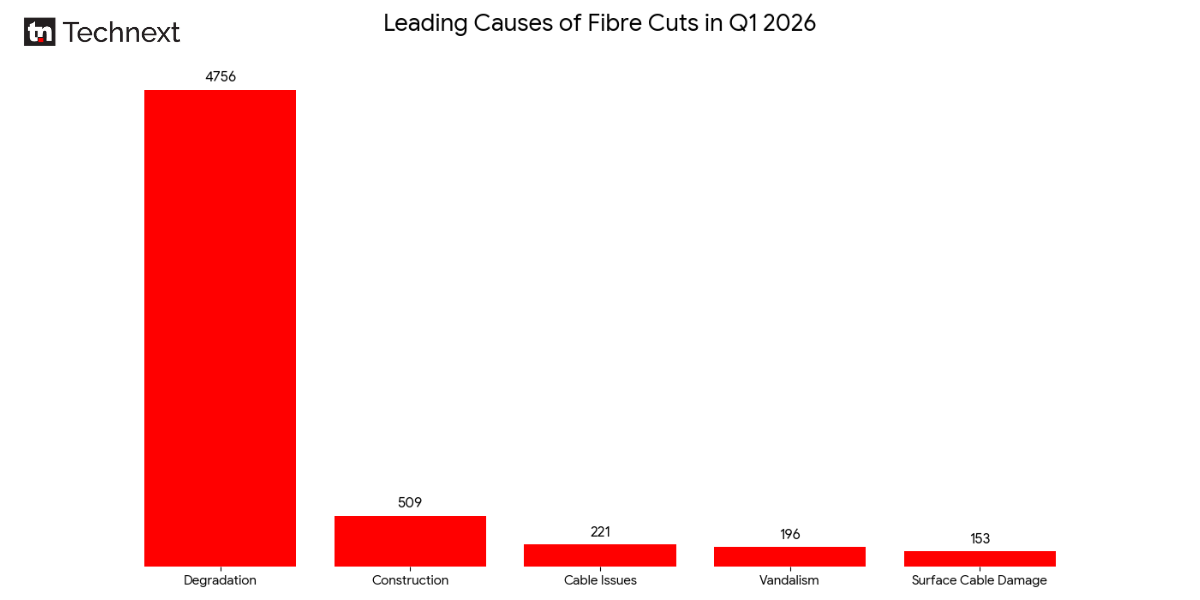
However, degradation accounted for the leading cause of fibre cuts across the three months. In all, the factor contributed to 4,756 incidents of fibre cuts across the first three months. This means that environmental deterioration, caused by industrial waste, other human causal factors and natural effects, critically affects network flow.
Fibre cut cases emanating from road constructions come second, with 509 incidents, followed by cable issues with 221 incidents. The industry also suffered damages owing to 196 cases of vandalism, while 153 cases were due to surface cable damage.
Other minor causal agents are bush burning, core breaks, force majeure, planned work and maintenance activities, termite attack and other forms of sabotage.
Aside from the QoE industry report, data from the NCC’s uptime portal shows that the industry suffered 577 network outages in the first three months of 2026. In breakdown, 238 outages in January, 189 in February and 150 in March.
Fibre cuts and power outages were the leading causes, with 361 and 144 incidents, respectively.
Equipment thefts
Not only did operators experience cuts in cables, but there were also 1,118 different cases of telecoms theft between the period under review. While January saw 402 equipment thefts, February declined to 323, while March recorded 393 cases.
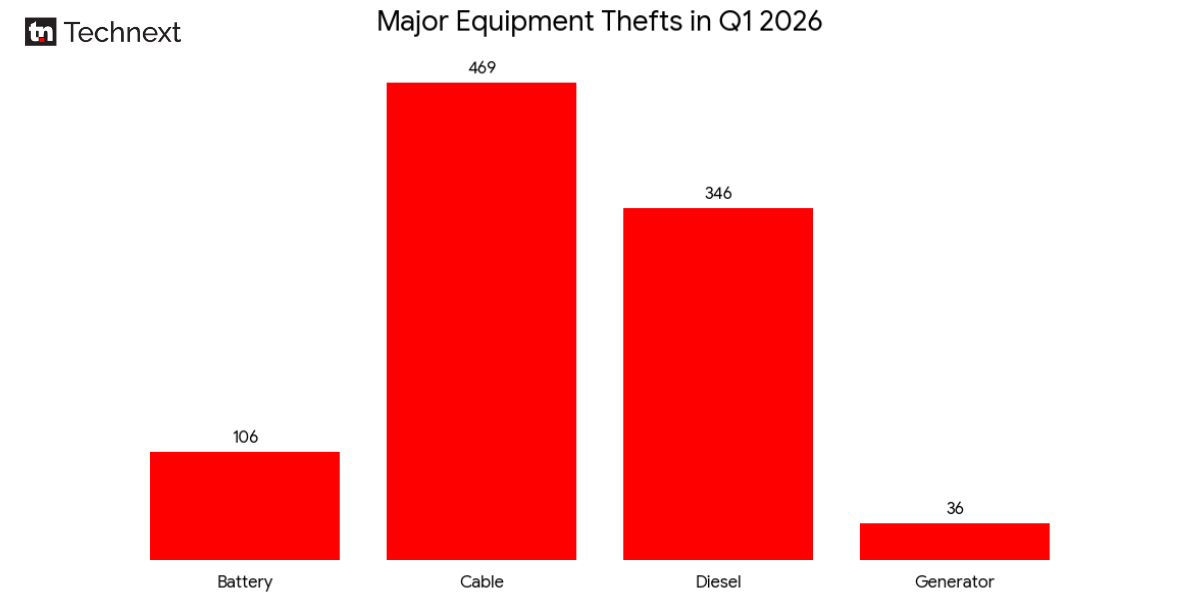
Cables (469 cases) recorded the highest equipment theft across the months, followed by diesel theft (346 cases) in base stations. Also, 106 cases of battery theft and 36 cases of generator theft were recorded.
Although telecoms infrastructure has been designated as critical national infrastructure by the federal government, industry data continues to reflect that operators are still accounting for periodic losses amidst fibre cuts, thefts and vandalism.
To curb these financial losses, experts have advised telcos to invest in controllable techniques such as proactive infrastructure monitoring and real-time incident detection.
The initiative involves installing CCTV cameras, deploying fibre-cut alarms, enabling power anomaly alerts, and using predictive maintenance to detect sudden site shutdowns, as vandals often test sites first.
