






Connectivity penetration in Nigeria’s rural areas continues to see significant growth in network speed, indicating that the region is growing digitally faster than society thinks.
A joint Q1 2026 Quality of Experience (QoE) report by the Nigerian Communications Commission (NCC) and OOKLA revealed that rural median upload speed increased by 47.5% from 6.1 megabits per second (Mbps) in September 2025 to 9.0 Mbps in March 2026.
While the increase might look or sound like a normal numeric jump, the impact is a time resource saver, bringing a better internet usage experience. At 6.1 Mbps, a 1-minute video can take about 12 minutes to upload.
But at 9.0 Mbps, the upload time reduces to 8 minutes. This also means that with the improved speed, some phone backups can run automatically without waiting for the coast to clear.
While it’s an identification of network potentials in rural areas, it shows the readiness for digital exploration and positioning for economic development. Say, Ponmile, a web developer, will no longer be worried about how to achieve his tasks when he travels to the rural part of the country.
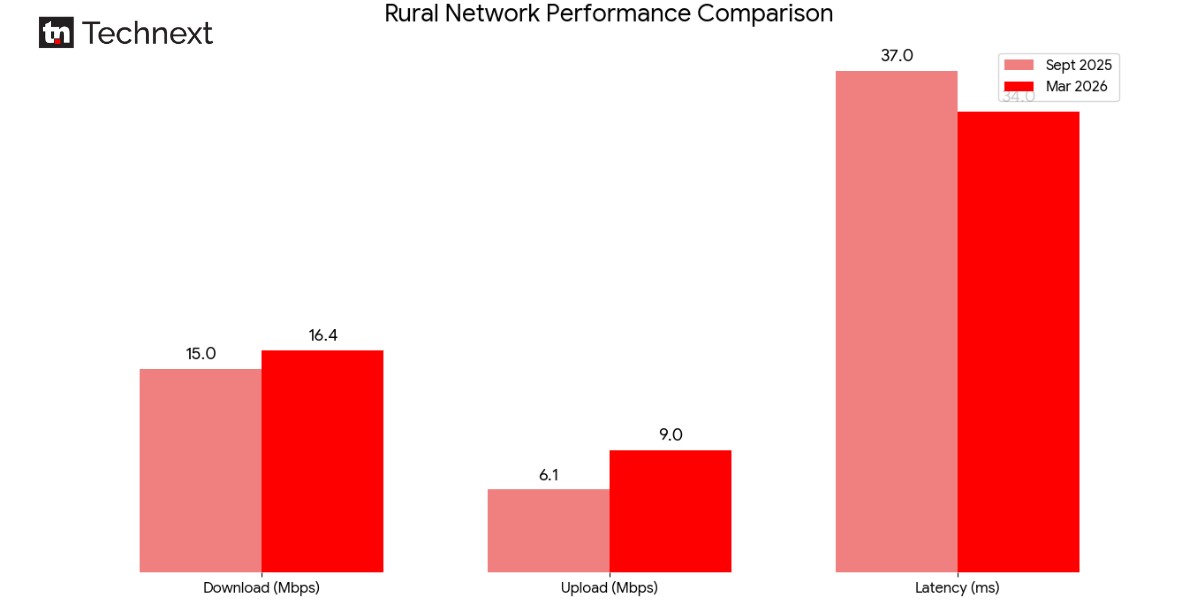
In fact, network response time (latency) in rural areas dropped by 8.1% from 37 milliseconds (ms) to 34 ms, 5 ms less than that of urban areas. Meaning the tendency of Ponmile’s experiencing delay when loading a page has dropped. In fact, when the network is in its fine form, he might not notice the delays.
In the same light, rural median download speed increased by 9.3% in six months. Compared to 15.0 Mbps recorded in September 2025, the speed has now grown to 16.4 Mbps, as of March 2026.
For Ponmile, streaming YouTube, Netflix or watching videos on social messaging apps becomes more encouraging with little lag during peak hours (7 am to 9 pm). It also means that Ponmile can turn on his hotspot and share data with his brother/sister while both still get a quality internet experience (without stepping on each other’s toes).
The picture is changing, and Nigeria’s rural areas are starting to show a conscious effort towards internet usage, attributed to increased financial inclusion and capacity for smartphone usage.
Also Read: Why African telcos need government support for rural network coverage and expansion.
Here are the network drivers
While it has been established that the cost of expanding network infrastructure, such as towers and fibre layout, is higher in rural areas owing to lower population density and susceptibility of equipment to damage, it’s surprising to see that Nigerian telcos are still leading the drive for quality network presence in these regions.
The NCC and OOKLA report revealed that MTN and Airtel recorded a surge in rural speed within the six months under review. For instance, MTN saw an 8.1% increase from 15.2 Mbps to 23.3 Mbps while Airtel surged by 3.3% to 13.7 Mbps from 10.4 Mbps.
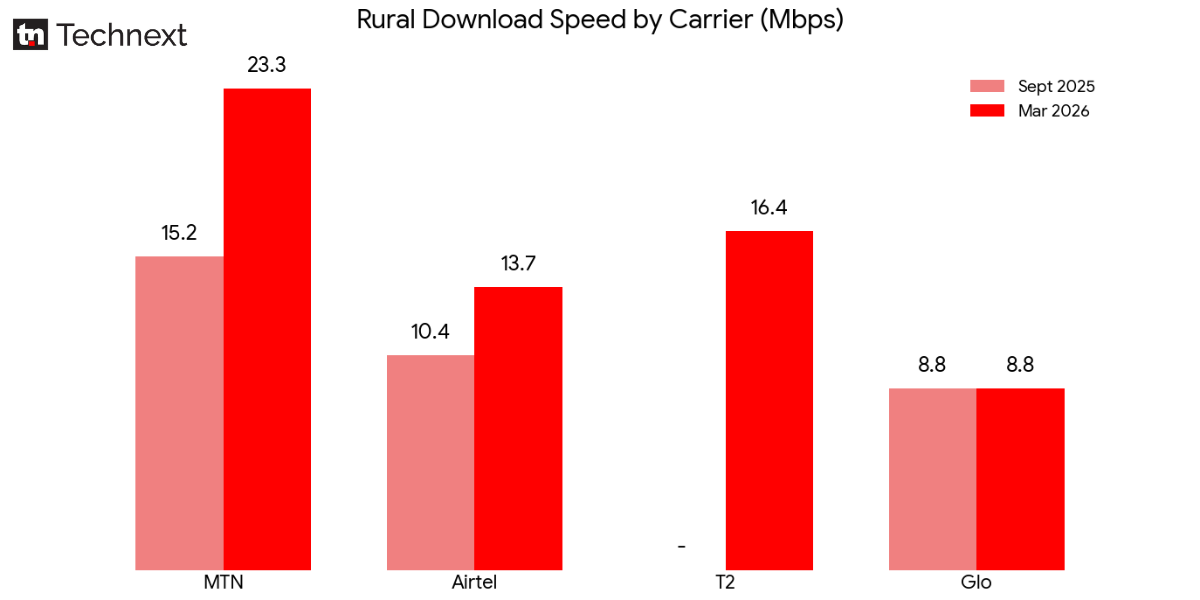
T2mobile, which had no record in September, now holds a rural speed of 16.4 Mbps. However, this is short of the operator’s rural average speed of 24.9 Mbps recorded in December. Globacom maintained its position of 8.8 Mbps, the same speed it recorded in September.
Rural network quality is increasing, so that some operators’ rural speed exceeds some competitors’ urban speed. In December, T2mobile’s rural average speed (24.9 Mbps) surpassed Airtel’s and Globacom’s urban speeds of 15.9 Mbps and 9.6 Mbps, respectively.
However, operator investment is the primary driver of this growth. While the cost of infrastructure in the region is not sustainable for telcos, room for shared network and roaming activities is an enabler for a quality experience for users.
Recall that Airtel and MTN signed a shared network agreement in March 2025. The deal focuses on reducing both CAPEX and OPEX on infrastructure, coupled with expanding coverage, particularly in remote and rural areas that do not fully enjoy the benefits of a modern connected life.

Another is T2mobile’s strategic spectrum lease agreement with MTN Nigeria, which allows the operator to lease MTN’s spectrum for a period of three years. Through the deal, T2mobile has increased its presence in rural areas.
Outside the operator’s inputs, the positioning of some rural towns along routes that connect cities together is another enabler. Cities like Jos, Enugu, Benin City, and Ibadan extend urban-standard connectivity into surrounding rural landscapes. It also shows that with developments, more rural areas are getting closer to cities.
The takeaway
Rural areas are showing strong speed in both upload and download speed, a proof of their gradual readiness to catch up and bridge the digital divide.
Our dear Ponmile, after experiencing a good internet experience in that particular rural area, will be convinced of establishing himself in the region. Not only him, but the increased network speed also allows farmers and small traders to use high-quality video for inventory management and their commercial operations.

The narrowing latency gap is gradually reducing the “failed payment” scenario, making mobile money transactions faster, safer and more reliable.
Also, students in these regions can enjoy the potential of their smartphones by streaming educational content, the same way as those in cities.
