



By Sofiat Nafiu
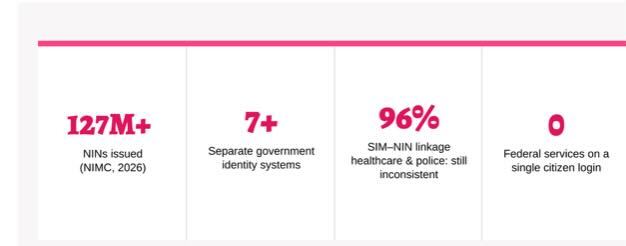
Over 127 million Nigerians have a National Identification Number. The same citizens re-enter their names, dates of birth, and addresses every time they use a new government service. Nigeria solved the collection problem. It has not solved the experience problem. These are not the same thing.
SCENE — SOMEWHERE IN NIGERIA, REPEATED DAILY BY MILLIONS
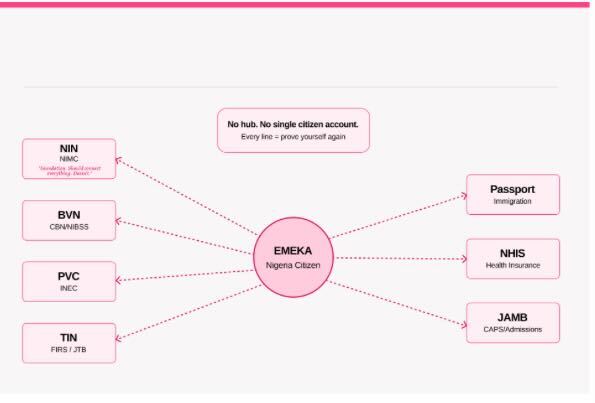
Emeka is thirty-four. He has a NIN, a BVN, a voter’s card, a tax identification number, and a passport that he renewed last year. He is trying to enrol in health insurance through the NHIA. The portal asks for his full name, date of birth, state of origin, local government, next of kin, phone number, and a scanned ID. He submits, and then the portal times out. A CAPTCHA appears in a font his phone cannot render. He visits the NHIA office in person. A form is produced. Same fields. He fills it in with a pen, in a queue, in 2026.
This is not a complaint about one broken portal. Rather, it is a description of the structural condition of Nigeria’s digital identity experience. This condition recurs in varying forms whenever a Nigerian citizen tries to navigate multiple government services.
Nigeria has built a significant identity infrastructure in the last decade. The NIN database, for example, holds over 127 million enrolments. BVN covers tens of millions of bank customers. Passport issuance is partially automated. FIRS issues TINs online. By the numbers, this looks like success.
But there is, remarkably, a distinction the Nigerian policy conversation has barely named: identity infrastructure is the backend. Identity usability is the front end. Nigeria invested heavily in one and has almost entirely neglected the other. That neglect has a cost that is measured not in naira but in hours lost, queues endured, and trust eroded.
THE PROBLEM
Identity has been collected. It has not been connected.
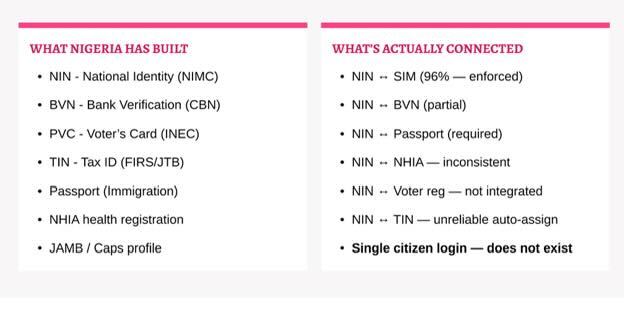
A typical adult Nigerian navigates NIN (NIMC), BVN (CBN), PVC (INEC), TIN (FIRS/JTB), passport, NHIA, and JAMB at different life stages. Each was built by a different agency on a different timeline. None delivers a joined-up citizen experience. There is no unified portal, no common login, no profile that carries your verified identity from one service to the next. Each system demands you prove you are you, from scratch, on its own terms.
The most damning current example is POSSAP, the police digital services platform launched in 2022. Nigeria already operates major biometric databases through NIMC, BVN, and passports. Despite some virtual verification options, core POSSAP services still require fresh biometric capture, forcing citizens to queue at police registries to submit fingerprints and facial scans that the government already largely has. This is not a technical failure. It is a design governance failure — the result of agencies that are not governed by a citizen-first data principle.
WHAT NIGERIANS ARE SAYING ON X
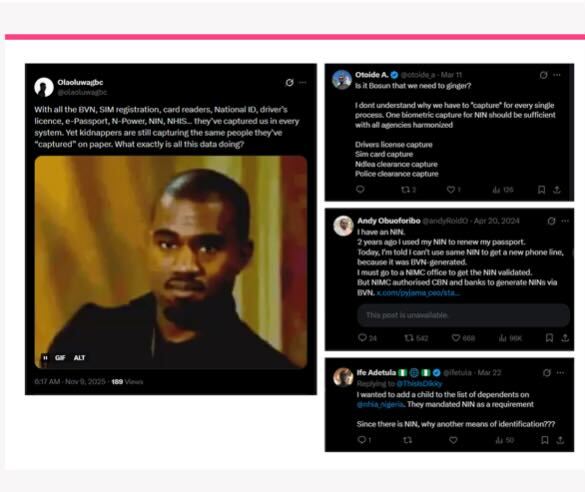
These are not one-off complaints. They are a pattern that, in real citizen language, describes exactly the architecture of failure this article is about.
WHEN ONE DATA FIELD LOCKS YOU OUT OF EVERYTHING
ThisDay Live (March 2026) documented Seun Adewale, 18, who lost his university entrance year to a NIN name-arrangement error the self-service portal could not fix, despite confirming “success” after payment.
TheCable’s earlier investigation documented that Susan, whose birth year error blocked her passport renewal, was required to pay a ₦15,000 fee and undergo an eight-week in-person process at the NIMC Lagos headquarters. One data field. System-wide exclusion. No digital exit. Frontline staff had no authority to override automated decisions.
THE PSYCHOLOGY
What repeated friction does to people and to institutions
The cost of fragmented identity systems is not only logistical, but also psychological, and in the context of public services, it is costly and long-lasting.
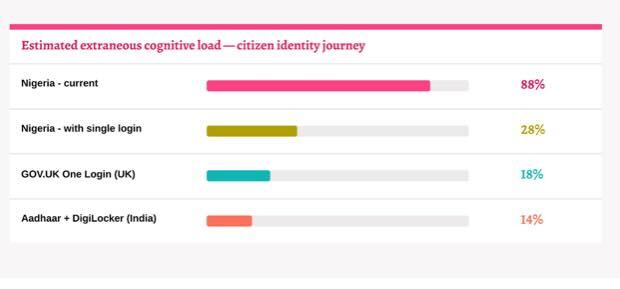
Cognitive load theory (Sweller, 1988) distinguishes between complexity inherent to a task and complexity created by poor design. Re-entering information the government already holds is pure extraneous load, friction that serves no user purpose and exists entirely because systems are not integrated. Every unnecessary form field is a tax on working memory. Multiply that across seven systems and millions of citizens, and the aggregate cost is enormous.
Albert Bandura’s self-efficacy research adds a deeper dimension. When systems repeatedly fail, people do not conclude the system is broken. They conclude they are not capable of using it. That belief generalises, making citizens less likely to try again with that service, with government digital services broadly, and sometimes with formal institutions entirely. Learned helplessness in digital government is a design-created phenomenon. Nigeria is creating it at scale.
“Any law without enforcement is just good advice. The real elephant we must eat in little bits is technology.” We need a platform that aggregates data from telcos, NIMC, FRSC, tax authorities, and providers. Without that digital backbone, every other effort is floating in the air.”
— Dr Leke Oshunniyi, Former Chairman, Health and Managed Care Association of Nigeria (Guardian, December 2025). Link
“Nigeria told citizens: your NIN is your identity. Then asked them to prove their identity again, separately, every single time.”
THE COMPARISON
What the UK Built and What It Require
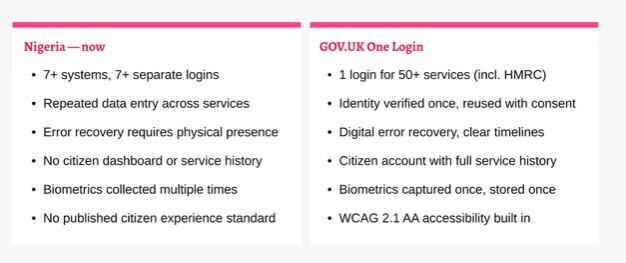
GOV.UK One Login is not offered as a blueprint to copy. It is offered as proof that the problem is solvable and that solving it requires a design mandate alongside a technical one. The GDS user research that preceded it found something simple: citizens already assumed the government was joined up. They expected one login to work everywhere. The UK built a system to match that mental model. Nigeria has not, despite the citizens’ expectation being identical.
WHAT NIGERIA IS GETTING RIGHT
NIMC’s migration to MOSIP—begun July 2025, backed by an $83M World Bank NIMS 2.0 tender and the broader $430M+ ID4D commitment—is a sound technical foundation. The 96% SIM–NIN linkage rate is a genuine governance achievement. Importantly, NIMC and NHIA signed an MoU in October 2025 to link NIN directly with health insurance records, a direct acknowledgement of the Emeka problem. Ground-level rollout is still inconsistent. The policy intent is right. The citizen experience has not yet caught up.
THE ASK
Four design decisions that would change this
- Build a unified citizen login, linked to NIN. One authenticated account, login.ng, or equivalent for all federal services. Not a new database. A usability layer over what already exists, using OIDC standards that MOSIP already supports. This is the single highest-leverage design decision available.
- Pre-fill government forms with verified NIN data. An authenticated citizen should never re-enter their name, date of birth, or address on a government form. The technology is trivial. The decision is to treat citizen time as valuable.
- Stop collecting biometric data twice. A single inter-agency mandate: no new government system may collect biometrics already held by NIMC. The POSSAP situation must not be repeated. The citizen’s biometric data belongs to the citizen, not to whichever agency last collected it.
- Publish and enforce a Citizen Experience Standard via NITDA. Pre-filled data, digital error recovery, WCAG 2.1 AA accessibility, and language support for Yorùbá, Hausa, Igbo, and Pidgin as a condition of service approval, not an aspiration.
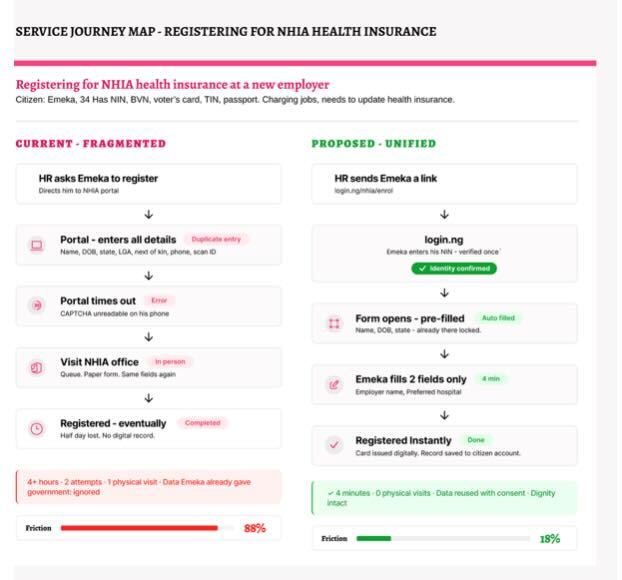
Emeka is still in that queue. The paper form in his hands is proof that Nigeria’s impressive identity infrastructure has not yet reached the people it was built to serve. The gap is not technical. It is a question of design priority, whether government services are built around institutions or around citizens’ actual lives. That choice is made by people, every time a new service goes live without a unified login, a pre-filled form, or a digital recovery path.
Emeka’s time is valuable. So is the time of every Nigerian in every queue.
