




When programmer Laszlo Hanyecz famously traded 10,000 Bitcoin for two Papa John’s pizzas on 22 May 2010, the transaction was a crude, empirical experiment to prove the digital asset could function as a medium of exchange. Sixteen years later, that historical benchmark has taken on an entirely different meaning.
Global headlines over the past year have been dominated by the pioneer coin’s historic march to $126,000 all times high, driven by unprecedented institutional liquidity, corporate treasury adoption, and Wall Street exchange-traded funds (ETFs). Yet, beyond the soaring asset valuations and boardroom validation, the real story of Bitcoin’s maturity is being written far away from Western trading floors.
In Africa, the narrative has fundamentally shifted. The release of the Bitcoin Pizza Day Impact Report 2022–2026 by the Crypto Bootcamp Community (CBC) offers the first comprehensive, data-supported account of organised Bitcoin community infrastructure on the continent. The data suggests the ecosystem is evolving beyond retail speculation toward broader economic integration.
From multi-city experiment to continental infrastructure
The urgency for real-world utility in sub-Saharan Africa has long been documented; World Bank data notes that roughly 57% of adults on the continent remain locked out of the formal banking system. While markets like Nigeria consistently rank at the top of global peer-to-peer exchange volumes, early adoption was fragmented, digital-only, and highly exposed to market volatility.
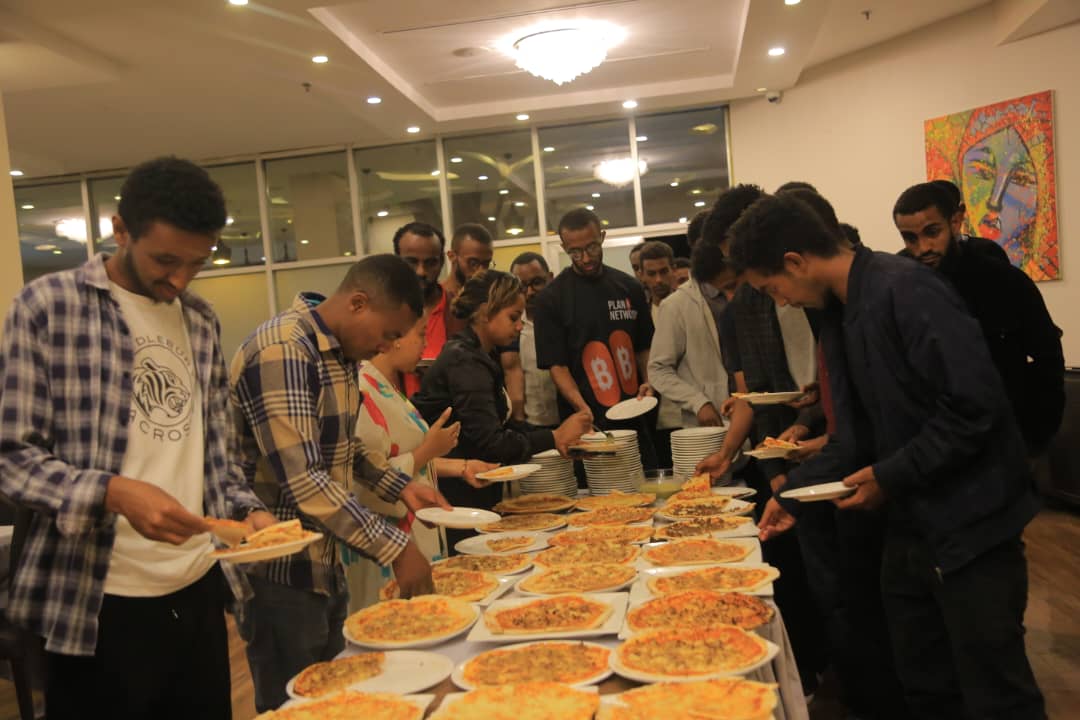
In 2022, CBC launched the Bitcoin Pizza Day Hangout. Spanning 18 cities across Nigeria, Kenya, Ghana, and Uganda, the simultaneous activation served as the first formally organised multi-country BTC community celebration in African history. No public records identify any structured Bitcoin Pizza Day activation on the continent before this inaugural campaign.
CBC Bitcoin Pizza Day network expansion (2022–2025)
Over four consecutive annual editions, the project scaled from a regional gathering into a massive network covering more than 40 cities across 16 countries, eventually expanding footprints into the United Arab Emirates and the United States. Total cumulative participation across 94 organised events has surpassed 50,000 individuals, effectively turning a global commemorative date into Africa’s largest informal, community-scale BTC circular economy experiment.

The economics behind the grassroots plumbing
Building this level of physical infrastructure across fragmented African jurisdictions required significant sacrifice. In the early days, institutional venture backing for Web3 literacy was limited. The impact report reveals that CBC founder Obinna Iwuno personally financed roughly 60% of the total programme costs during the foundational years, which included liquidating his personal Bitcoin holdings to keep the inaugural 2022 and subsequent editions solvent.
“Bitcoin Pizza Day Hangout was built on a straightforward conviction: that the first proof of Bitcoin’s utility as money belonged to Africa as much as to anyone,” says Obinna Iwuno, Founder of Crypto Bootcamp Community. “A continent where hundreds of millions of people remain outside the formal banking system, where currencies devalue, where remittances are taxed – this is the continent that should be celebrating Bitcoin’s utility most loudly.”
As the network proved its distribution power, the financing model matured. Early backing from local platforms like Bundle, Binance, Obiex, and Vent Africa paved the way for major institutional sponsors. In recent years, global liquidity providers and infrastructure giants, including Tether, PlanB Network, Yellow Card, Quidax, and Roqqu, stepped in to anchor the financial architecture.
The ultimate metric: Decentralisation and self-sustainability
For a quiet observer tracking ecosystem health, the most critical metric in the CBC report is not the total attendee count but the operational decoupling of the events. The programme has become fully self-sustaining. Independent communities across Africa, North America, and the Middle East now organise and execute their own Bitcoin Pizza Day activations annually without requiring direct coordination or funding from the core Crypto Bootcamp team.
The initiative has also served as an incubator for local leadership. Former operational team members have transitioned to establish independent, targeted Bitcoin hubs across the continent. Notable spin-offs include Gorilla Sats and Bitcoin Kampala, led by Brindon Mwiine in Uganda, alongside Bitcoin Pidgin and Bitcoin Anambra, founded by Kester Ejikeme in Nigeria.

Yet, as BTC enters a more mature macroeconomic phase globally, the grassroots networks that onboarded the first wave of African users are shifting their strategies. Mass awareness campaigns are no longer the primary objective in an environment where basic crypto literacy has reached a critical mass.
The Crypto Bootcamp Community is currently transitioning its operational focus away from large-scale adoption events toward building formal economic integration infrastructure. This next phase targets structured professional transitions via the ‘Blockchain Without Borders’ initiative, advanced technical developer education, crypto-native business operations support, and institutional policy engagement. Concurrent developments see Iwuno stepping into corporate strategy and compliance roles to focus heavily on the institutional adoption of blockchain frameworks for enterprises.
Sixteen years ago, Bitcoin was a niche cryptographic toy used to purchase fast food. Today, as the global market navigates institutional asset allocation, Africa’s infrastructure builders have proven that the true value of the network lies in the self-sustaining, local economies built around it.
