



When Chimoney founder Uchi Uchibeke announced in May 2026 that the cross-border payments startup was shutting down, he described a structured, clean wind-down. Every client’s wallet balance would be refunded.
Migration playbooks had been published. The process, he said, was designed to protect everyone who had built on or trusted the platform.
For at least one international user, that promise did not hold.
Technext has reviewed documented evidence showing that a user outside Nigeria and the United States submitted a refund request to Chimoney on April 17, 2026, received an official confirmation email from the platform, and watched their $355.28 balance sit frozen in “Review and Processing” status for 38 days, with no refund issued and no clear explanation from the company until Technext put direct questions to Uchibeke.
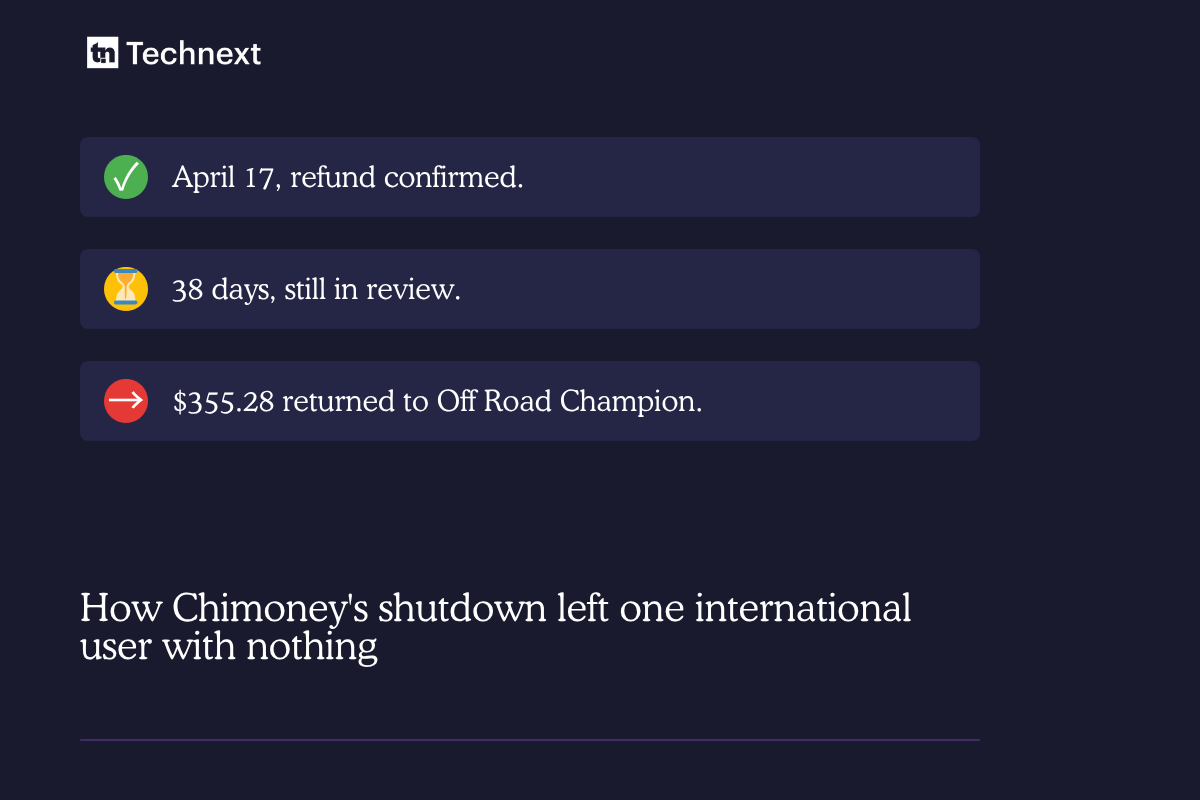
The user, who contacted Technext following the publication of our earlier Chimoney coverage and requested anonymity, shared a screen recording taken on May 24 showing the balance still appearing as withheld on dash.chimoney.io, alongside email correspondence with Chimoney support and formal complaints filed with multiple regulatory bodies.
What Chimoney says happened
In responses to Technext, Uchibeke provided a detailed account of the situation that differs materially from the user’s understanding of their own case.
The user, he explained, was never a direct Chimoney client. Their KYC submission was not approved, and Chimoney does not onboard accounts from their country of residence. The $355.28 appeared in what Uchibeke described as a receiving endpoint because a third-party app built on Chimoney’s API, called Off Road Champion, initiated a payment to the user’s email address through the platform. The user was a customer of Off Road Champion, not of Chimoney directly.
When Chimoney settled Off Road Champion’s account during the shutdown, the funds, including the $355.28 sent to this user, were returned to Off Road Champion as the originating business client. The user’s refund request, submitted on April 17, was not processed because by the time it reached review, the underlying funds had already been returned upstream.
“Our contractual relationship is with our business clients,” Uchibeke told Technext. “End users of third-party apps are governed by those apps’ own terms.”
As for why the balance continued to show as withheld on the dashboard more than a month after the settlement, Uchibeke said in his final response to Technext: “The balance continues to appear in this individual’s wallet view on the dashboard because our system has not yet updated the display to reflect the upstream settlement. This is a display issue, not an indication that the funds are pending or available.”
He added that Chimoney would update the dashboard to remove the balance display and acknowledged the situation “should have been handled more cleanly on the system side.”
Where the system broke down
Uchibeke’s explanation is architecturally coherent and legally defensible. B2B payment infrastructure providers routinely structure their obligations around business clients rather than end users, and Chimoney’s terms of service reflect that. What the case exposes is not fraud but a gap, specifically the point at which an automated system and a shutdown process met an edge case they were not designed to handle cleanly.
The automated refund confirmation email is the clearest illustration of that gap. When the user submitted their refund request on April 17, Chimoney’s system generated a confirmation stating the request had been received, the account had been frozen, and funds would be sent to the specified bank account within 7 to 14 business days.
That confirmation was real, the language was unambiguous, and the user had no reason to know it had been generated without distinguishing between a direct client and a third-party payment recipient.

Uchibeke acknowledged this directly: “The refund confirmation was generated by an automated system that did not distinguish between direct clients and third-party payment recipients. We acknowledge this created confusion for this individual.”
The refund geography question adds a separate dimension. The user’s correspondence with Technext raised the concern that Chimoney’s self-service refund flow only supports US and Nigerian bank accounts, creating a structural barrier for international users.
The refund confirmation email seen by Technext shows the user had specified a US bank account as their refund destination, which falls within the supported methods, yet the refund was still not processed.
Uchibeke’s explanation accounts for why: the funds had already moved upstream before the request could be actioned. But the broader question of whether international users outside Nigeria and the United States have adequate refund pathways under the shutdown remains unanswered at a systemic level.
What the user says
The user disputes Chimoney’s account on several points. They maintain that their account was active and functional before the shutdown, citing earlier successful transactions on the platform.
They contend that no one from Chimoney or Off Road Champion contacted them to explain that their funds had been returned to the originating business. They argue that moving funds out of their wallet without their knowledge or consent, regardless of the upstream contractual arrangement, represents a breach of trust.
And they point to the dashboard still showing the balance as evidence that Chimoney’s own account of events is incomplete.
On the question of Off Road Champion, the user told Technext they had no direct relationship with that company in the context of this dispute and that directing them there without introduction or facilitation from Chimoney left them with no practical recourse.
The structural question this case raises
Uchibeke told Technext that cases where an end user of a third-party app has a residual balance after the business client’s account has been settled are limited. He did not quantify how many such cases exist.
For the users in that category, the shutdown process, as designed, offers no direct remedy. Their recourse sits with the business that sent them the payment, a business they may have no ongoing relationship with, no contract with, and no practical means of reaching.
That is the gap the Chimoney shutdown leaves open. It leaves a structural blind spot in a shutdown that was otherwise more responsibly executed than most. The user’s $355.28 went back to Off Road Champion. Whether Off Road Champion returns it to the people it was originally sent to is a question Chimoney says it cannot answer and has no obligation to pursue.
Uchibeke’s final word to Technext on the matter: “The individual’s recourse for the $355.28 remains with Off Road Champion, who received the funds and has the direct relationship with this individual.”
For a user who received a refund confirmation from Chimoney, waited 38 days, and never received their money, that answer, however legally accurate, is cold comfort.
Update, May 29, 2026: Subsequent to publication, Technext received correspondence from a representative of Pixel Pirate Studio, the company operating the Off Road Champion app, stating that the company has not received any refund from Chimoney and that no funds from Chimoney have passed through their portal. Chimoney’s founder Uchi Uchibeke had told Technext that the $355.28 was returned to Off Road Champion as the originating business client during the wind-down settlement. Technext has noted this development and will update if further information becomes available.
