





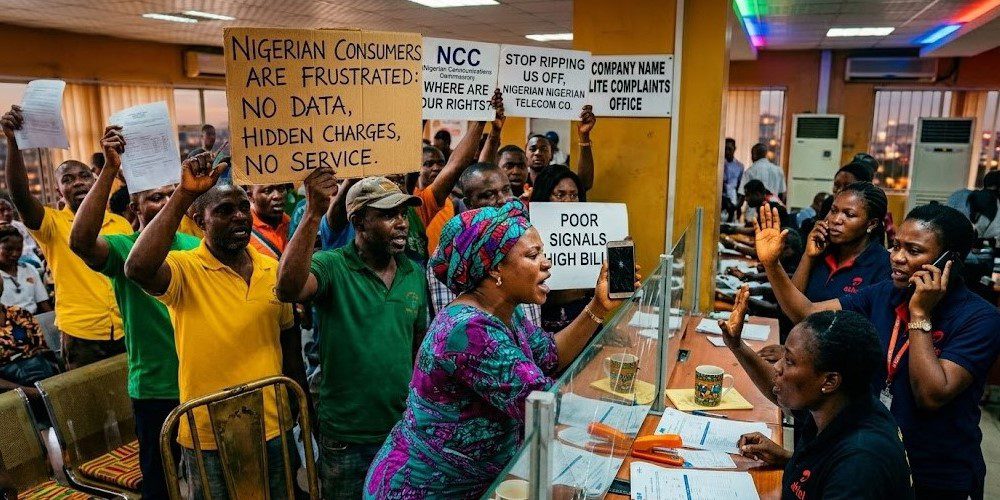
Jolade, an everyday Nigerian hustler, bought a 75GB monthly data plan on Friday night. By Saturday morning, it was all gone. She recalled that she only replied to messages on WhatsApp and scrolled through her Facebook news feeds the night before.
No downloads, no video streaming, no YouTube checks and no hotspot sharing, the mobile data meant to last for 30 days has flashed by in less than a day. Of course, you will expect Jolade to ask questions. To her, the situation is difficult to explain. Yet, it requires an answer.
Mind you, a lot of Jolades are out there. Almost every Nigerian subscriber has, at one time or another, experienced cases of data depletion, unauthorised activation of caller tunes or plans and airtime deductions.
Are Nigerians complaining? Yeah, louder than the deaf can hear. Across various social media pages, especially TikTok, Facebook, and X (formerly Twitter), Nigerians expressed their complaints on unexplained data exhaustion and poor network services.
When voice and data costs have risen, getting value becomes crucial. But when a subscriber experiences a drop in quality of service or suspects unauthorised deductions, who comes to their rescue?

How Anene challenged and won
A subscriber, Ezugwu Anene, has set a landmark that others can reference for many years to come.
In a case involving Anene and MTN Nigeria (Anene v. MTN Nigeria Communications Plc [2025] 16 NWLR (Pt. 2010) 1), the Supreme Court of Nigeria condemned unethical, unfair and exploitative practices by telecom operators.
Anene, an MTN subscriber, approached the court because of repeated deductions from his airtime for “caller tunes”, a service he had not subscribed to. This became embarrassing for Anene on May 13, 2024. His call was abruptly terminated during a live radio programme, because his airtime had been exhausted.
After repeated complaints, MTN refunded him N700 airtime. But the unauthorised deductions persisted.
As internal resolutions with the operator became abortive, Anene filed a lawsuit against MTN at the Abuja High Court. He claimed damages of N50 million on the grounds of hardship and discomfort.
The trial court awarded N5 million in favour of Anene as general damages and N500,000 as costs and a resolution that MTN’s conduct was an unfair business practice.
Thereafter, MTN, unsatisfied with the verdict, approached the Court of Appeal, which reduced the damages to N400,000. Seeing that the initial judgment had been attenuated, Anene appealed against the Court of Appeal’s decision at the Supreme Court.
The Supreme Court’s intervention led to the restoration of the Abuja High Court’s judgment, holding that MTN failed to provide sufficient evidence that Anene subscribed to the caller tunes service. It also stated that service providers must be held accountable when their practices are exploitative.
The judgment proves that consumer rights are important and justiciable.
Also Read: Despite complaints about poor service, NCC says network quality is improving.
Lessons for subscribers
Anene’s case with MTN isn’t the first. And it won’t be the last, provided subscribers are ready to fight for their rights. It also stipulates how telecom operators must comply with consumer protection laws and be transparent in their operations.
Speaking with Technext, Agbo Obinnaya, a practising lawyer and CEO of Case Radar, noted that charging subscribers without their consent is outlaw.
Agbo explained that the N700 refund shows that MTN doesn’t really care about the magnitude of damage they’ve done to their subscribers. He noted that the refund shows that the operator acknowledged the unauthorised deductions did occur.
And that’s why the court tried to hold MTN accountable for taking care of customers.“The court is trying to let Nigerians know their right, although Nigerians don’t know their right,” he hinted.
One thing that makes consumers hesitant to report to consumer protectors such as the Federal Competition and Consumer Protection Commission (FCCPC) or approach the court is the time-consuming and bureaucratic process involved.

“However, the best approach is always to end up in court where you can lay your claims in a proper legal way. Sometimes the agencies make more delays and may end up not getting what you’re meant to get,” Agbo added.
He highlighted important rights every Nigerian subscriber needs to be aware of:
- An operator must secure the consent of a subscriber to charge for a service. No consent means violation of rights.
- A subscriber has a right to transparent and accurate information and freedom of choice. It also involves choosing what he/she wants or not.
- Right to fair and reasonable service delivery.
- Right to redress and compensation.
- Right to regulatory protection and enforcement.
- A consumer can sue to the extent to which their rights have been violated. Both emotional and psychological.
While consumer protection laws and policies exist, compliance by operators is one challenge; swift response to infractions by consumer protectors and regulators is another.
