






As economic realities continue to widen educational inequalities in Nigeria, the challenge of keeping children in school extends beyond tuition fees alone.
For many families, the rising cost of school supplies, transportation, uniforms, books, and daily learning essentials has become a growing burden, disrupting a child’s educational journey.
According to UNICEF, Nigeria currently has about 18.3 million out-of-school children — the highest globally — with over 10 million of them at the primary school level alone.
“Nigeria’s nearly 105 million children and adolescents aged 0-17 years represent about half of the country’s population. Investing in children is a strategic opportunity for building human capital development and long-term economic and social development in Nigeria,” a report by UNICEF said.
UNICEF also notes that only 63% of primary school-age children regularly attend school, while many others struggle with learning poverty, retention challenges, and poor access to quality educational support.
Education experts have also repeatedly warned that keeping children enrolled in school requires more than classroom access alone. It demands continuous motivation, household support, learning resources, and early encouragement capable of helping children remain confident about their future despite economic uncertainty.
It is within this context that PalmPay’s Young Stars Initiative positions itself as a targeted social impact intervention focused on supporting foundational education and reducing some of the economic pressures affecting young learners and their families.
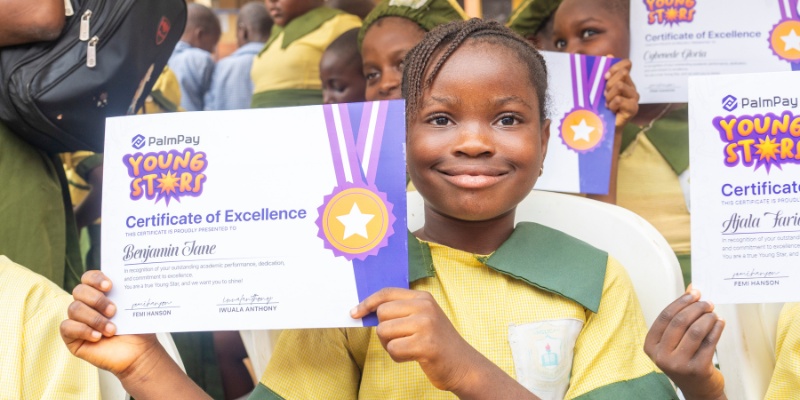
Through the initiative, the leading fintech innovator for digital banking empowered 60 outstanding pupils across selected public primary schools in Lagos State with scholarships, branded school kits, educational materials, and N50,000 shopping vouchers aimed at supporting their educational journey and easing back-to-school needs.
This was executed in partnership with the Lagos State Universal Basic Education Board (LASUBEB). The initiative was designed not only to reward academic excellence but also to reinforce the value of education among children in underserved communities while encouraging them to remain committed to learning.
The programme, which commemorated Children’s Month, ran from May 12 to May 30, 2026, with outreach activities held across four selected schools, including Adeniyi Primary School, St. Peter’s Primary School, Lagos Model Primary School, and Opebi Primary School.
Beyond scholarships and school materials, PalmPay also organised financial literacy workshops introducing pupils to basic money management and responsible spending habits at an early stage.
Beneficiaries additionally participated in a special shopping experience where they redeemed vouchers for essential school supplies and personal items.
Read also: IWD: PalmPay champions female inclusivity with tech skills training for 100 women
PalmPay and LASUBEB’s Partnership for Educational Impact
According to PalmPay, the partnership with the Lagos State Universal Basic Education Board (LASUBEB) helped identify participating public primary schools and beneficiaries across Lagos State.
Speaking on the importance of the initiative, Chika Nwosu, Managing Director at PalmPay, said recognising young learners goes beyond celebrating academic excellence.
“Recognising and rewarding high-performing students reinforces the value of education, strengthens motivation, and supports families in keeping their children in school. Through our partnership with LASUBEB, we are contributing to an ecosystem where young people are encouraged to stay engaged and pursue their ambitions,” he said.

At the presentation ceremonies held at Adeniyi Jones Primary School and St. Peter’s Primary School, PalmPay’s Chief Operating Officer, Samuel Oluyemi, also encouraged pupils to remain focused on excellence despite prevailing social and economic challenges.
Teachers at the participating schools described the initiative as impactful, especially for children from underserved backgrounds.
“This means a lot to the kids. Some children did not have some of the materials given to them today,” said Mrs Atunwa, Assistant Head Teacher of Lagos Model Primary School.
The Assistant Head Teacher of Adeniyi Jones Primary School also expressed appreciation to PalmPay for investing in the future of the pupils.
“We sincerely appreciate our sponsor (PalmPay), guests, parents, and every individual present here for your support and commitment towards empowering the next generation. To all the beneficiaries, this scholarship is not just financial support, but a motivation to strive for excellence and achieve greater success in life.”
How Palmpay’s Initiative Connects With Nigerians Directly
For many families that benefited from the initiative, the intervention represented more than educational assistance. It provided relief in an increasingly difficult economic climate, where even basic learning materials have become expensive for low-income households.
Mrs Abeleke, one of the beneficiaries’ parents, described the initiative as timely and deeply impactful.
“I am happy, and I cannot express the amount of joy in my heart. I’m overwhelmed by this opportunity that PalmPay has given to my child. I’m grateful to PalmPay for this scholarship,” she said.
Another parent, the mother of scholarship beneficiary Nana Sanni, said the recognition restored hope within her household.
“Her excellence has not just made us proud, it has brought hope back into our home,” she said emotionally. “I want to sincerely thank PalmPay for making this moment possible for my child.”
For the pupils themselves, the initiative became both recognition and inspiration.


Mohammed Jubril, one of the beneficiaries, shared his dream of becoming a governor in the future so he could “help more children get access to education and opportunities.”
As Nigeria continues to confront growing educational and socio-economic pressures, initiatives like PalmPay Young Stars highlight the increasingly important role private-sector organisations can play in supporting public education, reducing inequality, and helping young learners remain connected to opportunity.
The initiative also aligns with several United Nations Sustainable Development Goals (SDGs), particularly SDG 4 on Quality Education, SDG 1 on No Poverty, SDG 10 on Reduced Inequalities, and SDG 17.
For many beneficiaries, the impact of the initiative may begin with scholarships and school supplies, but its long-term significance lies in something far more lasting — restoring confidence, strengthening ambition, and reminding young children that their future remains possible.
“By providing scholarships and learning materials, we are helping parents redirect financial pressure toward other essential household needs while ensuring that children do not miss out on quality education because of economic constraints,” Palmpay said in a statement.
Palmpay’s Continued Advocacy for Socio-economic Excellence
Education remains one of the strongest predictors of economic mobility, employability, and innovation capacity. By supporting foundational education at the primary level, Palmpay is investing in the pipeline of future professionals, entrepreneurs, and leaders.
When children are educated early and consistently supported, they are more likely to grow into adults who contribute meaningfully to society economically, socially, and civically.
A key component of the PalmPay Young Stars Initiative is introducing children to basic financial literacy in practical, age-appropriate ways.

“We believe financial education should not only be theoretical, but it should also be experienced. Through structured activities such as the shopping experiences, students are exposed to simple but powerful lessons around making choices within a fixed budget, prioritising needs over wants, understanding value for money and making thoughtful spending decisions,” Palmpay said.
It added that this initiative is an early introduction to the principles of financial inclusion, helping children understand how to make informed decisions about resources, even in everyday situations.
“In this way, the impact of the initiative extends far beyond the classroom. It contributes to nation-building at scale,” Palmpay affirms.
