






The 2026 FIFA World Cup is upon us. This edition, hosted by Canada, Mexico and the USA, is already the biggest ever across several metrics.
It will be the first to feature 48 countries drawn across 6 continents, with a record 1,248 players participating. It is also the first Mundial to be hosted across three countries. The first and only time it has been hosted by more than one country was in Korea/Japan 2002.
The 2026 FIFA World Cup will also be the most data-dense and technologically advanced sporting event, not just in football but across the world of sports. It will witness the deployment of old technologies like goal-line and VAR, while heralding newer ones.
Without much ado, here are 5 new technologies set to debut at this year’s showpiece. These data-based technologies are designed to speed up officiating and make team data instantly available.
See also: 5 things you should know about the AI-powered 2026 FIFA World Cup official match ball
1. Advanced semi-automated offside and instant audio alert
The semi-automated offside technology is not new in itself, as it was first used during the 2022 FIFA World Cup in Qatar.
However, this advanced version has been greatly optimised to curb delays in calling offside decisions. Whereas the old system sent offside calls to the Video Assistant Referees (VAR), the advanced version sends them directly to the match officials on the pitch.
FA rules on offside indicate that the assistant ref should allow an attack play out before flagging an offside, just in case it was a wrong call. While the purpose of this was honourable, it has led to instances of players sustaining injuries while forcing the attack or defending it.
This is more devastating if the call ends up being an offside.
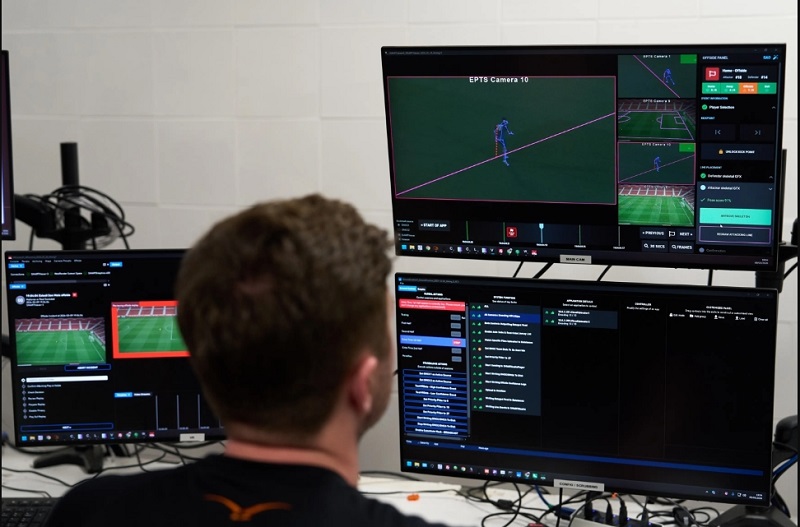
So, to guarantee accuracy and lead to more instantaneous offside calls, the advanced semi-automated offside technology would alert the linesman through an AI-powered alert system if an attacking player is more than 10 centimetres offside. The 2022 version only alerted the linesman to offside gaps of 50 cm or more.
While this is a vast improvement, tighter offside calls and the more technical ones, like interfering in play, would still require the human element. The linesman could also choose not to raise their flags after being alerted, especially if they suspect a mistake.
2. Every player has a 3D avatar
Every one of the 1,248 players taking part in the 2026 FIFA World Cup will have a digital twin. These twins will be created during each player’s photo session, when they will be asked to enter a 3D chamber for a one-second full-body scan. The scan will capture highly accurate body dimensions and produce a digital replica of each player.
As the game happens, a replica game is played by the digital twins. This game is powered by 16 optical tracking cameras installed in each stadium and generating as many as 172 million data points per game.
The old technology generated only 600,000 data points.
With this, officials can make highly accurate calls, like whether a player in an offside position was obstructing the goalkeeper’s view or whether the ball completely crossed the touchlines, in events where such decisions lead to goals.
Also, the offside decisions broadcast across the world will carry exact replicas of the players involved, not the generic images that were the case before.
3. Football AI Pro to give every team the same data analysis advantage
It is no secret that different countries have different match data analysis capabilities, especially when using technology. But FIFA introduced the Football AI Pro to level the playing field at the 2026 FIFA World Cup.

Before now, the federation provided each country with data in the form of a 50 to 60-page report, which required deep expertise to analyse. But with Football AI Pro, teams do not need to analyse anything. All they need to do is ask the AI Pro to give them the exact information they need, in any language they want.
While teams will still bring their expert analysts, nonetheless, it would be a huge plus to have this generative AI Assistant in your corner. This is especially so when you realise it has the capacity to generate data from the millions of data points made available by the AI-powered optical cameras in the stadia.
With this information, the Football AI Pro caninstantly generate validated tactical insights, match reports, 3D visualisations, and graphs before and after matches.
4. AI-stabilised referee body cameras
While this is not a new technology in football, as we see ref body cams used in club competitions, it is, however, quite new to the World Cup. The overall idea is to give fans an immersive experience, steeped in the promise of first-person perspectives, rather than a general broadcast.
However, the FIFA World Cup 2026 brings a small update with the body cam. Before now, images generated by the body cams were blurry and jumpy due to the movement of the referee.
To eliminate this, FIFA has introduced a new AI-powered stabilisation software to provide clean, high-definition broadcast footage.
5. High-tech ball and broadcast infrastructure
The 2026 World Cup match ball, the Trionda, needs no reintroduction. It is the smartest football anywhere, featuring an embedded inertial measurement unit (IMU) sensor which transmits its exact location data 500 times per second.
This tracks the exact millisecond it is kicked and helps in decision-making.

The 2026 FIFA World Cup will also witness the introduction of ultra-low-latency broadcasting to be deployed by Lenovo. A high-density, edge-computing server infrastructure has already been installed across stadiums and the Dallas Broadcast Centre.
This will reduce streaming delays to under 5 seconds, synchronising live video across fan zones, stadium screens, and media tribunes in near-real-time.
