


The Nigerian telecoms industry saw a sharp drop in foreign investment after recording a $7.24 million capital injection during the first quarter of 2026. This amounts to a 91% year-on-year drop compared to the $80.78 million recorded a year ago.
Also, the figure falls 93% short of the $103.36 million investment recorded in Q4 2025, the most recent quarter.
Data made available by the Nigerian Bureau of Statistics (NBS) reflects a significant negative result, even if a short-run fluctuation. Of the total $10.4 billion in received by the Nigerian economy during the quarter, telecoms only accounted for 0.07%.
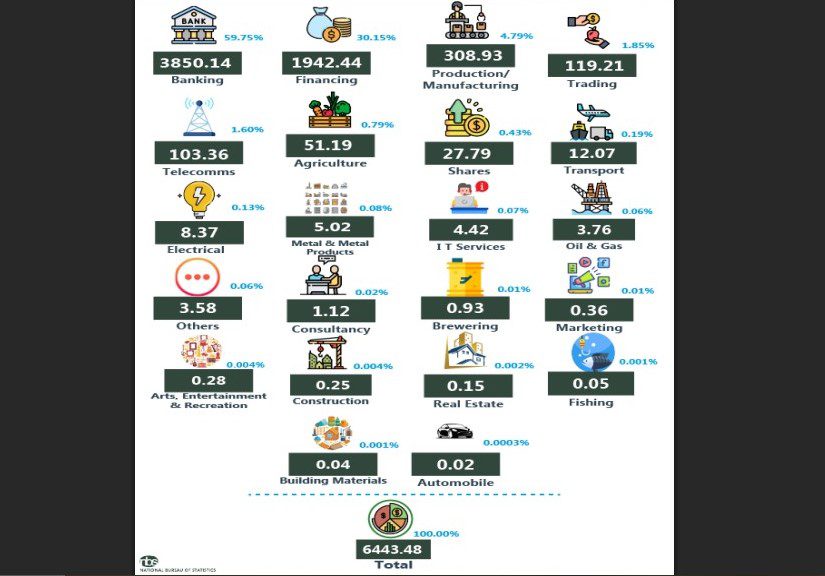
For an industry tagged as one of Nigeria’s most essential sectors, the figure is a drastic contrast considering the continued growth of the industry and recent reforms. However, the drop in investment reveals investors’ scepticism in an industry which has seen fluctuations in performance considering recent challenges.
Compared to the telecoms sector, the banking industry saw the highest foreign inflows of $7.6 billion, accounting for over 72% of total capital importation. The financing sector received $2.4 billion (23.4% share), Production/Manufacturing at $152 million (1.47%), and Shares with $75.34 million (0.73%).
Others in the top range include: Trading -$65.8 million (0.63%), Agriculture – $37.28 million (0.36%) and Information Technology services – $11.33 million (0.11%).
Also Read: Voice and data usage drives telecoms’ N4.7trn contribution to Nigeria’s real GDP in Q1’26.
What this means for the Telecoms sector
For the first three months of the year, industry data from the Nigerian Communications Commission (NCC) revealed that the telecoms sector added over 5 million subscribers, fueled by smartphone adoption and internet penetration.
Within this period, overall data usage reached nearly 4.5 million terabytes of data, revealing how this particular service has fueled revenues for operators.
However, issues such as data depletion and network outage complaints continue to offset its positives. Although vandalism, fibre cuts, thefts and other uncontrollable issues. For an industry that connects other sectors, the instability in trends can potentially pose an unbalanced intuition to investors.

The Q1 2026 sharp fall sends signals to foreign investors to keep close watch on the industry, and not be only convinced by obvious trends in subscriber numbers. For now, it shows how the industry might struggle to keep up with positive trends and also balance its positions at the most pivotal growth indicators.
Why the figure can be misleading
Trends in foreign investments are often influenced by large deals or a one-off deal. And this is peculiar to the telecoms industry.
For an industry which requires a large investment in network expansion, fibre rollout, tower base stations, data centre construction, and others. An investment in any of these can suddenly spike data for capital importation in a quarter. As seen in Q1 and Q4 2025.
Telecom operators might not raise investment or attract investors every quarter. Even when they secure investment in a particular quarter, they might spend the remaining quarters on strategising, implementation and spending of the funds received.
Recall that the Federal Ministry of Communications, Innovations and Digital Economy (FMCIDE), through the Minister, Bosun Tijani, recently announced a partnership with the Nigeria Universal Communication Access Project (NUCAP) to deploy 3,700 towers across the country.
The project, according to the Minister, will see the deployment of 1,000 before the year-end, with a focus on connecting 20 million Nigerians in underserved communities, bolstering the push for the digital economy and enhancing economic growth.

Such investments, alongside the project bridge can determine the status of the industry in this regard. Foreign investment data are volatile and are mainly fueled by big deals.
Although there are shortcomings such as fibre cuts, network outages and vandalism, the drop in foreign investment is still a short-run impact. It only takes a significant investment by an operator or the industry to push the figure back to normal trends.
Foreign investment reports by Q2 2026 will, in reality, reveal the status of the telecoms industry in terms of attracting foreign investors. By then, a picture of the first six months will be enough to grade the industry.
