





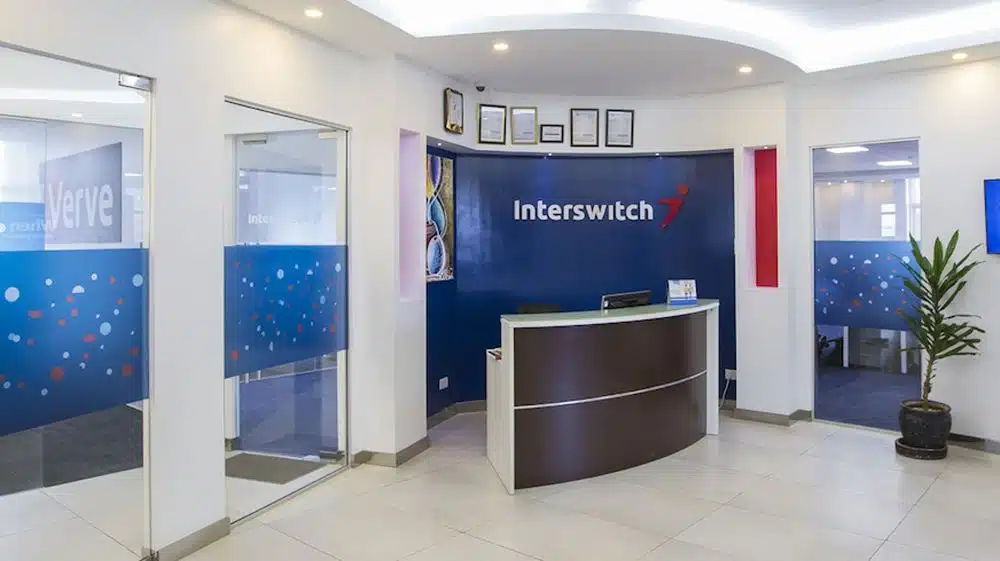
Elizabeth Okonji had passed every stage. The technical people had seen her, asked their questions, and decided she was good enough for the talent management role at Interswitch. Then she was told the final step was to meet the MD. She walked into the room and found she was not alone.
Candidates for different positions sat at the same table, all of them brought together at once. Mitchell Elegbe walked in, sat at the head, and started throwing questions into the open air. No particular order. No particular person. Whoever felt moved to answer, answered.
Mitchell Elegbe is the founder and Group Managing Director of Interswitch, a pan-African payments technology company he started in Lagos in 2002.

Okonji, who hosts the Thrive Not Survive podcast and has since built her own name as a leadership coach, recalled the experience on a recent episode where she hosted Elegbe. She remembered the disorientation of it, how the questions seemed random, but the listening was not random at all, how she eventually stopped performing and simply became herself. She got the job, spent years at Interswitch, and says she never forgot what she learned in that room.
“I learned a lot,” she told Elegbe on the podcast. “A lot of the way I interview today is from that day.”
‘Not the most technical person in the room‘
Elegbe has a phrase he returns to whenever the method comes up. He is not the most technical person to interview a talent manager, not a chartered accountant to interview a chartered accountant, not equipped to interrogate expertise in any specialist field.
By the time a candidate reaches him, the people with relevant knowledge have already done their work. His job is something different.
What I see as leadership, he said, is freeing people to do willingly and well whatever needs to be done. And it starts at the interview.
What he is watching for in those sessions is culture fit, how a person reacts to unexpected conditions and what they reveal when they stop performing and start responding. He calls it adaptive and multifocused thinking.
You adapt your questions but stay focused on each individual, because what you are really trying to see is behaviour that approximates real life. He now asks candidates for permission before proceeding that way. Most agree.
The people Mitchell Elegbe’s Interswitch is looking for
Interswitch launched in Lagos in 2002 with a specific ambition to build the real-time digital payments infrastructure that Nigeria did not yet have. Banks closed for the weekend. Workers collected cash on Fridays because there was no way to transact until Monday.
Elegbe wanted to change that, and he needed specific people to do it with him.
None of them needed payment experience, since almost nobody in Nigeria had any. What they needed was the right internal architecture, including native intelligence, genuine care, a desire to make things better, and what Elegbe calls long-term enlightened self-interest.
The willingness to delay gratification in service of a larger purpose.
He can tell the recruitment story for every key person in the early company. Akeem Lawal was his university classmate, a first-class mind he made a mutual pact with before graduation. Charles Ifedi was an Accenture consultant on an Interswitch project whom Elegbe spotted and pulled across. There’s a youth corps member at his previous employer whom he showed the vision to before she had finished her service year; she had an oil company offer waiting and turned it down.
Vincent Ogbunude, now MD of Verve, had been hired by a colleague before Elegbe could get to him. So when Interswitch was starting, he simply called him. Babafemi Ogungbamila, Executive Vice President of Operations and Technology, was a student at a competition Elegbe attended officially who approached him with personal projects unrelated to the event; He listened and made him an offer on the spot without authorisation.
These were the results of a man who was always looking, always cataloguing, always thinking about what a particular person might become inside the right structure.
There is a moment Elegbe tells as proof for all of it. In the early days, he was in his office with Hakim and Charles past nine in the evening when his phone rang, and a voice was screaming. He could not tell at first if someone was in distress. It was Vincent. Interswitch had just put Nigeria’s first online ATM live. The screaming was joy.
Interswitch has not retrenched in 23 years of operation. Elegbe states this not as a boast but as the logical outcome of hiring carefully.

When you invest in understanding who a person is before they join, the pressure to let people go in bulk does not accumulate the same way. The group interview, the strange room with all the candidates together, was always in service of that.
Real life is not one-on-one. A product launch is not one-on-one. The place where you spend most of your working hours is a social environment, and the person you are in that environment is the person who will either strengthen or erode the culture you are trying to build.
Elegbe wanted to see that person. So he built a room that made it harder to hide.
Watch the full interview:

