





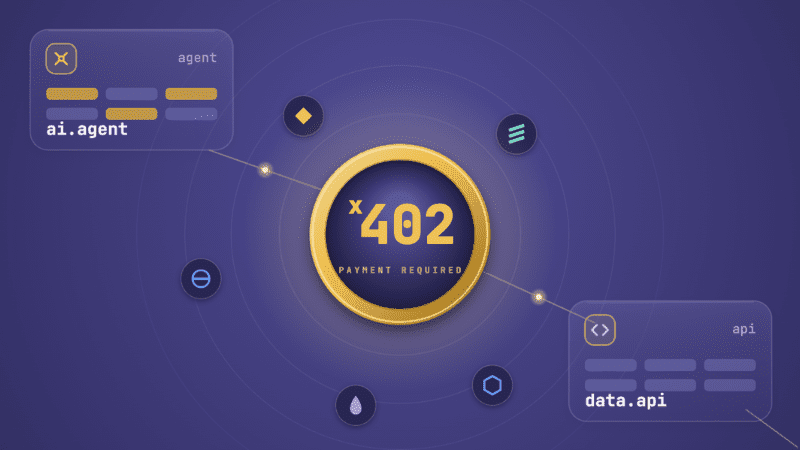
For most of the internet’s history, digital commerce assumed a human was sitting at the other end of the transaction. A person clicked an advert, filled a cart, entered card details, approved an OTP, subscribed to a plan, or waited for an invoice. That model built the modern web, but it was never designed for the next user of the internet: software that can decide, buy, negotiate, and act on behalf of people and businesses.
That is what is changing with AI agents. An agent does not want to browse a checkout page. It does not want to send emails to procurement. It does not want to wait three days for a transfer to clear before accessing a dataset, booking compute, paying for an API call, or pulling a risk score. It needs prices that machines can read and payments that machines can execute.
The commercial question for Africa is simple: when AI agents start buying digital services at scale, will African businesses be able to charge them?
The web had a placeholder for this moment from the beginning. HTTP status code 402, “Payment Required”, was reserved for future use and was originally intended to support digital cash or micropayment systems, even though no standard convention emerged for decades. X402 turns that dormant idea into a working payment flow. A software client requests a paid resource. The server responds with a 402 message and payment requirements. The client signs and submits payment, often in a stablecoin. A facilitator verifies and settles it, and the server delivers the resource.
The technical details matter, but the bigger shift is commercial. X402 makes it possible for any web endpoint to become a priced asset. An API call, an article, a weather feed, a logistics quote, a fraud score, a local-language dataset, a market price, a model inference, or a compliance check can be sold per request, in real time, without a human checkout flow.

This is no longer theoretical. Chainalysis reports that x402-linked agentic payments on Base moved from near zero in mid-2025 to more than 100 million cumulative transactions by Q1 2026. It also found that transactions of $1 and above rose from 49% of transferred volume in early 2025 to 95% by early 2026, suggesting the protocol is moving beyond experimental micropayments into more meaningful value transfer.
Why AI agents matter
For Africa, this matters because the continent has always been constrained by the economics of small transactions. Many African businesses are built around low-margin, high-frequency activity: small merchant payments, cross-border trade, remittances, airtime, transport, utilities, digital services, and informal B2B commerce. Traditional payment rails punish this structure. The World Bank’s Remittance Prices: A Worldwide Report says Sub-Saharan Africa remains the most expensive region to send money to, with an average cost of 8.46%, while banks average 14.99% globally as a remittance provider type.
At the same time, Africa already has the behavioural foundation for a machine-payable economy. Mobile money has trained hundreds of millions of people and businesses to think in small, frequent, digital transactions. Globally, mobile money processed more than $2 trillion in 2025 and reached 2.3 billion registered accounts, with most newly registered and active accounts coming from Sub-Saharan Africa. (GSMA) Stablecoins are also no longer a niche use case on the continent. Chainalysis estimates that Sub-Saharan Africa received more than $205 billion in on-chain value between July 2024 and June 2025, up roughly 52% year-on-year, while Nigeria alone received $92.1 billion, nearly triple that of South Africa, the next largest market in the region.
But moving value is only the first chapter. The bigger opportunity is monetising value.
Consider African media and data businesses. Today, a publisher in Lagos, Nairobi, Accra, or Johannesburg depends on subscriptions, advertising, sponsorship, or syndication. In an agentic web, that same publisher could charge an AI agent for access to a single article, a verified archive search, a company profile, a market brief, or a local-language corpus. Instead of being scraped, summarised, and excluded from the value chain, African content owners could price access at the point of use.

The same applies to developers. A startup in Lagos offering identity verification, a Kenyan company offering logistics pricing, a Ghanaian firm offering commodity data, or a South African compliance provider should not need to sell only monthly subscriptions to global customers. They should be able to charge per call: fractions of a cent, cents, or dollars, depending on the value of the request. That opens the market to smaller buyers, foreign agents, and automated workflows that would never go through a traditional enterprise sales process.
It also changes cross-border trade. An AI procurement agent sourcing goods across West Africa may need to pay for customs data, supplier verification, FX quotes, insurance estimates, escrow instructions, transport availability, and warehouse capacity. Each step may be too small for a bank transfer, but valuable enough to be paid for instantly. Agentic payments make those invisible steps monetisable.
This is where Africa can lead if it builds early. The continent has local knowledge that global AI systems need: languages, markets, prices, informal trade routes, risk signals, agricultural data, identity context, cultural content, and last-mile logistics intelligence. But knowledge only becomes an economy when access can be priced, collected, and settled. X402 gives African builders a way to expose that knowledge to machines without surrendering it for free.
Open standards, however, do not localise themselves. They need local infrastructure: stablecoin acceptance, compliance controls, wallet support, liquidity, local currency settlement, bank payouts, mobile money connectivity, tax records, and merchant tools. Without that bridge, agentic payments will remain useful to crypto-native developers in the United States and Europe, while African businesses are left with the same old problem: global demand, but no efficient way to collect.

That is the infrastructure gap Ivorypay is focused on closing. By supporting X402 across major protocol chains and connecting stablecoin payments to the settlement methods African businesses actually use, we are not simply adding another crypto feature. We are helping African businesses prepare for a web where the buyer may be an autonomous agent, the invoice may be an HTTP response, and the payment may settle before a human even sees the transaction.
Africa does not need to be late to this shift. The continent has the demand, the pain points, the developer talent, the mobile money culture, and the stablecoin adoption to make agentic payments useful in the real economy. What we need now is to make African products, data, and services machine-readable, machine-priced, and machine-payable.
The internet reserved “Payment Required” for this moment. The next question is whether African businesses will be ready to answer when the agents arrive.
Oluwatobi Ajayi is the CEO and co-founder of Ivorypay, a stablecoin payment infrastructure company operating across 17 African countries.
