




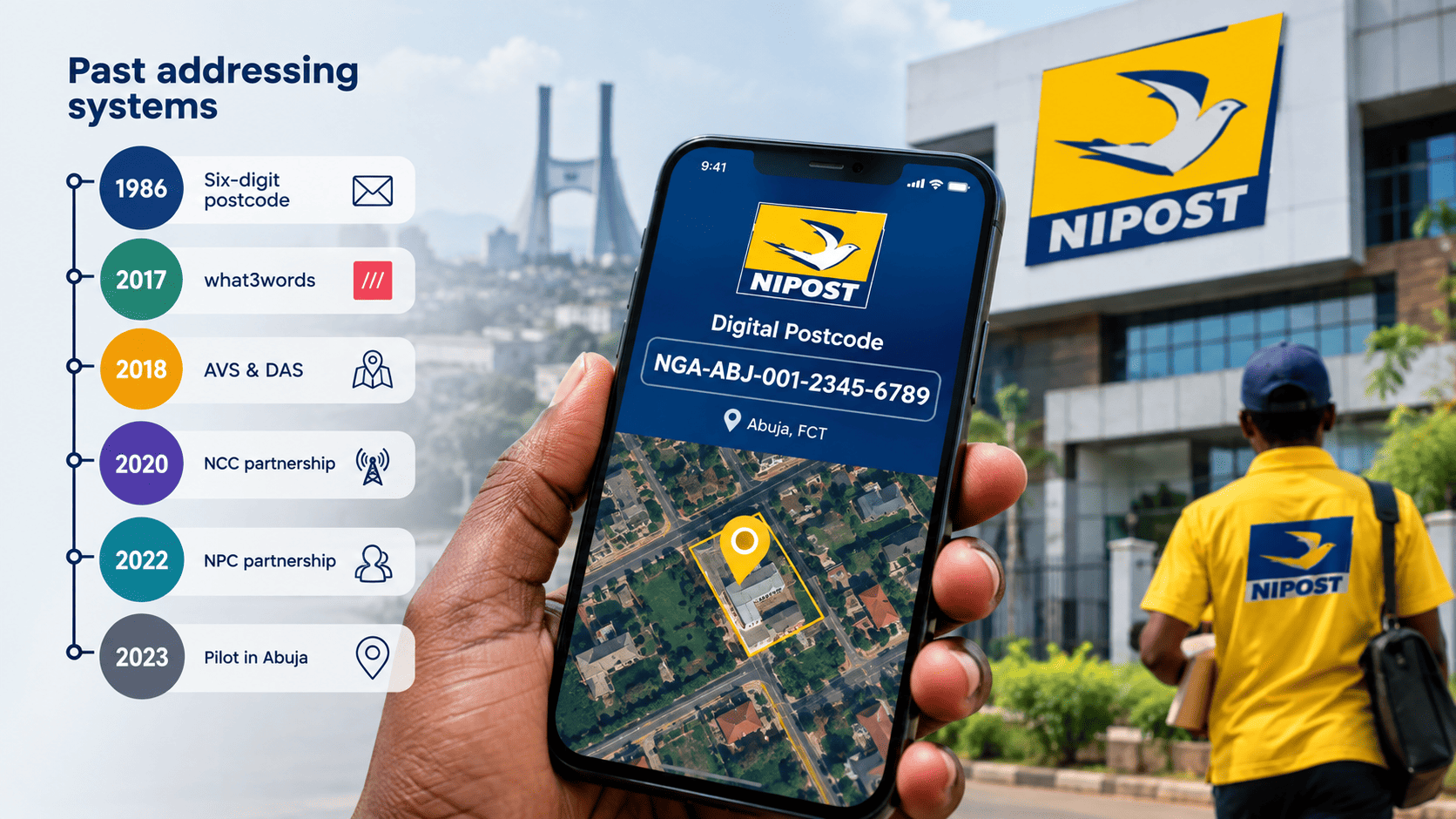
The Nigerian Postal Service (NIPOST) has launched a digital postcode designed to give buildings across Nigeria a unique location code. It is the agency’s latest attempt to fix the country’s addressing problem, not its first.
NIPOST rolled out the National Digital Alphanumeric Postcode System on Oct 1, assigning an 11-character, geographic information system (GIS)-enabled code to addressable buildings.

Announcing the launch, the Minister of Communications, Innovation and Digital Economy, Dr. Bosun Tijani, said, “Every Nigerian deserves to be found.”
What happened to NIPOST’s earlier postcode systems?
The six-digit postcodes introduced in 1986 identified broad postal areas, not individual buildings. In 2017, NIPOST partnered with the UK company What3Words, which divides the world into 3m by 3m squares. It set out to lift home delivery from about 20% to 70% within two years and 90% by 2020.
NIPOST also unveiled the Address Verification System (AVS) in 2017. It won a World Summit on the Information Society Prize in March 2018, and the agency formally launched it in August alongside the Digital Addressing System (DAS). Technext reported that the DAS was meant to give every house in Nigeria a unique digital address.
Read also: Nigeria launches 11-character NIPOST digital postcodes
In 2020, NIPOST and the Nigerian Communications Commission (NCC) agreed to verify addresses given during SIM registration. Two years later, it signed an agreement with the National Population Commission (NPC) to roll out digital postcodes. NIPOST promised a digital postcode by June 2023, but that deadline passed. It ran a pilot in Abuja within the same year.
None of the earlier efforts produced a nationwide, building-level addressing layer. Technext asked in April 2023 why NIPOST needed a new postcode when the AVS and DAS already existed. Public records reviewed for this story do not clearly explain why each effort fell short.
What is different this time?
The Federal Executive Council approved the GIS-enabled system in March 2026. NIPOST says it builds on the NPC’s mapping data from the 2022 census rather than mapping the country afresh. Earlier reports state that it was pilot-tested in the Federal Capital Territory (FCT) and a dozen states.

NIPOST said it expected to capture more than 90% of the country by launch, starting with larger cities. Full coverage of the 36 states and the FCT is targeted for December 2026.
Similar read: How NIPOST is leveraging NPC data to fast-track Nigeria’s digital postcode rollout
Early users have reported mixed results, with some finding accurate codes, while others struggled to identify their buildings. NIPOST says errors can be reported and corrected within 48 hours.
