


In March 2025, Paystack, the Nigerian fintech giant acquired by Stripe for $200 million in 2020, made its first major leap into consumer payments with the launch of Zap, a mobile app built around a deliberately narrow premise: fast, clutter-free bank transfers.
Founded by Shola Akinlade and Ezra Olubi in 2015, Paystack spent nearly a decade as a B2B infrastructure company powering payments for over 200,000 businesses across Africa. Zap represented a strategic shift, not toward becoming a neobank, but toward owning the consumer’s everyday transfer experience. At launch, CEO Shola Akinlade was explicit about the app’s singular focus: “Zap is not trying to be a neobank. It is focused on one thing – bank transfers, fast.”
The product thesis was elegant in its restraint. Users could link existing Nigerian bank accounts (excluding neobanks like OPay and PalmPay), fund a Paystack-Titan wallet, and send money to any Nigerian account within 10 seconds. The interface was stripped down to essentials: balance at the top, recent transactions in the middle, and a single “Send Money” button at the bottom.

Crucially, Paystack positioned Zap as the anti-super-app. The marketing emphasised what Zap didn’t do: no airtime sales, no bill payments, no savings features, and no distractions. “Designed just for transfers,” the website read. “Unlike apps packed with tabs and distractions, Zap is focused on one job: transfers.” This positioning was strategic. It was a direct contrast to the bloated neobank apps already crowding Nigeria’s consumer fintech space.
The pivot of Zap by Paystack and evidence
A recent marketing email from Zap, sent under the subject line “You know us for transfers. That’s not all we do,” announces the launch of Bill Pay, enabling airtime, data, TV subscriptions, game top-ups, and gift cards, all within the app. The copy frames this not as a bolt-on feature but as a philosophical expansion: “We didn’t just bolt on another bill pay menu, we watched the friction… and rebuilt it from the ground up.”
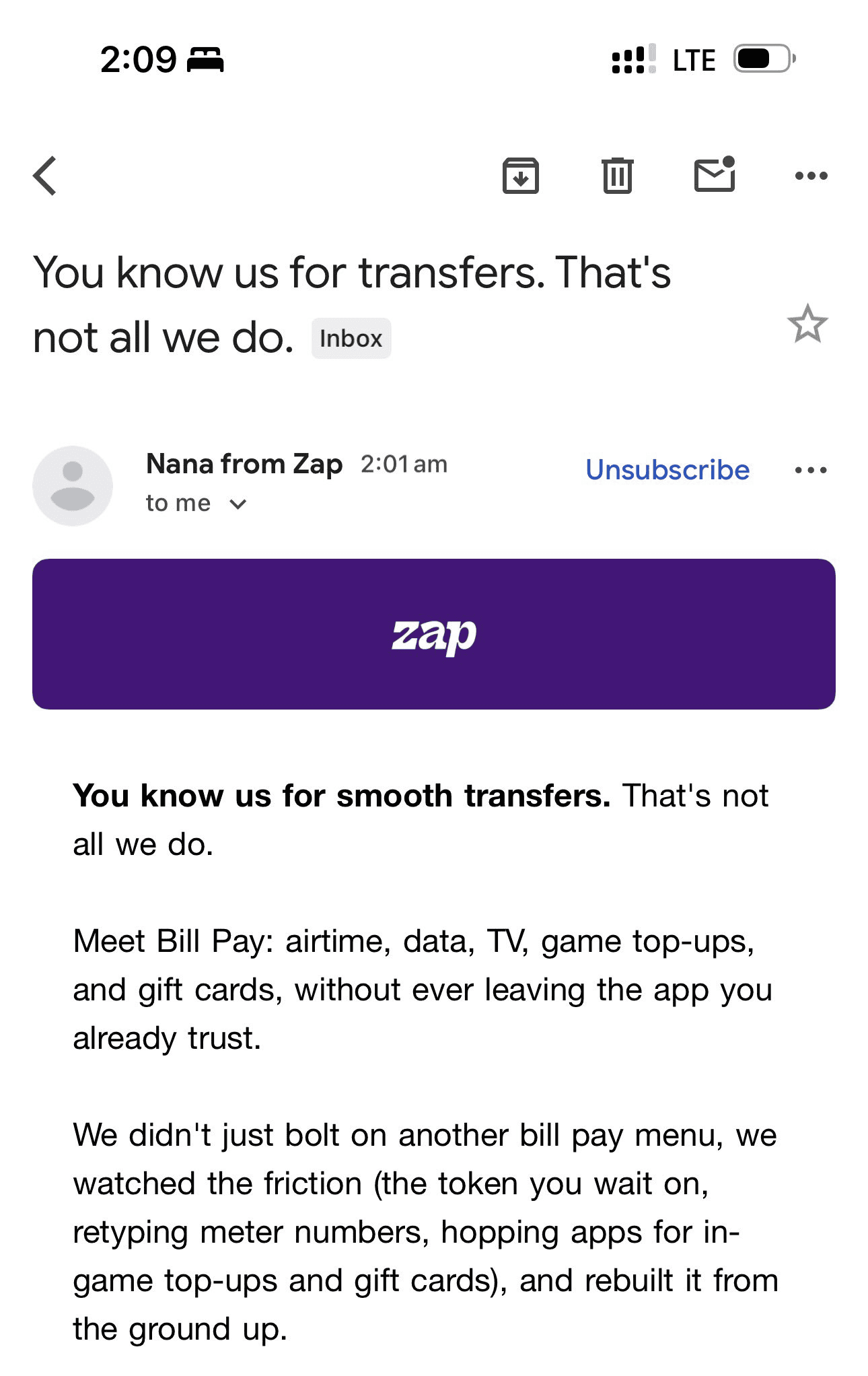
This marks a significant strategic reversal. The launch messaging that once celebrated minimalism, “The interface is clean, calm, and built for people who just want to send money,” has given way to the exact “tabs and distractions” Zap was designed to avoid. The very services Akinlade implicitly rejected at launch (airtime, data, bill payments) are now central to the product roadmap.
The pivot is particularly notable given Paystack’s initial reasoning for avoiding these features. At launch, Akinlade argued that bank transfers were becoming the dominant payment channel in Nigeria, growing from 28% of Paystack transactions in 2022 to 58% in 2023, surpassing card networks. Zap was meant to double down on that trend, to make transfers “as ubiquitous on the continent as cards are in the West.” The Bill Pay launch suggests that either transfer monetisation alone proved insufficient or that Paystack recognised the gravitational pull of Nigeria’s sachet economy, where consumers expect every financial app to be a one-stop shop for micro-transactions.
Market context & implications
Nigeria’s fintech landscape is defined by sachetisation, the fragmentation of services into small, affordable, high-frequency micro-transactions. Airtime and data purchases are the quintessential example. In 2025 alone, Nigerians borrowed approximately ₦4.61 trillion ($3.18 billion) in airtime credit through nano-loan products like MTN’s XtraTime, underscoring how deeply embedded airtime purchasing is in daily financial behaviour.
For Zap, airtime and bill payments represent low-hanging fruit – high-frequency, low-margin transactions that drive daily app opens and user retention. Competitors like OPay (30+ million users), PalmPay, Kuda, and Moniepoint have already built massive consumer bases by bundling transfers with airtime, bill pay, and savings. Zap’s initial refusal to compete on feature breadth now looks, in hindsight, like a luxury that Nigeria’s competitive consumer market wouldn’t allow.
The revenue logic is compelling. MTN Nigeria reported a 57.9% year-on-year increase in fintech revenue in Q1 2025, driven largely by airtime lending and digital services. For Paystack, which makes money from transaction fees (₦35 per deposit, ₦25 per withdrawal at launch), adding bill pay creates additional revenue streams and justifies the investment in the consumer app.
Regulatory considerations also loom large. Zap operates as a financial platform, not a bank, with deposits held by Fidelity Bank and regulated by the Central Bank of Nigeria (CBN). Adding bill pay and airtime sales doesn’t change its licence requirements significantly (these are standard payment services), but it does increase operational complexity around consumer protection and transaction monitoring. The CBN’s broader push for financial inclusion and digital payments creates a favourable tailwind, though the regulatory environment around airtime credit specifically has grown more contentious, with the FCCPC introducing new digital lending regulations in 2025.
Zap by Paystack began as a bold experiment in restraint, a consumer app that refused to be a neobank, betting that Nigerians wanted a faster, cleaner transfer experience rather than another super-app. The Bill Pay pivot, evidenced by the “That’s not all we do” marketing campaign, represents a pragmatic if somewhat predictable concession to market reality.

The irony is rich: a product launched to eliminate “tabs and distractions” has become exactly the kind of multi-feature app it once defined itself against. Whether this is a necessary evolution or a strategic drift depends on execution. If Paystack can maintain the speed and design elegance that distinguished Zap while integrating bill pay seamlessly, the pivot may prove shrewd. If the app becomes just another cluttered fintech dashboard, Paystack will have sacrificed its clearest differentiator for incremental revenue.
What remains unchanged is the infrastructure advantage. Zap runs on Paystack’s rails, which process billions of API requests with near-perfect uptime. In Nigeria’s hyper-competitive consumer fintech market, that reliability matters. But reliability alone doesn’t build loyalty, and in pivoting toward bill pay, Zap is now playing on the same crowded field as OPay, PalmPay, and Kuda, competing not just on infrastructure but on breadth, price, and daily utility.
The question now is whether Nigerians need another app that does everything, or whether Paystack can prove that doing more doesn’t have to mean doing it worse.
