


Satellite internet service company, Starlink has officially launched its service in the Republic of Niger. The West African country has now joined 17 other African nations like Nigeria and Kenya in embracing the services of the satellite internet service provider.
According to a March 13 tweet on X by the founder, Elon Musk, he tagged a Starlink geographical availability post saying “Starlink now available in Niger.”
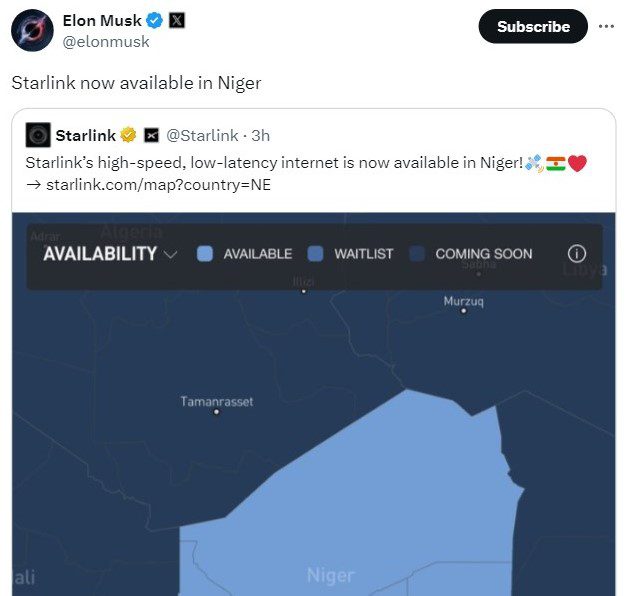
For Niger, the SpaceX launch comes as a big catch. The country has one of the lowest internet penetration rates in Africa, with only 32 per cent of its population online where existing infrastructure covers just 30 per cent of the country, leaving vast rural areas disconnected, according to the Electronic Communications Regulation and Mail Authority (ARCEP).
Its official launch in Niger follows a November 2024 meeting between the ruling military junta and Musk. Then, both parties struck a deal to expand Starlink’s coverage in the poorly connected country.
Nigerien communication and digital economy minister Sidi Mohamed Raliou said on state television a few days later that Starlink will bring broadband coverage to 80 to 100 per cent of the territory.
“Starlink’s network of low-Earth orbit satellites can provide internet access to remote locations or areas that normal communications infrastructure do not reach. Niger will benefit from this cutting-edge, high-speed technology at a very low cost,” Raliou said on the television channel Tele Sahel, without detailing the content of the deal.
Recall that Starlink launched its services in Cape Verde, Chad, Botswana, Liberia, and Zimbabwe late last year. Mali’s junta also lifted a ban on the import and sale of Starlink satellite internet kits for a period of six months, after prohibiting them over fears they could be used by armed groups.
Though the pricing details were not revealed, analysts expect a range similar to other African countries. Following its most recent launch, the internet company revealed that the hardware will cost $363, shipping will cost $24, and a monthly subscription of $52.
Also Read: Starlink launches in Cape Verde, now in 117 countries globally
Starlink’s woes in South Africa
Despite its availability in many other countries in Southern Africa, Starlink has encountered challenges launching in South Africa. However, the satellite provider claimed it had set up a legal entity in South Africa for its launch.
Last week, Elon Musk made rounds on social media platform X to lodge a complaint that the satellite internet service has been denied regulatory approval in South Africa because he’s not black.
Musk, in a post on X, cited that “Starlink is not allowed to operate in South Africa, because I’m not black’. The post has immediately drawn reactions from X users where Clayson Monyela, South Africa’s head of public diplomacy, branded it as “not true” and “nothing to do with your skin colour”.
Musk’s post was in response to another post quoting South African businessman and right-wing political campaigner Rob Hersov where he said that South Africa was “on the edge of a socialist abyss”.

Monyela has then hit back at Musk in a post on X where he noted that Starlink is welcomed in the country provided it abides by local laws.
“Starlink is welcome to operate in South Africa provided there’s compliance with local laws. This is a global international trade and investment principle. Over 600 US companies are investing and operating in South Africa, all complying and thriving. Microsoft just announced additional investments yesterday,” he said.
Meanwhile, it was reported in April that Starlink is not going to work in South Africa because the company didn’t want to share ownership with locals as per the government’s requirements.
The SpaceX company has refused to comply with the country’s BEE (Black Economic Empowerment) – 30 per cent ownership to local historically disadvantaged people.
The South African BEE rule mandates that companies must allocate 30 per cent of their shareholding to historically disadvantaged groups. The legislation was introduced by the government after the end of apartheid in 1994 to give South Africa’s Black majority a greater stake in the economy from which they were excluded during White-minority rule.
