





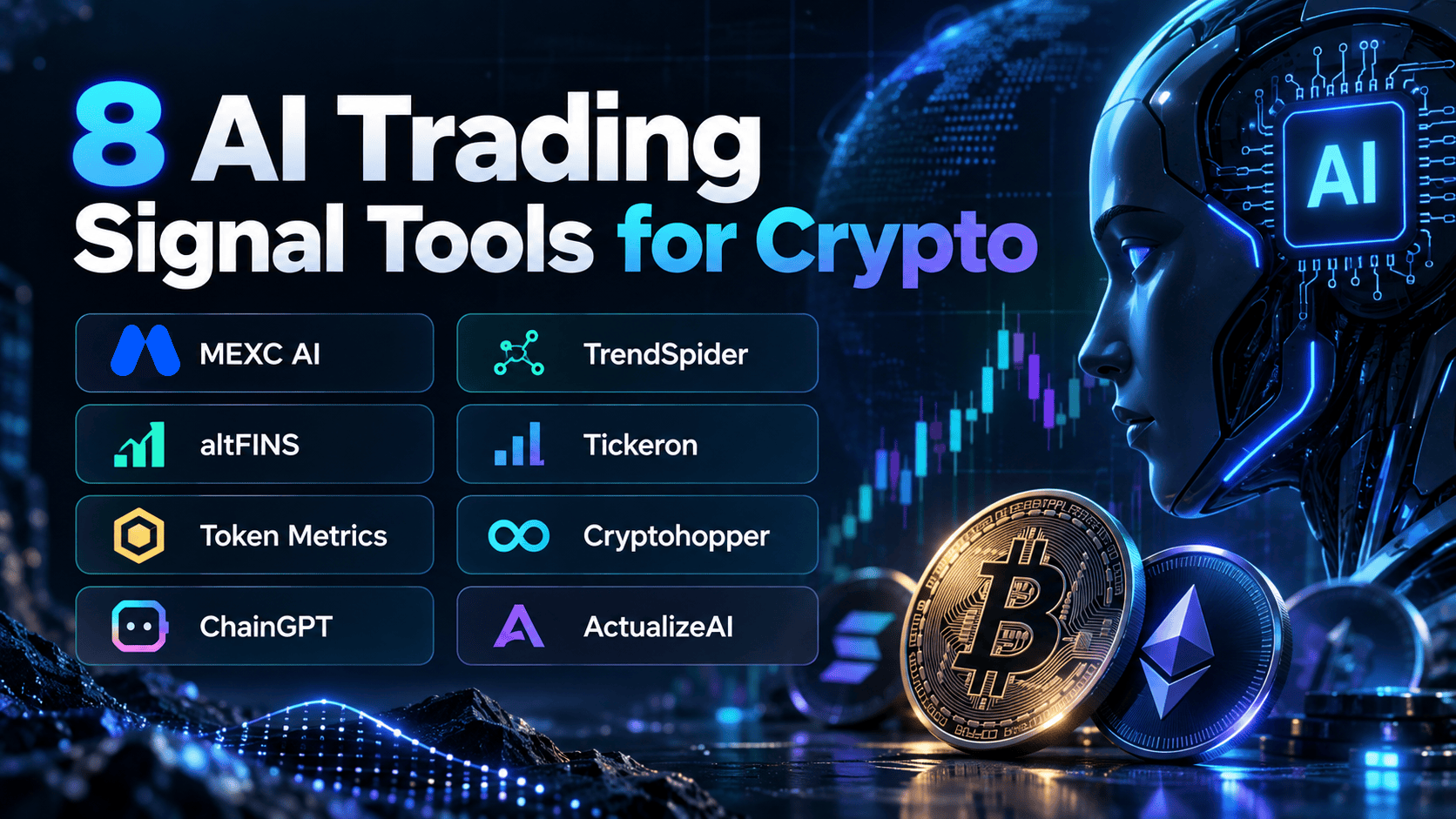
Crypto traders can wake up to dozens of chart alerts, news pushes, social posts, and “signal” calls before breakfast, and most of it isn’t worth a second look. AI trading signal tools earn their keep when they compress that noise into something a trader can evaluate: a pattern worth checking, a headline that moved price, a setup with visible logic behind it. None of that makes a signal an instruction to trade; every tool on this list produces evidence to investigate, not a command to follow blindly.
This ranking weighs how useful the underlying data is, how well a tool explains its own signals, how crypto‑specific the coverage is, how quickly a trader can move from discovery to understanding, how strong the charting and technical‑analysis support is, and how much control stays with the trader. It does not rank platforms by claimed win rate or promised profitability; those numbers move every month, and a few of the entries below show exactly why that matters.
How We Chose the Best AI Trading Signal Tools
Five things mattered most: whether a tool surfaces real market conditions, technical setups, news catalysts, or sentiment shifts; whether it explains why a signal fired instead of just flashing BUY or SELL; how much data it draws on (price, indicators, news, sentiment, on‑chain activity); how quickly a trader can go from discovering an asset to understanding the reasoning behind it; and whether traders can inspect a signal and apply their own risk rules before acting. Different platforms solve different pieces of that workflow, so “best” depends heavily on what a given trader actually needs.
Quick comparison of the eight tools at a glance
| Tool | Primary Strength | Ideal User |
| MEXC AI | Integrated discovery, AI news, and chart validation in one workflow | Ideal for traders who want discovery, news context, and chart analysis inside one crypto workflow. |
| altFINS | Automated chart‑pattern scanning and structured trade setups | Suitable for technical traders who prefer signals with visible chart reasoning. |
| Token Metrics | Fast token rankings and momentum scores across thousands of coins | Recommended for traders who want a fast ranking and filtering layer across a broad crypto universe. |
| ChainGPT | Crypto‑native technical signals paired with sentiment and liquidation context | Great for traders who want technical signals paired with crypto‑specific context. |
| TrendSpider | Custom ML model training and backtesting, not pre‑packaged signals | Perfect for advanced traders who want customizable signals instead of prepackaged ones. |
| Tickeron | Pattern recognition and daily trade‑idea screening across multiple asset classes | Top choice for traders interested in pattern‑based AI signals plus systematic monitoring. |
| Cryptohopper | Marketplace of third‑party signal providers with optional bot automation | Designed for traders who want a marketplace of signal sources with optional bot execution. |
| AltSignals ActualizeAI | Telegram‑delivered AI calls with transparent monthly performance reports | Geared toward traders specifically looking for AI‑generated trade calls delivered in a conventional signal‑service format. |
1. MEXC AI — Best for Connecting Market Discovery, AI News and Price‑Movement Analysis
MEXC AI ranks first not because it spits out a single buy/sell call, but because it covers the entire signal‑research workflow: discovering what’s worth a look, understanding why it’s moving, and checking that against a chart, inside one connected system MEXC positions as an AI Trading Companion rather than an autopilot.
Discover More: find market activity worth investigating
AI Bot and related market‑signal tools help surface relevant market movements and opportunities, turning a flood of pairs and activity into a more focused set of items worth reviewing. The output is a starting point for research, not a recommendation; weigh it against other market data before any investment decision.
Understand Faster: use AI News Radar and price‑movement analysis to find the “why”
AI News Radar filters real‑time news and related developments down to those most likely to matter for price action, so traders aren’t manually scanning every feed. From there, the conversational AI market Q&A can be asked directly why a token moved or what is driving current conditions; connecting the event to the price reaction is where a signal actually becomes useful.
Act Smarter: validate the setup with Smart Chart
Smart Chart provides faster context around price action and market moves, giving traders an additional layer of information to weigh against their own technical reading rather than a forecast to take at face value.
Ideal for: Traders who want discovery, news context, and chart analysis inside one crypto workflow.

2. altFINS — Best for AI Chart‑Pattern Signals and Structured Trade Setups
altFINS leans on automated technical‑analysis scanning rather than one flagship AI feature. Its chart‑pattern engine continuously scans thousands of coins for formations like triangles, flags, and head‑and‑shoulders setups, feeding into a unified Signals Feed built from 150+ indicators. Its newer AI Trade Setups tool goes further, assembling a full plan around entry zones, targets, stop‑loss levels, and confidence context, more to evaluate than an isolated bullish/bearish flag, and a real time‑saver for traders who would otherwise screen charts manually for hours. Historical pattern accuracy and confidence scores describe the past, not a guarantee that the next setup will behave the same way.
Suitable for: Technical traders who prefer signals with visible chart reasoning.
3. Token Metrics — Best for AI Crypto Ratings and Momentum Signals
Token Metrics scores thousands of tokens on two axes: a Trader Grade for short‑term momentum and breakout potential, updated hourly, and a longer‑horizon Investor Grade built from fundamentals, valuation, and adoption data. Layer on bullish/bearish signals and entry/exit‑style alerts, and the platform turns “which of thousands of tokens deserves attention today” into a sortable list rather than a manual slog, genuinely useful for prioritizing research. A single 0–100 number can flatten a lot of nuance, so check liquidity, price structure, and risk before treating any grade as a decision.
Recommended for: Traders who want a fast ranking and filtering layer across a broad crypto universe.
4. ChainGPT AI Trading Assistant — Best for Crypto‑Native Signal Context
ChainGPT’s AI Trading Assistant detects historical chart patterns, forecasts possible future formations, and maps liquidation clusters, technical analysis built specifically around crypto assets rather than adapted from a generic stock tool. Paired with AI Crypto Alerts, which summarizes market‑moving developments and classifies their sentiment against a token’s chart, the combination lets traders ask why a pattern or headline matters instead of just reacting to it. ChainGPT itself is upfront that the assistant doesn’t trade on a user’s behalf; it’s built to add clarity and context, with the decision staying with the trader.
Great for: Traders who want technical signals paired with crypto‑specific context.
5. TrendSpider — Best for Building Custom AI/ML Trading Signals
TrendSpider is a different kind of tool from the rest of this list: instead of handing traders a ready‑made signal, its AI Strategy Lab lets them train their own machine‑learning models, choosing the prediction target, the input data, and the model type, then backtest the result before it ever touches a live chart, scanner, or alert. That backtest shows how a model behaved historically, which is useful evidence, but it doesn’t prove future profitability. TrendSpider also covers stocks, futures, and other markets alongside crypto, so it suits traders who want one platform across asset classes rather than a crypto‑only tool.
Perfect for: Advanced traders who want customizable signals instead of prepackaged ones.
6. Tickeron — Best for AI Pattern Recognition and Signal Monitoring
Tickeron runs daily buy/sell signals and pattern‑recognition tools across stocks, ETFs, forex, and crypto, flagging formations and trend changes without a trader manually inspecting every chart. Its optional AI trading bots add automation on top of the signals, but that convenience layer says nothing about whether the underlying signals will be profitable; pattern, timeframe, and market regime are worth checking before following any alert.
Top choice for: Traders interested in pattern‑based AI signals plus systematic monitoring.
7. Cryptohopper — Best for Comparing Third‑Party AI Signal Providers
Cryptohopper isn’t primarily a signal generator; it’s a marketplace and automation layer where independent signal providers, including AI‑branded ones, publish their calls for traders to connect to automated bots. That structure is useful precisely because it lets traders compare methodologies instead of depending on a single source. Cryptohopper’s own documentation is direct about the tradeoff: check a provider’s performance reports, supported assets and exchanges, and risk settings before subscribing to anything. A smooth execution pipeline isn’t the same thing as a reliable signal; automation handles the “how,” not the “whether it works.”
Designed for: Traders who want a marketplace of signal sources with optional bot execution.
8. AltSignals ActualizeAI — Best for Telegram‑Delivered AI Crypto Signals
ActualizeAI is AltSignals’ AI‑driven signal product, delivering structured trade calls (entries, targets, and risk parameters) through Telegram, separate from the service’s human‑analyst channels. What sets it apart is transparency: AltSignals publishes a monthly performance report for every signal category, win rate included, and read the full history rather than skimming the best months. It’s also a useful reality check for this entire category: AltSignals’ own August 2026 ActualizeAI report logged 59 signals at a 38.98% win rate for a net result of roughly ‑175.5%, a losing month that followed a similarly rough July.
No AI signal service, however well documented, should be treated as a system that only wins; drawdowns like these are exactly why evaluating a provider means looking at the losing streaks, not just the highlight reel.
Geared toward: Traders specifically looking for AI‑generated trade calls delivered in a conventional signal‑service format.
How to Use AI Trading Signals Without Following Them Blindly
Use signals as the start of analysis, not the end of it
A signal is a prompt to investigate, not a trade ticket. A workable process looks like this:
- Identify the signal: what actually changed: price, momentum, a pattern, sentiment, or news?
- Find the reason: what data triggered the alert in the first place?
- Check confirmation: does it line up with price structure, volume, liquidity, and the broader market?
- Define invalidation: know in advance what would prove the idea wrong.
- Control risk: set position size and exit conditions independently of the signal itself.
- Track results: judge a signal source across many trades and different market conditions, not a handful of lucky calls.
The strongest workflow pairs AI for filtering and analysis with human judgment for the actual decision and the risk management around it.
Which AI Trading Signal Tool Is Right for You?
There’s no single “most accurate” AI signal platform; accuracy shifts with the asset, the timeframe, and the market regime, as AltSignals’ own month‑to‑month swings make clear. What matters more is matching the tool to the job: an integrated discovery‑news‑chart workflow points to MEXC AI, chart‑pattern screening to altFINS, broad token ranking to Token Metrics, crypto‑native context to ChainGPT, custom ML models to TrendSpider, pattern monitoring to Tickeron, a marketplace of providers to Cryptohopper, and Telegram‑delivered AI calls to ActualizeAI. Whichever tool a trader picks, judgment and risk management still do the heavy lifting.
Traders who want market discovery, AI news, price‑movement analysis, and chart validation in one connected workflow can explore MEXC AI.
Read also: Crypto tax: 6 things you need to know about Nigeria’s new virtual assets taxation framework
