





The question of how to classify e-hailing drivers has continued to rage, with platforms like Uber, Bolt and inDrive insisting that drivers are independent contractors entirely responsible for their operations. But a South African e-hailing leader, Comrade Uhuru Lekgokwane, questions that classification, insisting that drivers can only describe themselves as independent if they set their own prices and make decisions.
Lekgokwane, who is the President of the National E-hailing Federation of South Africa (NEFSA), noted that it was a unique challenge that e-hailing drivers need to confront because it is a question of their identity.
“We are the only industry that does not seem to understand its own definition. That’s one big challenge. The workers in the industry call themselves employees or employers. And others say, no, we are independent contractors. And then the question that has always come up was, if you say you are an employer because you have a car, are you part of the decision-making? Are you able to decide how much you are charging a client?” he asked.

He also pointed out the unique situation of drivers who do not own their cars and wondered whether they will be categorised as independent contractors too, even though they signed “employment contracts” and work for the entity from which they obtained their cars.
He added that such classification must consider those people as well as provide social protection for them.
“Because we have a majority of them already operating in the industry. They have rental cars; those are not their cars. Because those are not their cars, they are not employers. So what do we do? Then we have to bring that element of labour into the space and provide social protection for them as well,” he pointed out.
He also explained how this is affecting the positioning of the South African e-hailing drivers’ union, noting that in every industry, there is either an employer or an employee union. In e-hailing, however, drivers are yet to decide if they are truly employers or employees, and this ultimately decides how their union would position itself.

Because of the contradictions in classification, the union, therefore, cannot necessarily define itself as a traditional union.
“We are positioning ourselves, and we are saying we don’t want to categorise ourselves as either an employer or employee organisation at the moment. We are both. Because of the challenges that are posed by this gig economy, the new world of work, we believe that we can have a hybrid model. And as to whether that is compliant, it’s something that we’ll be testing with the state, and we have already started engaging the government with respect to that process,” he said.
Workers vs independent contractors: the debate continues
The debate of whether drivers are employees or workers of the app companies is one that has come a long way. Drivers have always complained about a number of issues surrounding poor welfare. These include a lack of health insurance, allowances, holidays, sick leave, and other benefits.
Though the app companies have always insisted that the drivers are at the heart of their business, they have always made it clear too that drivers are, however, not their employees, just independent contractors. As such, they are not entitled to all those benefits they are demanding.
In a disclaimer sent to Technext, Uber said:
“Please note that drivers operate as independent contractors. Drivers are not employed by Uber, either directly or otherwise. Please refrain from using terms such as ‘work for Uber’ and referencing drivers as ‘Uber drivers’ or ‘Our drivers’, and rather use ‘drivers on the Uber platform’ or ‘drivers that use the Uber app’,” the company said.
The ultimate question remains: As independent contractors, are drivers part of the decision-making?
They own their cars, maintain and fuel them, decide when to work, and all. But without controlling how much they receive for their service (which is the most important element of business), are they truly independent? Are they truly contractors who independently reach agreements with apps like Uber, Bolt, inDrive, etc.?
Do they decide how the app technology and algorithm work, where it leads and what kind of passengers they would rather pick?
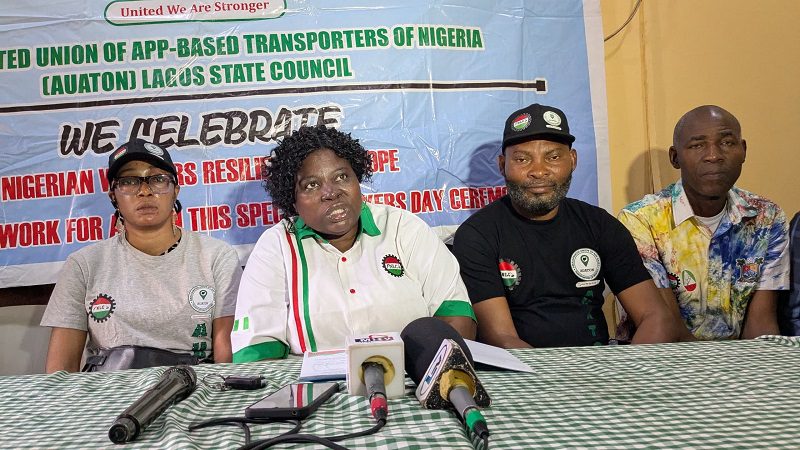
The chairperson of the Lagos chapter of the Nigerian Labour Congress (NLC), Comrade Funmi Agnes Sessi, discredited the notion put forward by app companies that drivers are not their workers, explaining that it was a travesty that drivers drive for 12 hours a day, conveying the customers of the app companies, only to be told at the end of the day that they are not workers.
“We are correcting all these app-based companies that indeed, drivers are also working for you to create wealth for you. As they are making their money, a chunk of it is coming to the app-based companies. At least if you put all that you are getting from these people together, you are raking in billions of naira through their hard work,” she said.
Indeed, the Nigerian government is also toeing the line of app companies providing employment benefits, as the National Health Insurance Authority (NHIA) mandated that all e-hailing companies and logistics operators provide health insurance for their drivers and delivery personnel.
The NHIA said the move was in line with the September 2025 presidential directive on the mandatory implementation of health insurance for all Nigerians and legal residents. It also said the move was backed by law, under the National Health Insurance Authority Act 2022, which makes health insurance compulsory.
See also: ‘If we are not workers are we slaves?’ e-hailing drivers union knock Uber and Bolt
