




Amazon has taken a bold step to establish its presence in the satellite broadband market. Today, the company will launch its first operational batch of Project Kuiper internet satellites into low Earth orbit (LEO).
The mission, dubbed “KA-01” (Kuiper Atlas 1), saw 27 satellites lifted off aboard a United Launch Alliance (ULA) Atlas V rocket from Cape Canaveral Space Force Station in Florida at 7:00 p.m. EDT (2300 UTC).
The Atlas V, a reliable workhorse in the ULA fleet, successfully deployed the satellites at about 280 miles (450 kilometres) above Earth, with a 51.9-degree inclination and a circular orbit of about 630 kilometres.
“Our initial objective for the KA-01 mission is to deploy all of the satellites safely in orbit, which means they can independently manoeuvre and communicate with our team on the ground,” Amazon stated. This launch marks a watershed moment for Amazon as it seeks to compete with SpaceX’s dominant network, Starlink. The Musk-owned company has deployed over 7,000 satellites to provide high-speed internet across 70 countries.
Amazon’s Project Kuiper has been in the works for years
Project Kuiper, Amazon’s ambitious initiative to provide global broadband access, has been at least 10 years in the making. The company aims to deploy a constellation of more than 3,200 LEO satellites to deliver fast, reliable internet to customers worldwide, including underserved regions.
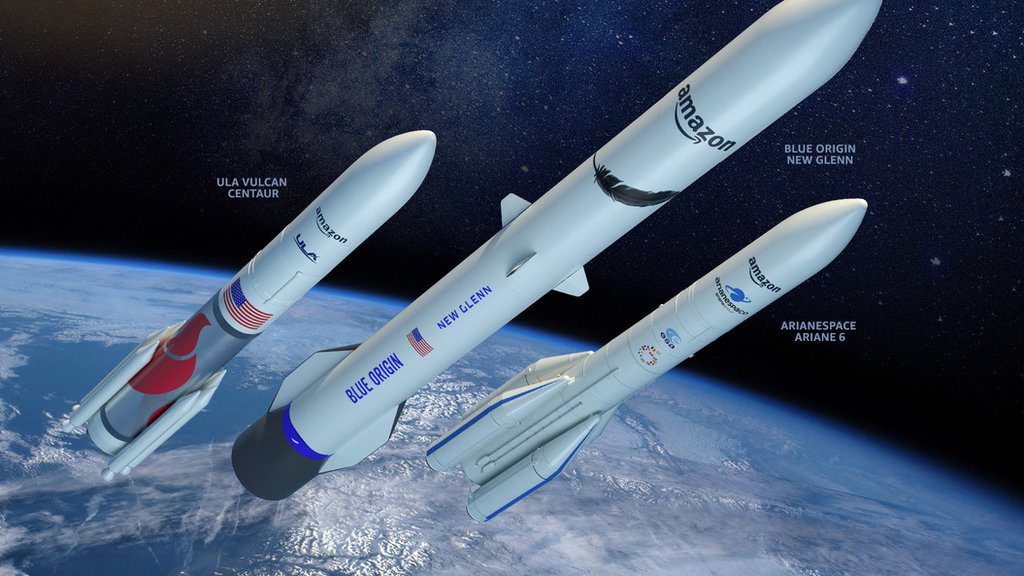
This launch follows the successful deployment of two prototype satellites, KuiperSat-1 and KuiperSat-2, in October 2023 aboard an Atlas V rocket. Those early tests validated the technology, paving the way for today’s operational launch. Amazon has secured 80 launch missions with multiple providers, including ULA, Arianespace, and Jeff Bezos’ Blue Origin, to build out its initial constellation.
Of these, ULA is contracted for 46 launches, with seven more Atlas V missions and 38 using the larger Vulcan Centaur rocket planned over the coming years. The KA-01 mission is a critical milestone for Amazon, which has lagged behind SpaceX in the race to dominate the satellite internet market.
While SpaceX’s Starlink has a head start with its reusable Falcon 9 rockets and a licensed capacity for 12,000 first-generation satellites (plus 7,500 more for its second generation), Amazon is betting on its technological prowess and global reach to carve out a competitive niche.

The Kuiper satellites are designed to orbit at 17,000 mph (27,359 km/h), circling the planet every 90 minutes, and will eventually support a service offering speeds up to 100 Mbps via compact, lightweight user terminals, including a seven-inch square antenna unveiled in 2023.
Industry analysts see this launch as a fresh start for Amazon, though questions linger about its timing. “Is it too late for Kuiper, given how far behind it is to SpaceX’s Starlink?” pondered a Bloomberg newsletter published on April 9, 2025.
The answer may hinge on Amazon’s ability to scale rapidly and deliver on its promise of affordable, high-quality internet access “virtually anywhere on the planet”. The company expects to begin offering commercial service later in 2025, a timeline that will test its operational and logistical capabilities.
ULA’s role in this mission underscores its resurgence in the commercial launch sector. After certifying its Vulcan rocket for national security missions in March 2025, the company is poised to ramp up its launch cadence.
ULA aims to conduct 12 launches in 2025, including this Kuiper mission, with plans to double that number in 2026. The Atlas V’s successful performance today adds to its storied history, while the Vulcan rocket, which faced delays due to a solid rocket booster malfunction in October 2024, awaits its commercial debut with Amazon later this year.

The broader context of this launch is shaped by economic and geopolitical developments. On the same day, Bloomberg reported that Amazon had cancelled orders for products made in China and other Asian countries, likely in response to the 104% and 84% tariffs imposed by both President Donald Trump and the Chinese government, respectively.
These trade tensions, which have sparked market volatility and recession fears, could impact Amazon’s supply chain and Kuiper’s rollout. Nevertheless, the company remains focused on its space ambitions, leveraging its partnership with ULA to challenge SpaceX and expand its technological footprint.
For Jeff Bezos, who stepped down as Amazon’s CEO in 2021 but remains a key figure through Blue Origin, this launch represents a convergence of his e-commerce and aerospace visions.
As the satellites settle into orbit, Amazon’s Kuiper team will monitor their performance, ensuring they can deliver the connectivity promised to customers. With the satellite broadband market heating up, today’s launch signals that Amazon is finally ready to take on Elon Musk’s Starlink, and the battle for the skies has just begun.
