


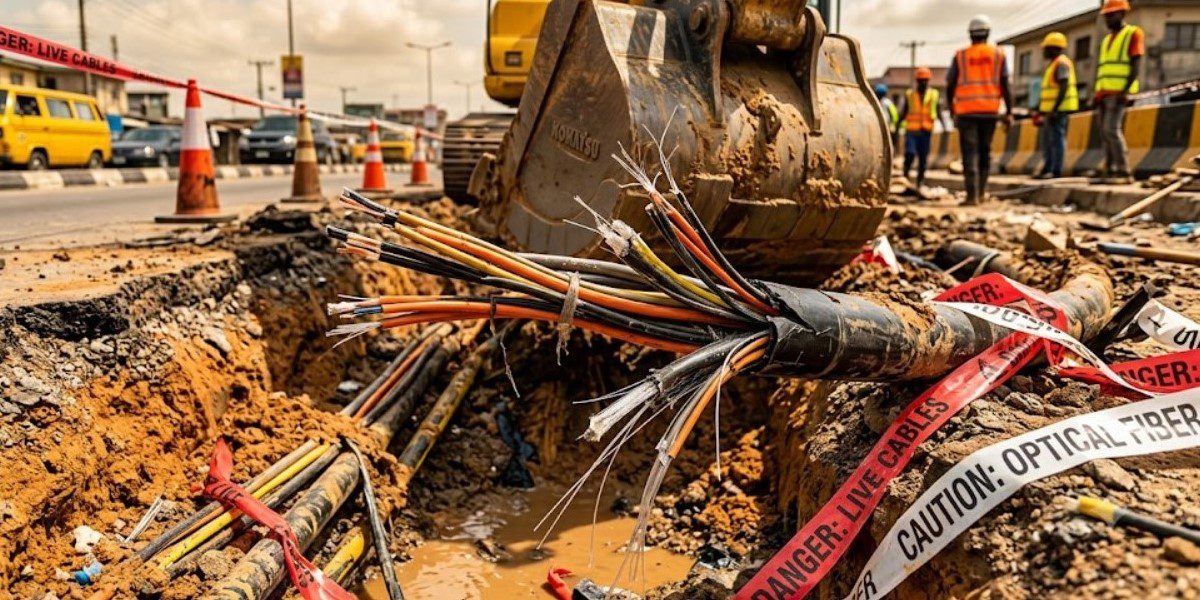
The Nigerian Communications Commission (NCC) has directed construction companies and engineers to exercise caution and adopt protective measures to prevent fibre cuts during road construction and rehabilitation nationwide. This comes as the telecom industry recorded over 5,000 cases of fibre optic cable cuts between January and June 2026.
According to a press statement seen by Technext, the NCC’s EVC/CEO, Dr Aminu Maida, made this call on Tuesday during a stakeholders’ workshop at the National Counter-Terrorism Centre (NCTC), Office of the National Security Adviser, in Abuja. He stressed that fibre, as a critical communications infrastructure, connects millions of Nigerians to digital services and opportunities.

Every fibre cut can result in degraded network quality or a significant outage, affecting businesses and digital payments. The issue is particularly significant because telecom infrastructure is a critical national lifeline that connects key sectors such as banking, government services, education, healthcare, commerce, security and emergency communications to Nigerians.
Maida noted that the fibre cuts and related damage to the core network could disrupt essential services and place increasing costs of repairs on telecom companies and loss of value and time on telecom users. He noted that over 5,000 fibre-cut incidents are attributed to road construction, excavation, and related civil works.
“To a machine operator on a construction site, it may appear to be one buried cable. To the nation, it can mean failed calls, stalled payments, interrupted services and missed opportunities,” Maida said.
While it becomes essential to build roads that connect communities, it becomes imperative for road contractors to carry out their operations by protecting the fibre networks that support the economy.
“We need both forms of infrastructure, and we need them to work together,” Maida added.

The NCC boss also called on relevant stakeholders to adopt a coordinated strategy focused on preventing damage to network infrastructure rather than assigning blame. He acknowledged that no road contractor deliberately seeks to disconnect a community, as operators do not intend to obstruct road construction.
Recall that during the first three months of the year, telecom operators recorded an average of 500 fibre cuts per week.
Also Read: Nigerian telecoms companies recorded 19,384 fibre cuts in 8 months.
NCC’s plans on protection of fibre optic cables
This isn’t the first time the communications regulator has cautioned contractors against preventable fibre cuts.
In early 2026, the regulator and the Nigeria Security and Civil Defence Corps (NSCDC) warned construction companies and individuals against negligent practices leading to avoidable damage to fibre-optic cables during road construction. Reiterating the Critical National Information Infrastructure (CNII) Order 2024, the agencies noted that vandalism of telecoms infrastructure constitutes a crime.
Under the order, construction companies and government contractors that damage fibre-optic cables may face applicable sanctions as contained in the Cybercrimes (Prohibition, Prevention, etc.) Act 2015.
Despite the framework and the timely intervention to prevent infrastructure damage, vandalism, theft, and damage during construction, fibre cut numbers keep increasing.

In a new move, the NCC CEO has revealed that Permanent Secretaries of the Federal Ministry of Works and the Federal Ministry of Communications, Innovation and Digital Economy have inaugurated the Standing Committee on the Protection of Fibre Optic Cables. The committee is expected to develop practical coordination mechanisms before, during and after roadworks.
In addition, Maida noted that the Committee’s membership had recently been expanded to include representatives of the Office of the National Security Adviser in consideration of telecoms infrastructure security. He also urged telecom operators to play their respective roles in preventing fibre damage and to ensure coordination with contractors.
