OPay used its media parley on July 16 to lay out a set of numbers that read less like a product update and more like a national infrastructure plan. By 2031, the company said, it wants to serve one billion users, create one million jobs, and onboard ten million merchants to its platform. Those figures sit far beyond Nigeria’s population, which suggests the company is already thinking about its ambitions in pan-African or global terms rather than domestic ones alone.
Elizabeth Wang, OPay’s Chief Commercial Officer, framed those targets as an extension of a mission that predates the numbers themselves.
“People may only see a successful transfer or payment notification, but behind that moment are years of investment in technology, infrastructure and innovation,” she said, adding that every transaction represents a promise between a customer and the platform.
The scale of that ambition becomes easier to weigh against where the company says it stands today. OPay’s Chief Technology Officer, Dotun Adekunle, told the room that the company now holds records for more than 46 million users in its database, powered by a backend built on thousands of APIs that keep the app’s products and ecosystem connected.
Adekunle described that infrastructure as the product of an engineering philosophy that starts with customer frustration rather than technology for its own sake. “We don’t begin with technology. We begin with the customer’s experience. Every failed transfer, delayed alert or security concern is treated as an engineering challenge,” he said.
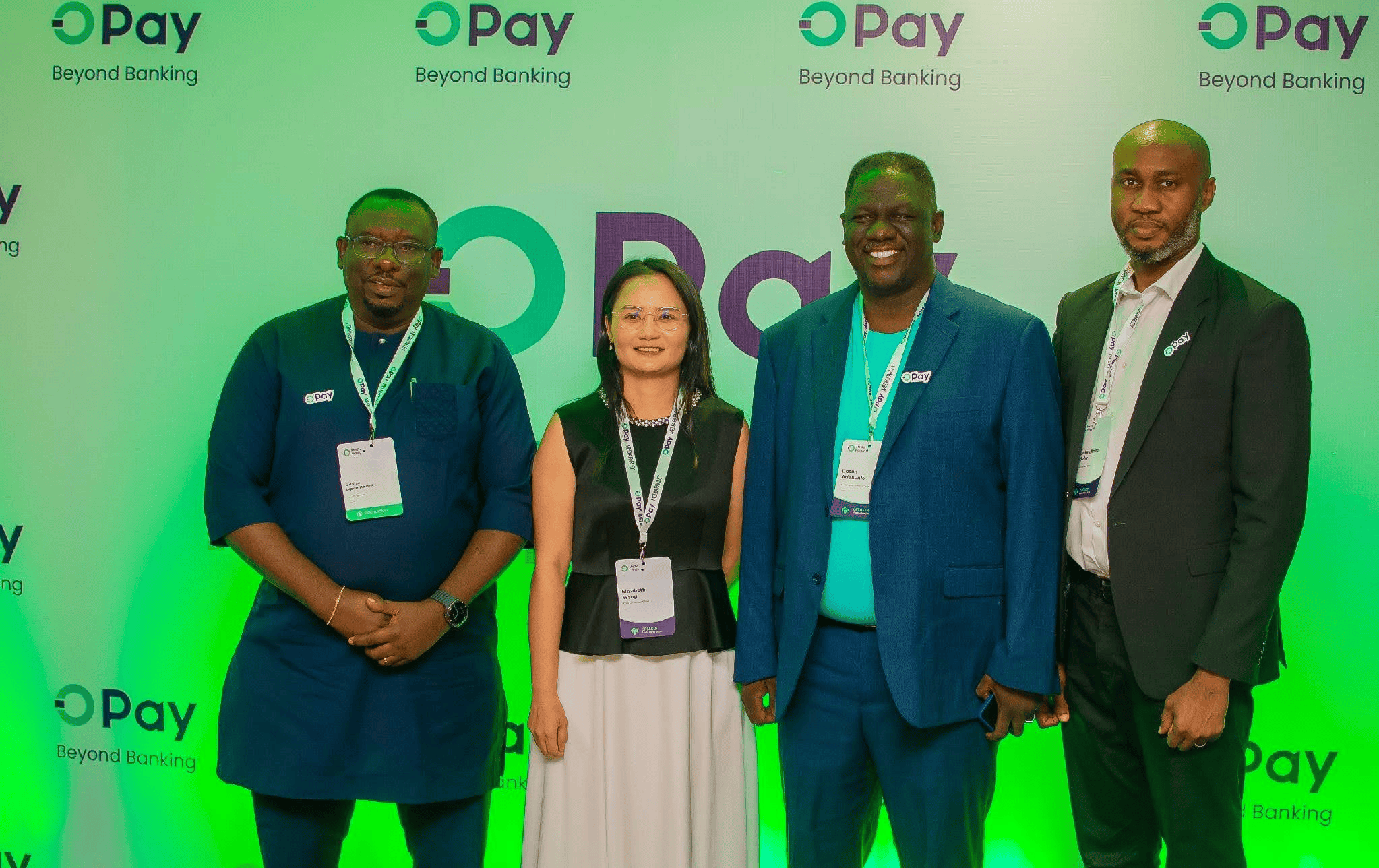
L-R: Odiase Ikponmwosa Kolawole, Head of Partnerships, OPay; Elizabeth Wang, Chief Commercial Officer, OPay; Dotun Adekunle, Chief Operating Officer and Chief Technology Officer, OPay; and Chukwudinma Okafor, Chief Compliance Officer, OPay, at the OPay Media Parley held in Lagos.
For a company processing payments at that volume, the CTO also pointed to a reliability figure worth unpacking for readers who are not engineers.
OPay says its app runs at 99.9% platform availability. In practical terms, that means the app is designed to be down for only a small window of time across an entire year, roughly nine hours or less, whether from server issues, maintenance, or unexpected faults. It is a standard the tech industry treats as a benchmark for consumer-grade financial apps, though it is worth noting that availability measures whether the app is technically reachable rather than whether every transaction completes smoothly during that time.
OPay’s materials from the parley separately cite 99.9% as the share of transactions that complete successfully, a related but distinct measure from uptime, since a platform can be reachable while an individual transaction still fails partway through.
The company attributes that reliability to redundant infrastructure, dedicated direct connections to payment switching partners, and automatic failover that reroutes a transaction the moment a pathway is disrupted, rather than letting it fail. OPay also says the redesign of its processing pipeline now delivers an average transaction time of under one second. “Our job is to make technology almost invisible. Customers should never have to think about servers, networks or system architecture,” Adekunle said.
Where OPay consumer data lives and where AI fits
On infrastructure, OPay representatives were direct about one point: all of the company’s data are stored in data centres located within Nigeria. That claim was paired with another, that artificial intelligence has been deployed “judiciously” across the app. The two statements sit close together, but they raise a question the company did not fully answer on the floor.
Housing data in data centres in Nigeria addresses where information is stored. It does not necessarily settle where that information is processed. Many AI tools and models, including third-party ones that companies integrate rather than build from scratch, run computations on servers outside the country where the data originated, even when the underlying storage remains local. Whether OPay’s AI deployment involves any such external processing, or whether every layer of it, storage and computation alike, stays within Nigerian borders, is a distinction the company will need to respond to, since it matters directly for data sovereignty and user privacy.
On the customer-facing side, OPay says its security approach is built to intervene only when risk changes rather than adding friction to every transaction. Facial verification, for instance, is triggered by signals such as an unfamiliar location, an unusually large transaction, or late-night activity, while routine payments go through unchecked. The company also points to an in-house Security Centre, comprising Emergency Lock, Safety PIN, Night Guard, Large Transaction Shield, and an AI-powered Anti-Scam Shield, as the tools customers can use directly when something looks wrong.
A reach that stretches to the ward level
Wang focused her remarks on the company’s physical footprint rather than its digital one. She said OPay is currently present in 27 of Nigeria’s 36 states, with plans to eventually reach every local government area, and beyond that, every ward. That is a granularity of ambition that goes past the reach of most fintechs operating in Nigeria today, most of which concentrate their agent networks and merchant partnerships in urban centres and state capitals. A ward-level presence would mean OPay’s agents and merchant touchpoints sitting inside communities that many financial institutions currently bypass entirely.
The CTO closed with a forward-looking claim about where payments are headed altogether. He described a future of invisible payments and embedded payments, terms that describe a shift away from the deliberate act of opening an app, entering an amount, and confirming a transaction.
‘Embedded payments’ refers to payment functionality built directly into other everyday platforms and services so that paying happens as a built-in step of using something else rather than a separate errand, the way a ride-hailing app charges a card automatically at the end of a trip without the rider opening a separate banking app.
‘Invisible payments’ pushes that further, describing transactions that happen with little to no visible action from the user at all, triggered by context such as location, a scheduled routine, or a device interaction. If OPay is building toward that, it signals an intention to move away from being an app users open to make payments and toward becoming infrastructure that other services quietly run on.
L-R: Dotun Adekunle, Chief Operating Officer and Chief Technology Officer, OPay; Chukwudinma Okafor, Chief Compliance Officer, OPay; Joshua Folayemi, PR Lead, OPay; Elizabeth Wang, Chief Commercial Officer, OPay; and Bayode Bajeh, Customer Service Manager, OPay, at the OPay Media Parley held in Lagos.
OPay frames some of this investment as extending past payments infrastructure into social outcomes, pointing to its ₦1.2 billion, 10-year OPay Scholars Programme and an accompanying National Innovation Challenge as part of preparing young Nigerians for the country’s digital economy.
Taken together, the numbers and the language from the parley point to a company positioning itself less as a payments app and more as a piece of financial plumbing for the country, and eventually, in its own telling, for a much larger population than Nigeria alone.
Technext Newsletter
Get the best of Africa’s daily tech to your inbox – first thing every morning. Join the community now!
Register for Technext Coinference 2023, the Largest blockchain and DeFi Gathering in Africa.