


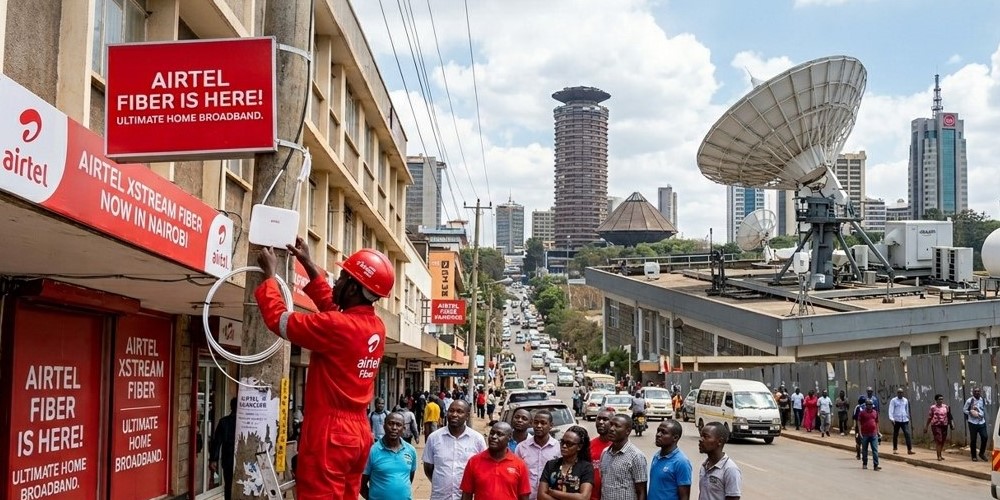
Leading telecoms company Airtel Africa has launched its fibre-based internet services for individuals and corporate organisations in Kenya. The development forms the telco’s way of improving its service offering and a strategic move to acquire more subscribers.
The fixed broadband service rollout includes both fibre-to-the-home (FTTH) and fibre-to-the-business (FTTB) connections. By adding this to its mobile money internet offerings, Airtel is positioning itself to take on more stake in Kenya’s fixed internet market.
Although it is new to the fibre operation in the country, Airtel’s pricing plans were set in line with other established providers.
The operator rolled out four pricing tiers starting with the lowest price at $15.48 (Ksh 1,999) for speeds of up to 15 Mbps, followed by the $23.22 (Ksh 2,999) plan for 30 Mbps. The higher-tier prices are $30.96 (Ksh 3,999) for 60 Mbps, and $38.71 (Ksh 4,999) for speeds of about 100 Mbps.
However, Airtel’s fixed broadband launch didn’t happen out of the blue.
The company had begun making preparations for the rollout in September 2025. Then, Airtel revealed intentions to enter the home fibre segment during its $150 million Nairobi Data Centre event at Tatu City in Nairobi, Kenya.
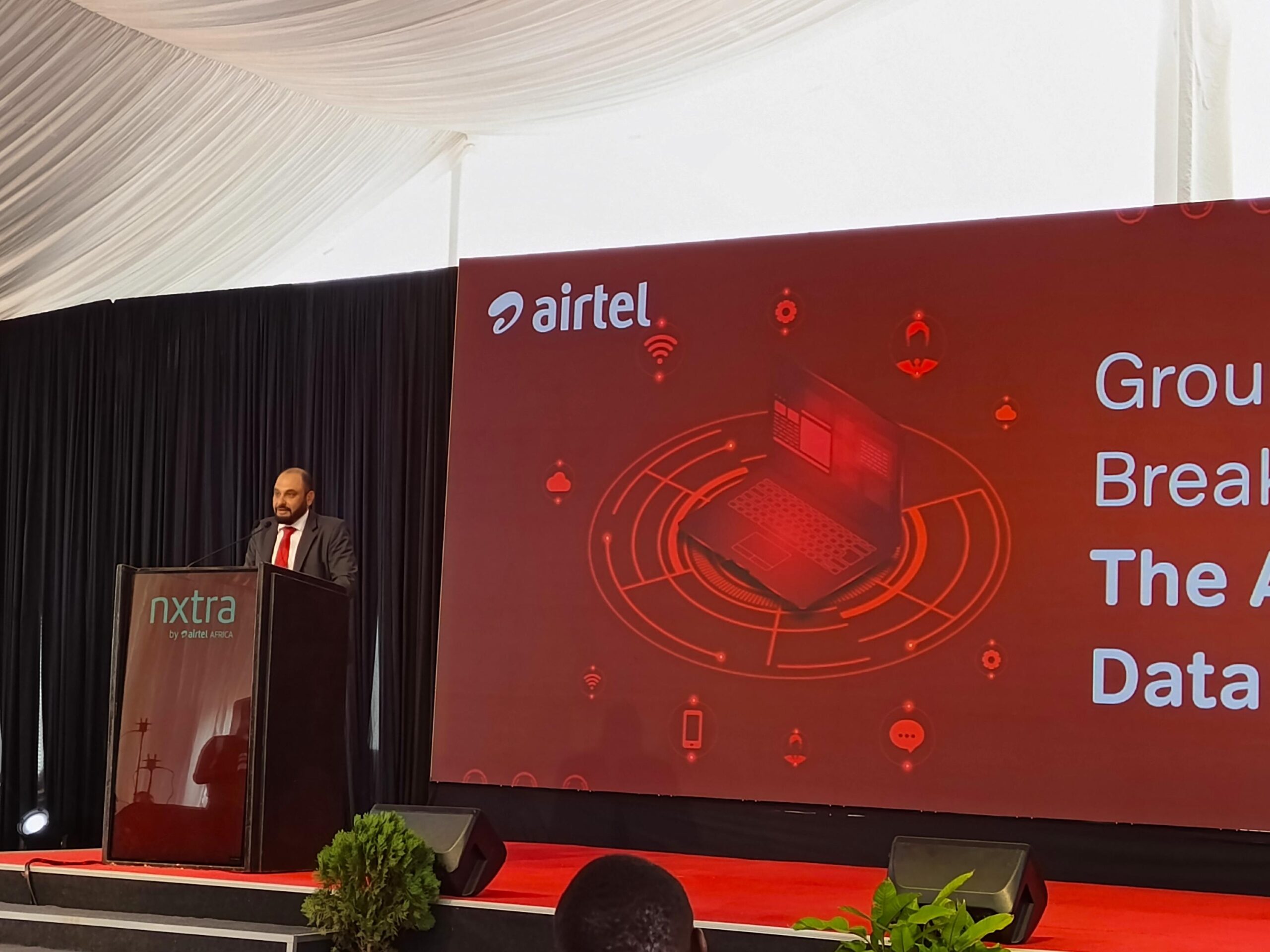
When the Managing Director was revealing the project, he said the move is part of a long-term investment plan in internet explorations and digital infrastructure, which includes data centres that will support AI workloads, enterprise connectivity and cloud services.
Airtel is entering a competitive Kenyan fixed broadband space with major players such as Safaricom, through Safaricom Home Fibre, Faiba (Jamii Telecommunications Ltd), Zuku, Poa Internet, Mawingu Networks, and Liquid Intelligent Technologies.
Commanding a 35.6% market share, Safaricom is the market leader with 815,037 home internet customers, fueled by its home fibre product. Jamii Telecommunications Ltd (JTL) is in second place with 466,458 subscribers (20.4%), while Wananchi Group (including its Simbanet and Wananchi Telecom brands) is the third largest with 270,320 connections.
Also Read: Understanding Kenya’s 373% internet subscribers growth in 6 years.
Amazon eyes internet space
While Airtel has joined the race to tap into the growing Kenyan internet space, another player is also eyeing an entry, but in the satellite internet space.
Amazon, the United States firm owned by Jeff Bezos, has formerly applied for an operating license in Kenya. The application for regulatory approval was filed through a local subsidiary, Amazon Kuiper Kenya Limited.
The move not only makes the East African country’s internet ecosystem more competitive but also comes as a direct take on Elon Musk-owned Starlink. Outside Kenya, Amazon has secured a 7-year licence in Nigeria, with plans to launch in South Africa and other Southern Africa regions.

Amazon plans to deploy over 3,200 satellites globally by 2028, with a longer-term model that includes satellite-to-phone without relying entirely on terrestrial mobile networks.
While it’s a direct competitor, it’s still short of Starlink’s presence in Africa. With its first launch in Africa in Nigeria in 2023, Starlink has now extended to 27 African countries.
Gold in Kenyan internet space
There’s a particular reason players are staging their tents in Kenya, especially in the fixed fibre market. And the reason lies in two indications.
First is the surge in broadband subscriptions.
Industry data from the Communications Authority (CA) figures for the July-September 2025 period show that Kenyan broadband subscribers have reached 1.27 million subscriptions, driven by the fibre-to-the-home (FTTH) services.
In fact, between 2019 and 2025, fixed fibre-optic subscriptions increased by 373%, from 268,753 to 1.27 million. Also, subscriptions more than tripled from 268,753 to over 1 million between 2014 and 2019, a growth attributed to remote work and entertainment.

Not only in numbers, but key infrastructure is also making the rollout easier for players.
President Ruto’s administration recently added nearly 8,000 km of fibre layout to reach 30,454 km. With transitions to e-governance and the digital economy, the government has a target of 100,000 km of fibre by 2027.
