


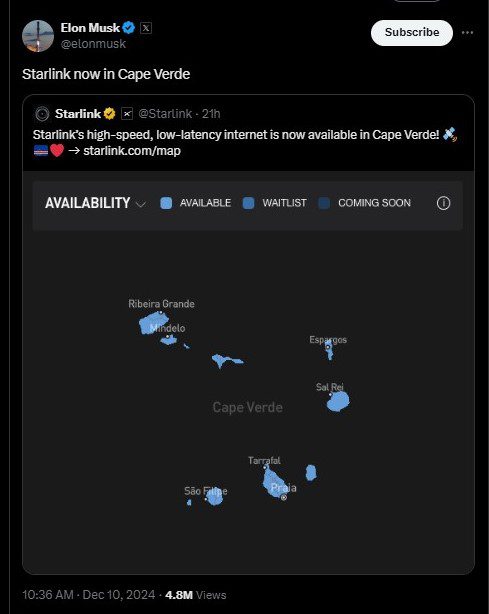
SpaceX’s satellite internet company, Starlink has officially launched in Cape Verde. This development marked the West African country as the latest to approve the low-Earth orbit (LEO) satellite-based connectivity solution. The launch also brings the total number of countries where Starlink is operational to 117.
Announcing the latest feat in an X post, Elon Musk stressed the milestone while emphasizing its role in advancing global digital connectivity. “Starlink now in Cape Verde,” the post reads. Another from Starlink says, “Starlink’s high-speed, low-latency internet is now available in Cape Verde!”
In October, Cape Verde’s regulatory authority, Agência Reguladora Multissectorial da Economia (ARME), announced the approval of Starlink Cape Verde, the local entity representing the service.
The agency added that it granted the authorization to provide electronic communications services throughout the country thereby expanding access to high-speed satellite internet. The approval has been projected to mostly benefit remote and underserved areas with limited connectivity and as well complement existing geographical networks.
Moreover, ARME stressed that the approval aligns with its commitment to fostering competition in the communications sector which seeks to foster the quality of service rendered to its citizens. It also stressed that through Starlink’s quality internet infrastructure, the approval decision will bridge the existing digital gap and support the country’s economic growth.
On how much it costs, Starlink said its hardware in Cape Verde will cost CVE 39,000 ($373), with the Mini dish available for CVE 20,000 ($191). For subscription, the Residential plan will be made available for CVE 5,000/month ($48/month) with standard connectivity while the Residential Lite Plan costs CVE 3,500/month ($34/month), providing a more affordable option with deprioritized unlimited data, potentially experiencing slower speeds during peak hours.
Experts have also pointed out that SpaceX’s deployment in Cape Verde will drive a significant step in advancing its digital inclusion efforts and strengthening its position in Africa’s evolving connectivity landscape.
Regulatory Approval – A roll-on challenge for Starlink
Amidst its latest approval and launch in Cape Verde, Starlink still faces a couple of regulatory approval woes in Africa.
Last month, the Communications Regulatory Authority of Namibia (CRAN) issued a cease-and-desist order to Starlink for operating in the country without a license. The regulatory body also ordered the confiscation of all its terminal equipment across the country and directed Namibians to avoid importing or using Starlink equipment until the licensing process and compliance with local laws are guaranteed.

In South Africa, the Elon Musk Satellite provider seems to be facing a tough task. The country stands as one of the few countries in the world that doesn’t have an estimated in-service date. It was reported in April that Starlink is not going to work in South Africa because the company didn’t want to share ownership with locals as per the government’s requirements.
Starlink refused to comply with the country’s BEE (Black Economic Empowerment) requirements to gift 30% ownership to local historically disadvantaged people. Also, the Independent Communications Authority of South Africa (Icasa) and the Minister of Communications have failed to issue new communications licenses in about 13 years.
In April, Cameroon seized Starlink kits at its borders because the Internet service provider is not yet licensed. The company had already scheduled a discontinuation of service in regions where it is not yet licensed to operate, including Cameroon, on April 30.
Likewise in the same period, the government of Zimbabwe ordered the company to shut down its services in the country over its failure to obtain regulatory approval from the Postal and Telecommunications Regulatory Authority of Zimbabwe (POTRAZ). The regulator would eventually give the company approval to operate in the country.

With its latest launch in Cape Verde and Chad (November 2024), the SpaceX satellite internet provider continues to expand its coverage in Africa. Other countries in the region with published forecast go-live dates include Mauritius (sometime in 2025), Angola (fourth quarter of 2024), Tanzania (also Q4 2024), the Democratic Republic of Congo (2025), Comoros (2025) and the Seychelles (2025).
Also Read: Namibia shuts down Starlink for operating without a licence, confiscates equipment.
