



SpaceX satellite internet provider Starlink has confirmed its official return to Uganda after securing regulatory approval in May. The licence allows Starlink to operate in Uganda and sell its hardware without obstruction.
The relaunch, confirmed in a Tuesday night X post, now marks its official return to the East African country after months under a cease-and-desist order for failing to secure a recognised licence.
“Starlink’s high-speed, low-latency internet is now available in Uganda!” the company said, with its availability map showing its presence in Uganda.
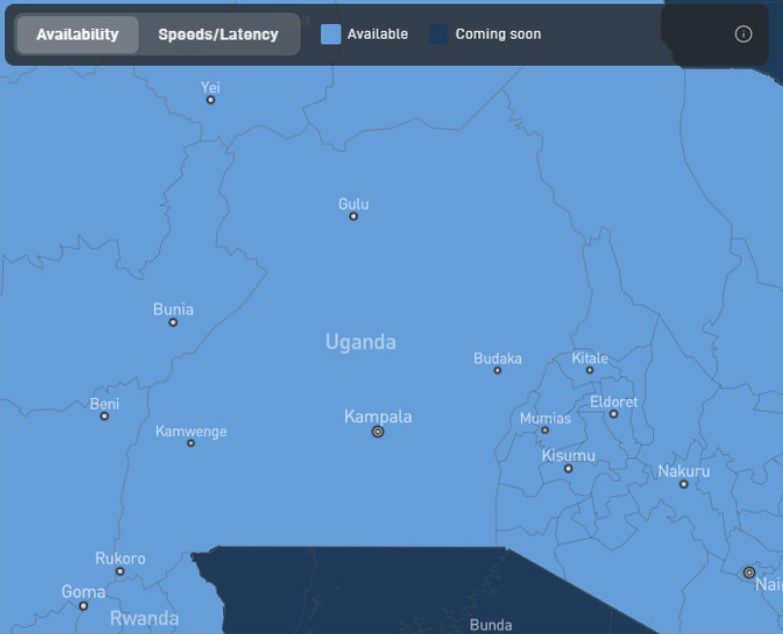
For Starlink, the return means it can now freely deploy its low Earth orbit (LEO) satellite offering in Uganda, especially for the two-thirds of its population that reside in rural areas.
Its satellite would be a strategic tool in closing this digital divide by spreading internet access across communities and providing quality connectivity when existing telecom services fail.
Up to speed: Starlink’s path to launch
The move to launch in Uganda started in 2024 when Starlink sought a license to operate in the country.
Complications began in April 2025 after the company faced delays in securing operating licenses (Public Service Provider and Public Infrastructure Provider) from the Uganda Communications Commission (UCC).
The greatest hurdle it faced was the failure to comply with Uganda’s Regulation of Interception of Communications Act. The rule mandates that telecom operators must give the government access to communications for security purposes. But the clause is in contrast with the company’s independence of operation.
Talks got ugly in January after the regulator directed the operator to suspend its service and importation of hardware into the country. This comes after citizens found a way to import its hardware securely while the company is yet to be licensed.
In response, the satellite internet operator said hardware in use was activated in neighbouring countries like Kenya, where it is authorised, before being imported into Uganda without approval.

In May, talks resumed with Starlink securing a license to operate in Uganda. It involved the signing of a memorandum of understanding between the company, through Director of m Market Access & Development, Ryan Goodnight, and the Executive Director of UCC, Nyombi Thembo.
Also Read: Starlink launches in Equatorial Guinea, its 30th African market.
Operational approach in Uganda
Starlink’s entry into Uganda would provide the country with an avenue to close its digital divide and coverage gap. With its LEO satellites, the operator will be spreading internet access across communities and providing quality connectivity when terrestrial telecom services fail.
According to the company’s service coverage map, the company plans to provide internet access in several key Ugandan towns and cities, including Kampala, Lira, Mbarara, Masaka, Jinja, Soroti, Kasese, Gulu, Pader, Kitgum, Hoima, Masindi, Kotido, and Kaabong.
The plan shows its intent to cover both rural and urban areas.
To refine its launch, Starlink has partnered with Paratus Uganda, a joint venture and telecoms operator. In late August, Paratus became the first provider to commercially launch Starlink low-Earth orbit satellite services in Uganda for remote enterprise clients.

With the addition, Starlink strengthens Paratus Uganda’s existing connectivity layout, which includes its cross-border connectivity through the 2,000 km Goma-to-Mombasa (G2M) route. It has a line of experience as it also provides other satellite connectivity offerings, including OneWeb, combining satellite links with its terrestrial network infrastructure.
Paratus Uganda said it’s positioning Starlink’s service primarily for enterprise customers such as organisations operating in areas where telecom tower connectivity is limited or unavailable. It will target sectors including mining, healthcare, tourism, non-governmental organisations and government, where reliable connectivity is pivotal to day-to-day operations.
Paratus will also offer different Starlink hardware configurations for fixed and mobile applications for Ugandans. This includes the Standard Kit and Flat High Performance Kit.
