





Starlink owner, Elon Musk, has denied the satellite internet service’s involvement in terrorist activities in India. This development comes weeks after the Indian authorities seized two Starlink devices in operations involving militancy and a drug smuggling bust.
According to a statement released late Tuesday by Elon Musk on X, “Starlink satellite beams are turned off over India” and were “never on in the first place.” This is the first comment from the SpaceX owner since the country agency confiscated items bearing its logo. He also disregarded the hardware connection claims, stressing that “This is false.”
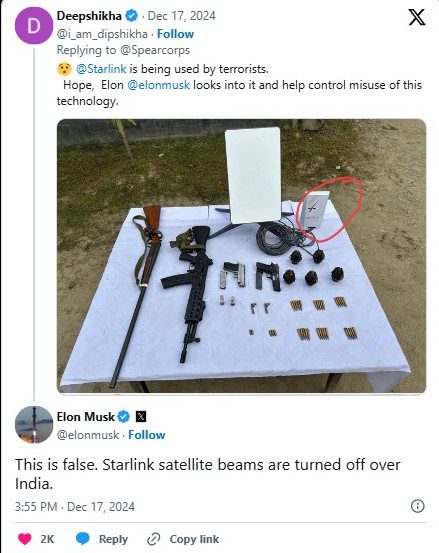
Musk’s comment was a response to a post from the Indian Army about a search operation on December 13 in the northeastern state of Manipur, a region affected by prolonged communal conflict. The post had shared images of a Starlink satellite dish among the items recovered from the militant group.
According to two military officers familiar with the operation, the device may have been smuggled through neighbouring civil war-torn Myanmar, where Starlink devices have been documented in use by rebel groups despite the company’s absence from the region.
Indian authorities said that the drug smuggling operation resulted in the seizure of $4.2 billion worth of methamphetamine, one of the biggest of such Indian seizures. The security agency also suspected that smugglers might be using the satellite internet device for navigation and has issued a legal demand to Starlink for details about its procurement.
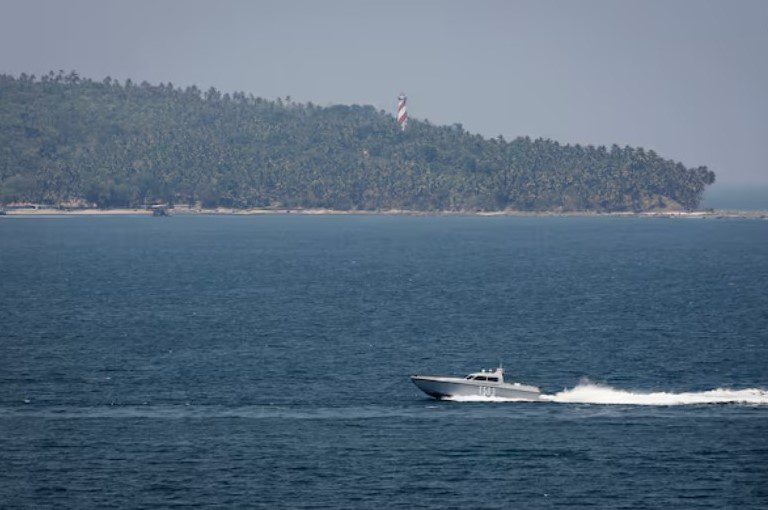
Hargobinder S. Dhaliwal, a top police officer in the Andaman Islands, one of the smuggling areas expressed that “This (case) is different because it is bypassing all the legal channels. They directly operated (phones) with satellites, creating a Wi-Fi hotspot.“
He said he planned to seek details from Starlink, such as who bought the device and when, as well as its usage history. “They (smugglers) were using Starlink since their journey started from Myanmar,” he said.
The incident is coming at a time when Starlink is actively seeking approval to provide satellite broadband services in India, a process that includes addressing security concerns raised by the government. The company has yet to secure the necessary clearances to operate legally within the country as it has been trying to address any potential security concerns as part of the process.
Manipur has been combated by ethnic conflict between the Meiteis and Kuki-Zo-Hmars communities since May 3, 2023. About 258 persons have died and more than 59,000 persons displaced since the conflict broke out. There was also an uptick in violence in the state in November.
Starlink faces refusal in India
The recent Starlink hardware seizure raises concerns about the likely misuse of satellite internet technology. While the equipment has shown potential to inclusively connect remote areas, it poses the dangers of the technology being manipulated and exploited by criminal and militant groups. Dhaliwal added that the smugglers used the Starlink Mini device, described on its website as “a compact, portable kit that can easily fit in a backpack“.
Starlink, which says it provides coverage in international waters, has plans to launch in India but says its coverage in territorial waters is contingent on government approval.
In its pursuit for regulatory approval, India’s stringent approach to security measures has become a critical hurdle for Starlink’s expansion. The regulatory scrutiny projects concerns in other regions, particularly where satellite internet devices could be misused in conflict zones for illicit and criminal activities.
As Starlink seeks to address these security threats and gain regulatory approval, its ability to obtain the license and its future in India remains uncertain. This also lies in the company’s ability to assure authorities of its operational security as it looks to tap into the country’s growing demand for high-speed satellite broadband.

With its global reach and decentralized capabilities, Starlink devices have drawn attention from governments worldwide. As its ability to secure regulatory approval in India turns sceptical, the satellite internet provider continues to expand its horizon across the globe.
Last week, the company officially launched in Cape Verde. While the development marked the West African country as the latest to approve the low-Earth orbit (LEO) satellite-based connectivity solution, the launch also brought the total number of countries where Starlink is operational to 117.
Cape Verde’s regulatory authority, Agência Reguladora Multissectorial da Economia (ARME) added that it granted the authorization to provide electronic communications services throughout the country thereby expanding access to high-speed satellite internet. The approval was also projected to mostly benefit remote and underserved areas with limited connectivity and as well complement existing geographical networks.
Experts also pointed out that SpaceX’s deployment in Cape Verde will drive a significant step in advancing its digital inclusion efforts and strengthening its position in Africa’s evolving connectivity landscape.
Read More: Starlink launches in Cape Verde, now in 117 countries globally.
