




For the better part of a decade, the product designer’s workflow followed a familiar rhythm: craft high-fidelity screens in Figma, build an interactive prototype, document the design system, and then hand everything off to a developer who would translate pixels into working software. The handoff was the industry’s ritual and its most notorious point of failure. Vibe coding cuts through that sequence and is ushering in a new era of design.
A concept of developing fully functional software via natural language prompts, on-the-go code generation, and an iterative feedback loop. Rather than crafting complex lines of syntax, builders need only explain the vibe, behaviour, and logic of the interface, and AI models do the rest, generating, executing and iterating the code. Ayomide Olukoga, a Lead Product Designer specialising in digital product strategy, interface architecture, and human-centred design systems, does not see vibe coding displacing designers.
“When anyone can generate functional code in seconds, code itself becomes a commodity,” he says. “What becomes rare and valuable is design judgement.”
That distinction may determine which designers thrive as AI code generation becomes a standard production tool. Olukoga, who has spent years inside the traditional design-to-development pipeline, now builds software differently, and he believes vibe coding represents the most consequential shift in software development since graphical design tools were invented.
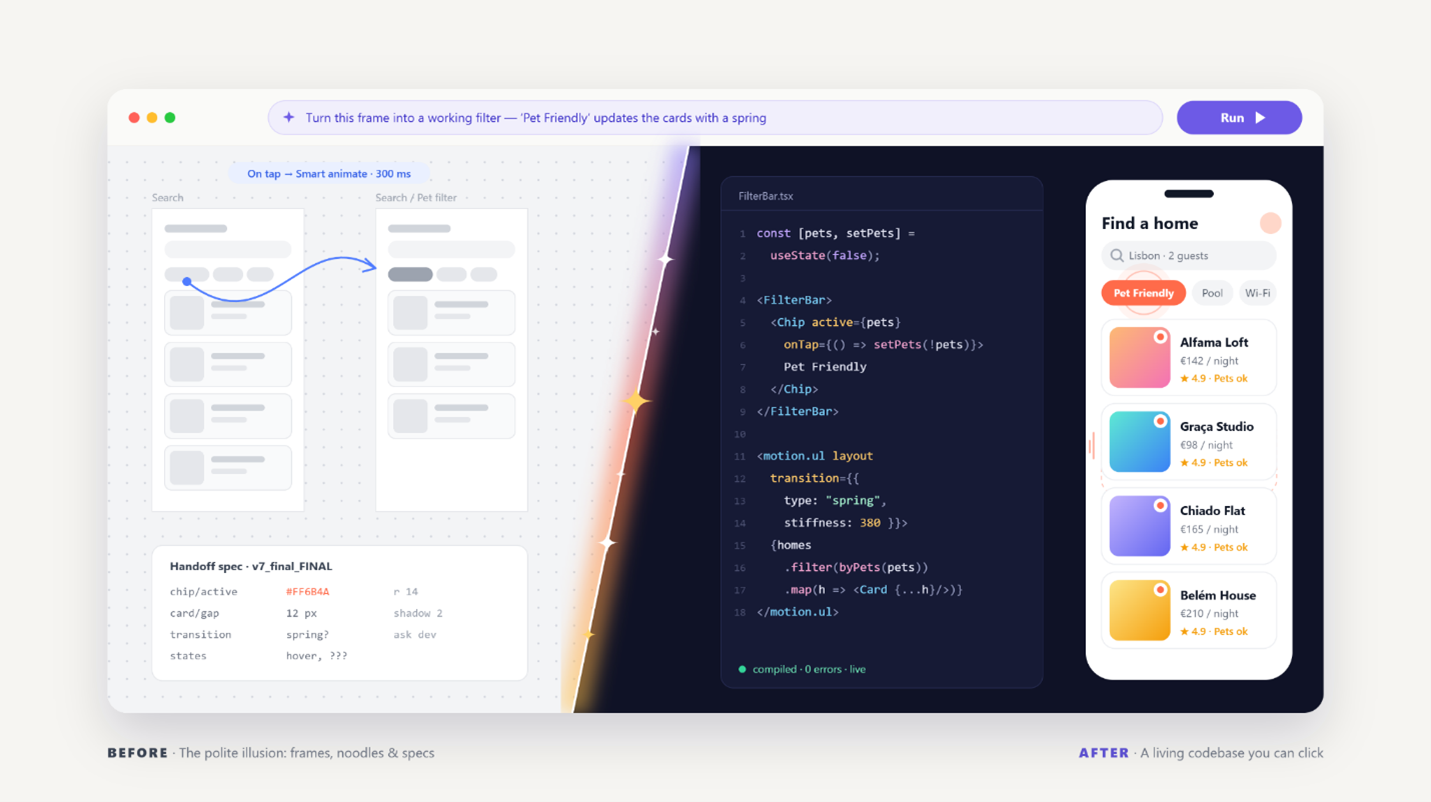
A Figma prototype, Olukoga argues, is a well-mannered illusion. Anyone can animate a button hover state in a design tool, but there is no way to simulate a live database query or user validation without writing actual code. Vibe coding collapses that distance entirely.
With AI-assisted vibe coding, the line between a design prototype and a live application completely vanishes. A designer can describe an interaction naturally:
“Build a dynamic filtering bar for a property search app where selecting ‘Pet Friendly’ triggers a subtle layout shift and updates the list cards in real time with smooth CSS spring animations.”
Within seconds, the AI generates functional React or HTML/CSS code. Designers are no longer merely presenting visual mockups of what software should look like; they are handing over living, interactive codebases of how software actually works.
“Vibe coding turns the designer into a film director. The AI acts as the camera crew and set builders executing the vision, but the designer maintains total creative direction over the final cut,” Olukoga explains. “Many people use tools like Claude Code, Cursor, or Anti-gravity to create things, but we still need human judgement, which is something AI cannot provide at the moment. AI cannot make decisions based on human psychology.”
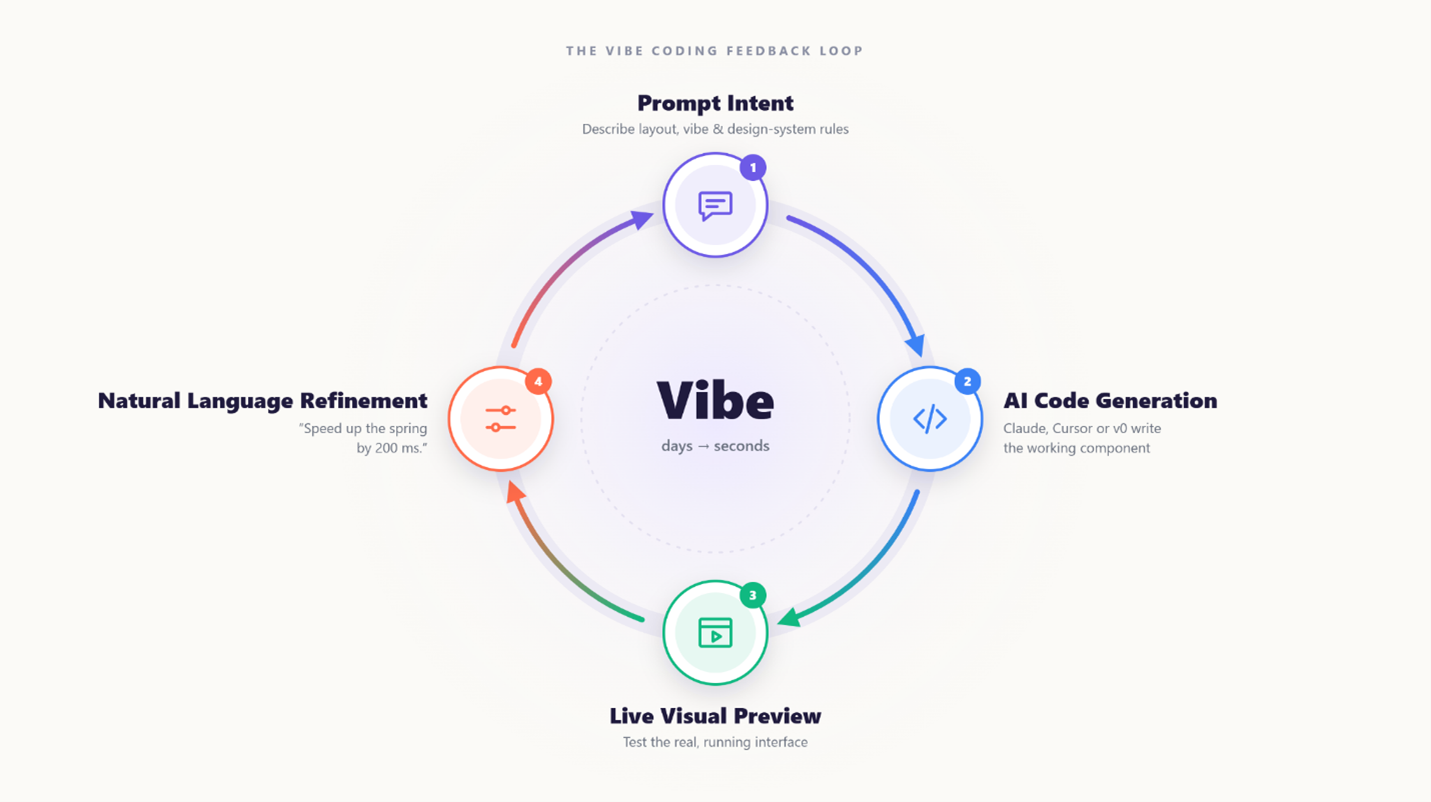
The iteration loop compresses accordingly. When a transition feels sluggish, the designer does not hunt through hundreds of lines of animation code. The instruction is conversational: make the background blur get darker and increase the entry spring animation by 200 milliseconds. A process that once took days now takes seconds.
Technically sound code is not the same as a good product. Olukoga offers a case in point: a game, built with a friend using Claude to generate the initial prototype.
“Claude generated visually and technically strong code, but it lacked good UX for a general audience,” he says. The fix required human intervention; a Nigerian illustrator was brought in to create mascot artwork that resonated with the local market. “Claude generated sound code, but it was visually lacking in cultural branding without our research and human input.”
Deploying vibe code in the real world
Asked for a recent example of this directing role in action, Olukoga describes a live engagement in the Middle East, where he works as a product designer for a telecommunications company tasked with redesigning a website with a very large architecture.
“I am currently working as a product designer for a telecommunications agency in the Middle East. I was tasked with identifying the ideal entry point for a redesigned website, which features a very large architecture. I asked Claude to crawl the current website, map out the site architecture, and identify the flawed entry flows. It brought out multiple entry points, and based on user interviews, we deduced which ones would convert the best. Because user interaction in the Middle East differs from the UK, we factored that in, and Claude helped identify new entry points that allowed us to make informed decisions moving forward,” he recounts.
It is a pattern he sees repeating across the industry: the AI maps terrain at machine speed; the human decides which direction to walk.
Anxiety runs high in design circles; as AI tools make coding accessible to everyone, the value of dedicated product designers will diminish. A recent statement by IMF Managing Director Kristalina Georgieva noted that AI would displace as much as 40% of the global workforce. Olukoga says, “In reality, the exact opposite is happening. When anyone can generate functional code in seconds, code itself becomes a commodity. What becomes rare and valuable is design judgement,” he argues.
“AI cannot feel,” he says, recalling a discussion with designers last year. “I tell them that right now is the worst AI will ever be, as it will continually evolve.” But the displacement, in his reading, lands on tasks rather than people. “Rather than replacing 40% of designers, AI is directly liquidating 40% of standard, routine, execution-heavy tasks. AI cannot replace problem framing and system architecture. It takes over heavy tasks, producing results in minutes, and the designer simply uses their higher taste to iterate and make decisions.”
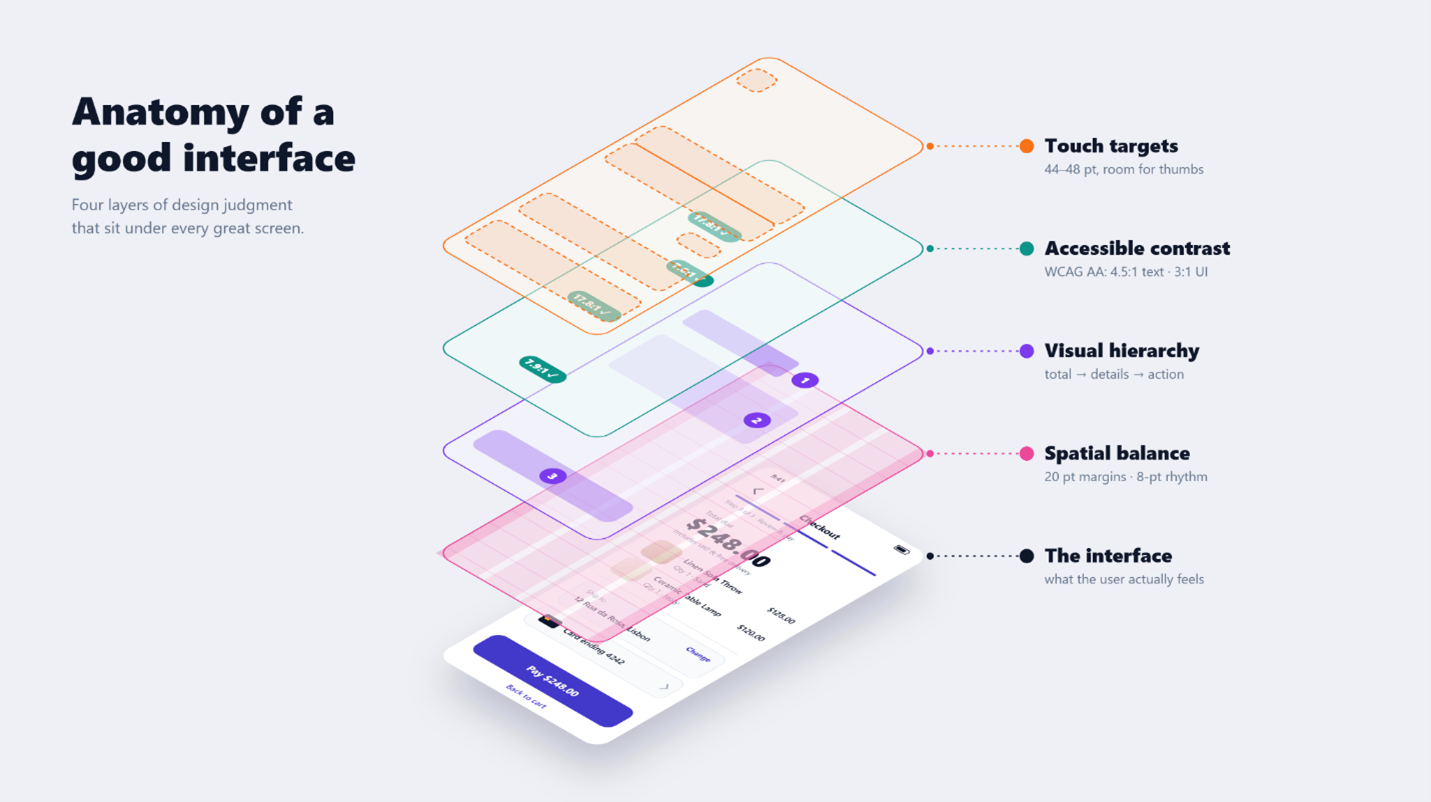
An AI can generate ten variations of a checkout screen instantly, but it doesn’t intuitively understand human psychology, spatial harmony, accessibility, or brand nuance. “AI will replace those who refuse to use it in their workflow,” he argues. “AI doesn’t know why a customer abandons a cart on step three; it takes a skilled product designer to curate, critique, and direct the AI toward a seamless user experience.”
The Figma question
If AI can generate production-ready interfaces from prompts, what happens to Figma, the default tool of product teams everywhere?
“I don’t see vibe coding entirely replacing Figma, but it fundamentally changes what Figma is used for,” Olukoga says. Vibe coding using natural language eliminates massive chunks of high-fidelity screen production, static prototyping, and developer hand-offs. It will replace Figma for mechanical production execution, but not for strategic alignment or systemic design. Designers used to spend 70% of their time drawing static screens and exporting specs. Vibe coding absorbs that mechanical production, making it easier for designers to focus on decision-making while AI handles UI frame generation.”
For early-stage startups in emerging markets, where engineering talent is expensive, vibe coding alters the economics of team-building. Olukoga describes a structural shift: the delayed hiring of a dedicated front-end engineer. Historically, a startup needed a backend architect and a frontend engineer just to get mobile components built. Natural language generation trivialises boilerplate code, meaning a single full-stack founder can now build and deploy complete user interfaces. Founders can ship an MVP quickly and hire technical staff only when scaling demands it.
He notes, “Vibe coding is bridging the historical divide between design and engineering. It allows designers to move directly from idea to working software without getting bogged down in syntax errors, boilerplate code, or lost-in-translation handoffs.”

For designers entering the field today, Olukoga’s counsel is not to choose between old tools and new ones. “They should learn both,” he says. “Because AI generates so many codes and designs, human judgement is required to yield unique results.” Mastering complex Figma components builds design fundamentals; prompting AI tools accelerates execution. The judgement, though, is non-negotiable.
The design profession’s centre of gravity is moving away from static pixels and toward something closer to direction. Olukoga concludes that software development is no longer about drawing what an interface should look like, but about directing the vibe through human judgement. The designers who thrive, he argues, will be those who pair deep empathy for users with the ability to prompt, guide, and shape live code in real time.
