




For millions of Nigerian internet subscribers, staying connected in 2026 brought a daily test of patience. Ironically, instead of economic pressures limiting internet access, subscribers spent the year battling dropped calls and poor internet, even when full signal bars appeared.
The trend is not hearsay. Data from the Nigerian Communications Commission (NCC) Quality of Experience (QoE) page shows that network quality issues, especially voice and data, generated more consumer complaints across Nigeria than any other telecom issue between January and October 2026.
Over the 10 months, MTN (172,317) and Airtel (361,690) reported a combined 534,007 subscriber complaints across their platforms.
Specifically, subscribers filed 333,615 (30,752 in October) complaints surrounding quality of experience in data and voice, with 61,715 complaints attributed to MTN and 271,896 complaints filed against Airtel. This also means that total complaints attributed to the two leading operators on poor network service took a 51% share of all complaints between January and October 2026.

A takeaway from the data is that poor voice clarity, frequent call drops, sluggish internet speeds, and high latency outranked complaints surrounding billing disputes, data depletion, failed payments, value-added services and others.
The drop in everyday network reliability comes amid surging digital demand. While more Nigerians increasingly rely on mobile data for work, commerce, streaming, and financial transactions, poor networks have struggled to keep pace, leaving users stuck in digital dead zones during peak hours.
Also Read: Nearly 200 million telecom subscribers: here is why Nigeria has more telephone lines than users.
NCC data: Poor networks are overheating phones
A closer look at the latest industry data reveals that poor connectivity is not just wasting time, airtime and mobile data, but also straining smartphones.
While experts have often linked poor networks to rapid phone battery drainage, a 2026 joint study by the NCC and Ookla Advanced Analytics Services titled “Battery Consumption & Thermal Status Analysis” has provided empirical backing. The analysis proved that poor network performance directly causes smartphones to run hotter and makes battery drain faster.
The report, covering January 2025 to August 2026, explained that when a mobile device is trapped in an area with weak signals or heavy network congestion, its internal modem continuously boosts power to search for and hold onto a cell tower. This extra workload generates heat, drains battery reserves and prompts the phone’s software to slow down processing speeds to protect the hardware.
By analysing crowdsourced Speedtest data across 3,048 geographic zones in Nigeria, the NCC–Ookla report uncovered widespread device stress directly linked to lagging networks.

In the results, 204 zones were flagged as battery hotspots, suffering severe daytime battery drain between 12:00 p.m. and 4:00 p.m. compared to overnight baselines. Another 305 zones were flagged as thermal hotspots, where devices recorded abnormally high temperatures during network tests.
In extreme cases, 23 zones suffered from both severe battery drain and extreme overheating simultaneously. In these stressed areas, internet performance significantly drops compared to normal zones.
| Performance Metric | Normal Zones | Battery Hotspots | Thermal Hotspots |
| Download Speed | 18.76 Mbps | 14.01 Mbps (25% lower) | 16.42 Mbps (12% lower) |
| Upload Speed | 9.40 – 9.41 Mbps | 8.90 Mbps (5% lower) | 8.37 Mbps (11% lower) |
| Latency (Lag) | 31.4 – 31.5 ms | 40.6 ms (29% higher) | 42.1 ms (34% higher) |
Northern Nigeria, where 13% to 16% of zones at latitude 10°N or higher were flagged as hotspots compared to roughly 9% in the rest of the country.
The report noted that while heat in the North raises phone heat, it links the phone stress directly to measurable drops in speed and spikes in latency, and that network stress and climate are a compounding factor.
In fact, in the North-East, nearly one in three zones registered as a high-thermal hotspot, compounding hot ambient weather with heavy signal strain.
Fibre cut link to network stress
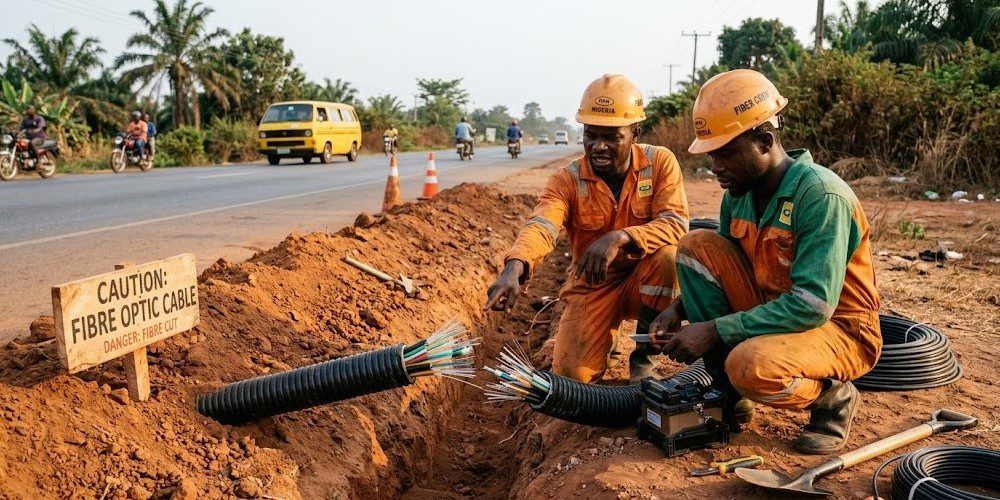
Regarding poor network delivery, one must mention the impact of fibre optic cable cuts. It also boils down to how uncoordinated road construction, equipment theft and vandalism increase spending on infrastructure deployment, repairs and upgrades.
During the first nine months of the year, operators experienced 44,678 fibre cuts in the first nine months of 2026, highlighting their major impact on network disruption and poor internet experience. Top leading causes of outages are degradation (17,462 cases), vandalism (9,283 cases) and cable connection issues (9,008 cases).
For October, data shows the industry recorded 5,393 cases, compared to the 4,868 cases recorded in September and 2,520 cases in August. With 10,251 reported cases of fibre cuts, June saw the highest count in 2026 so far.
The impact of every single fibre cut is more than mere cumulation of numbers. Each time a fibre line is cut, nearby base stations lose capacity or go offline entirely. Traffic is immediately redirected to neighbouring towers, triggering instant congestion, a rise in latency, and forcing thousands of nearby smartphones to work overtime just to hold a basic signal.
The fibre cuts are also influenced by ongoing equipment theft and rising energy cost challenges at cell sites, showing how telecom operators have spent much of 2026 restoring network uptime with less focus on expanding capacity.
Unarguably, and according to industry reports, Nigerians are paying twice for unreliable networks. While they pay once for data and voice bundles that fail to deliver, they pay a second time through degraded phone batteries and overworked devices.
Telecom operators are faced with pressure from rising demands to fix local network bottlenecks, and from the NCC to protect Nigeria’s underground fibre cables from persistent destruction.
Also Read: Nigerians spent N13.7bn daily on MTN and Airtel data despite economic pressure
