




Regardless of whatever happens before, during or after a trip, inDrive will not be liable or accountable to either its drivers or passengers. This is according to the details of its Terms of Use, written by its legal team and consented to by the thousands of drivers and riders who use the platform.
In other words, if any incident happens during the trip, even if it leads to theft, loss of property, harm, injury or even death, the company is not legally bound to be concerned.
Section 11 of its Terms of Use, titled InDrive’s Liability, expressly states that:
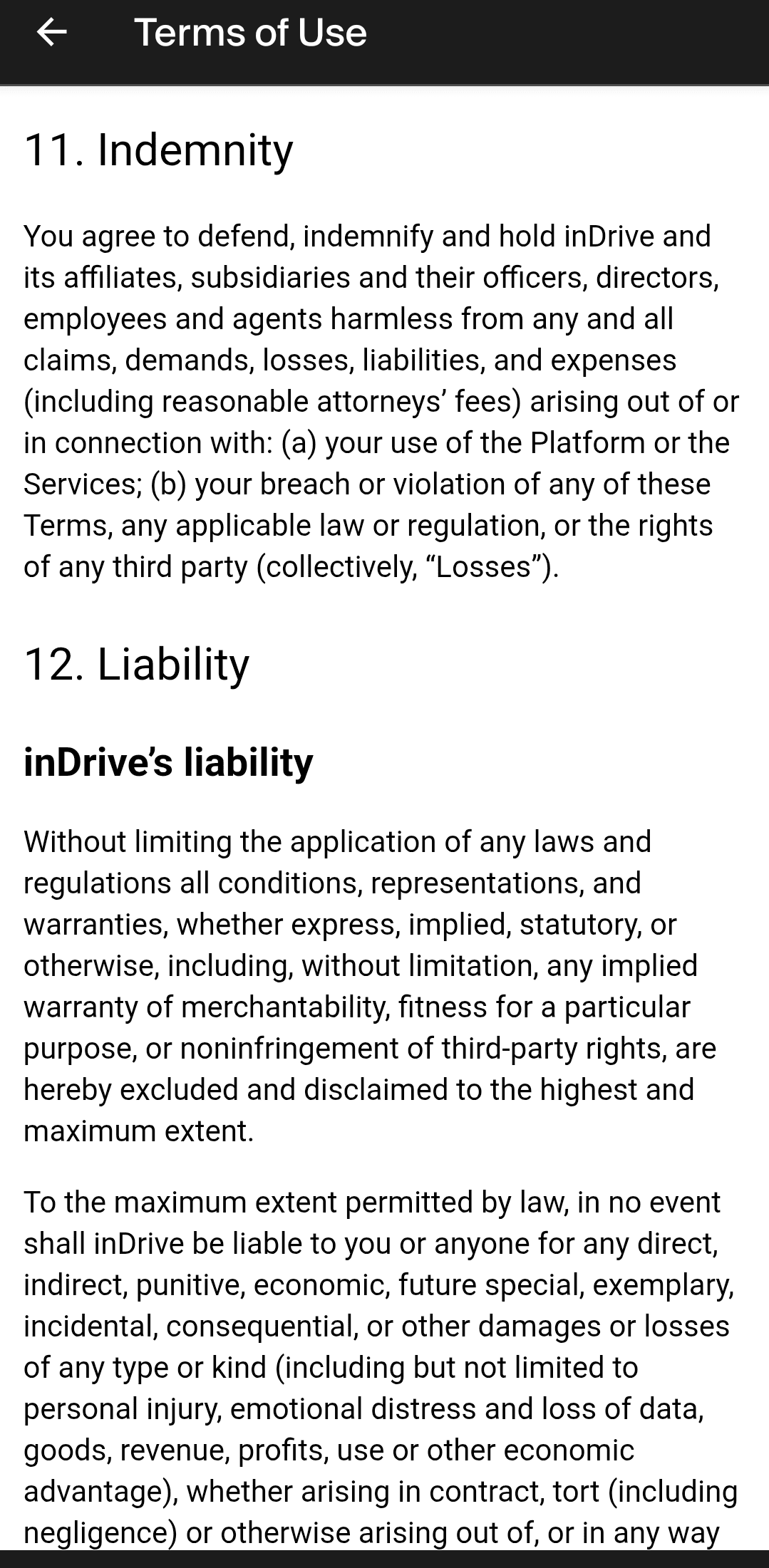
To the maximum extent permitted by law, in no event shall inDrive be liable to you or anyone for any direct, indirect, punitive, economic, future special, exemplary, incidental, consequential, or other damages or losses of any type or kind (including but not limited to personal injury, emotional distress and loss of data, goods, revenue, profits, use or other economic advantage), whether arising in contract, tort (including negligence) or otherwise arising out of, or in any way connected with the Platform, including but not limited to the use or inability to use them, any reliance placed by you on the completeness, accuracy or existence of any advertising, or as a result of any relationship or transaction between you and any Driver even if inDrive has been previously advised of the possibility of such damages.
The subsection titled THIRD PARTY SERVICES is even clearer, and perhaps more emphatic.
“No joint venture, partnership, employment, or agency relationship exists between inDrive and any of our users. To the maximum extent permitted by law, inDrive is not responsible for the acts or omissions of any Driver or Passenger or any of the Services. inDrive will not be a party to disputes or negotiations between Platform users. You expressly waive and release inDrive from any and all liability, claims, causes of action, or damages related to your use of the Platform in dealings with other Platform users,” inDrive says.
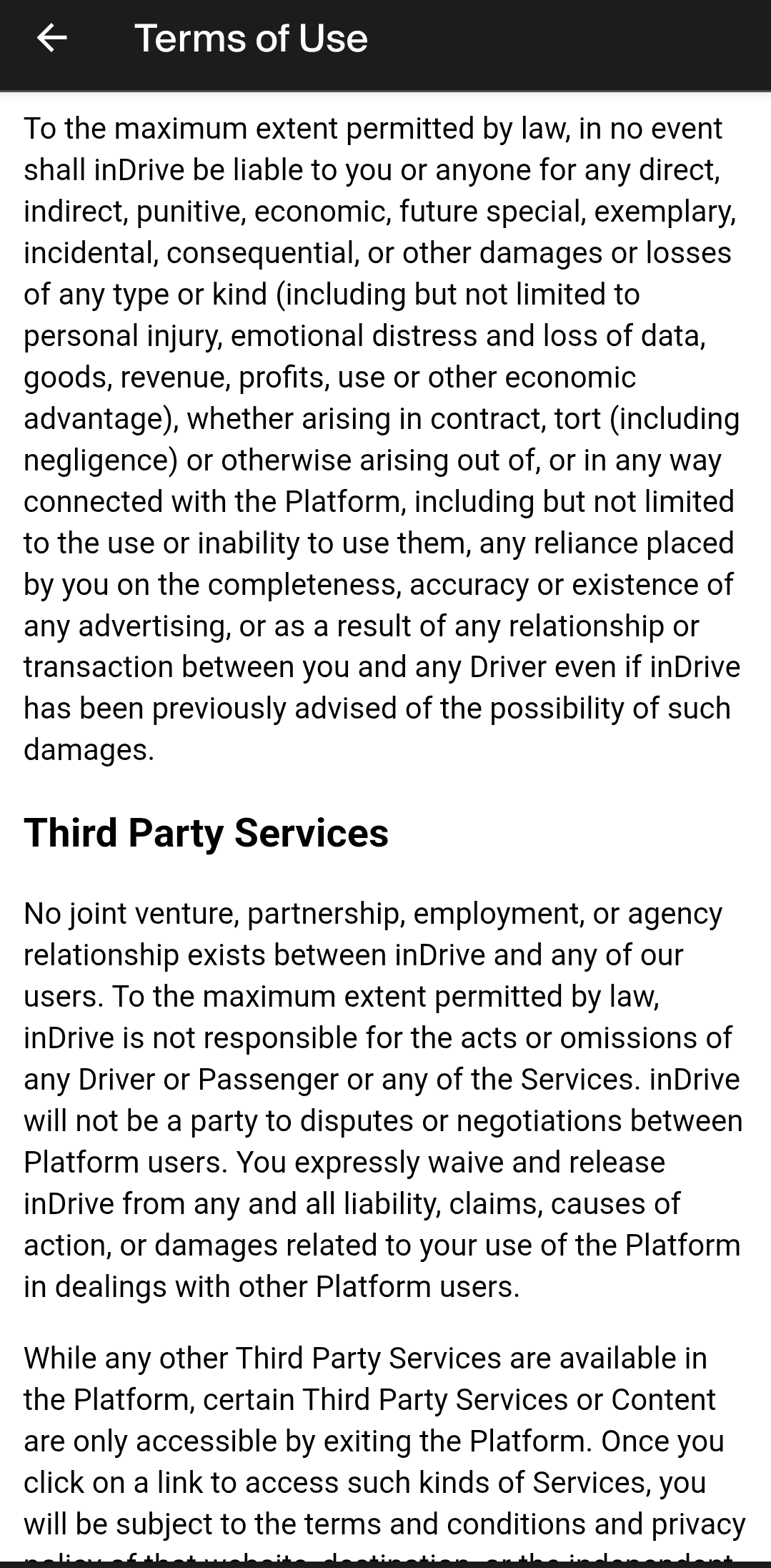
Section 11 of the contract, titled INDEMNITY, further clears all doubt as the company demands users to let them off every hook:
You agree to defend, indemnify and hold inDrive and its affiliates, subsidiaries and their officers, directors, employees and agents harmless from any and all claims, demands, losses, liabilities, and expenses (including reasonable attorneys’ fees) arising out of or in connection with: (a) your use of the Platform or the Services; (b) your breach or violation of any of these Terms, any applicable law or regulation, or the rights of any third party (collectively, “Losses”).
Legal perspectives on inDrive’s terms and conditions
Speaking about inDrive’s liability clause, UK-based legal practitioner Tobi Adebowale explained that, in simple terms, the company has said that it only provides a middleman service and the driver bears all the risk for using their platform.
“If a rider sues inDrive and the driver, the driver bears the cost of the court case and has to pay inDrive the money the company spends on legal fees because of that court case. They have essentially denied responsibility for anything that goes wrong while the driver uses their platform and if they get involved in any dispute with a passenger,” he said.
Mr Adebowale further explained that indemnity clauses are usually included in most contracts and terms of service of this nature. However, the service provider would typically state that it accepts liability for issues that arise from its own negligence or fraudulent action.
“inDrive hasn’t done that,” he said.
Unlike Bolt…
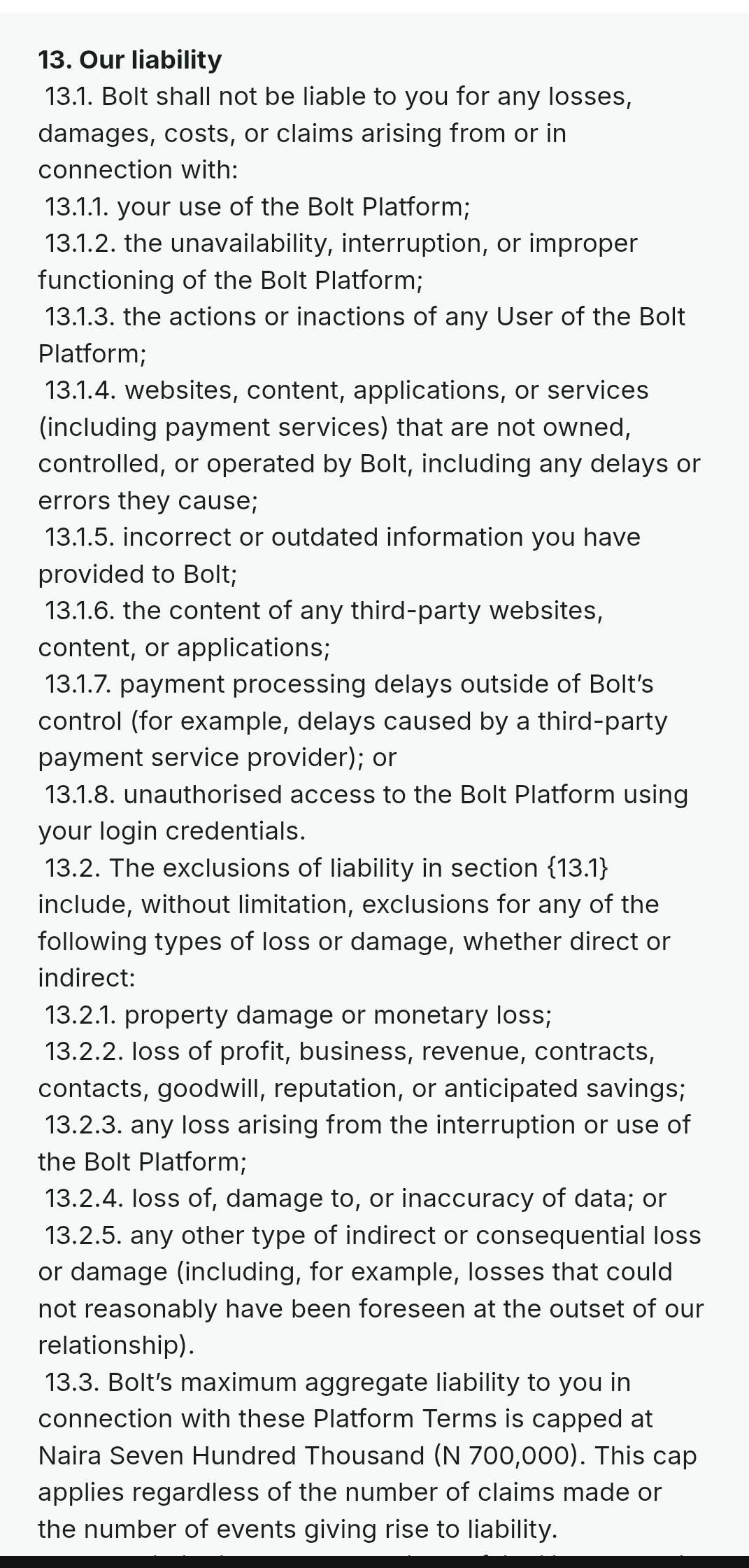
This is in sharp contrast with the liability provisions in the terms of Bolt, which expressly state that it would take liability to the tune of N700,000 for property damage or monetary loss, loss of profit, business, revenue, contracts, contacts, goodwill, reputation, or anticipated savings, any loss arising from the interruption or use of its Platform.
“Bolt’s maximum aggregate liability to you in connection with these Platform Terms is capped at Naira Seven Hundred Thousand (N 700,000). This cap applies regardless of the number of claims made or the number of events giving rise to liability,” Bolt’s terms and conditions read.
The platform also accepts full responsibility and liability if its negligence leads to death and personal injury, or any other lawful harm.
“Bolt’s terms reflect market standards to a certain extent, especially as they provide for amounts they can be sued for, and accept they will be responsible for losses arising from their negligence. However, inDrive’s terms are aggressive and can be said to be one-sided,” Adebowale said.
However, because inDrive refuses to take any liability does not mean it won’t, if push comes to shove.
Even the terms of use state that they all come without limiting the application of any laws and regulations. In other words, their terms apply to the extent Nigerian law permits. This acknowledges that a court can rule that they should bear responsibility for certain losses resulting from their actions.
Adebowale pointed out that some of the provisions in the company’s terms of use will likely go against the fairness standards under the Federal Competition and Consumer Protection Act (FCCPA) 2018, which protects consumers against unfair, unreasonable or unjust contract terms.
“A Nigerian court will typically not allow a company to hide behind its terms of service to avoid responsibility for its negligence or fraud. The courts can intervene to ensure fairness of contract terms, especially where one of the parties to the contract drafts the terms, and the other can only accept. Courts typically enforce against the drafter in certain situations even if parties are generally free to decide the terms of a contract,” he noted.
He further explained that a court will likely not uphold the indemnity provision in the inDrive terms of service in the event of death, especially where there is evidence the company had some responsibility, directly or indirectly, for the incident.
In a nutshell, the app company refuses all liability and only gives room for instances where the law imposes liability on them. This means the driver has to go to court or a regulator to establish that.
“Drivers and users of these platforms shouldn’t assume they have no rights just because the terms say so. It may be difficult to read the terms before using the services, but in the event of a dispute with the company, it is best to consult a lawyer before having a conversation with the company,” Adebowale advised.
Technext contacted an inDrive spokesperson on the matter but are yet to get a response as of time of publication.
Read also: Lagos drivers call off strike after 4 days, vow to dump inDrive
