




Every Nigerian with a bank account has lived the ritual. You initiate a transfer, the screen freezes, the debit alert arrives, and the credit never does. You call your bank, and they tell you to “exercise patience.” Two days later, the money reappears, or it doesn’t, and you start the reversal dance all over again.
The Central Bank of Nigeria (CBN) wants that ritual gone by 2028, setting a target of zero failed transactions within two years. What a new anonymous survey of 40 Nigerian payment professionals, bank staff, merchants, journalists, and everyday users reveals, though, is not a system waiting for one fix.
It’s an industry where every group blames a different villain for the same failure, and each group learned to blame that villain long before this survey ever asked them to.

Read also: Missing funds, unexplained loans and angry customers: Is GTBank still in crisis?
A habit Nigerian banks learned long before NIBSS existed
Ask a bank’s operations staff why a transaction failed, and the answer arrives almost reflexively: user error. Wrong PIN, wrong account number, insufficient funds. Every one of four bank employees who answered the survey gave some version of that explanation, and it isn’t hard to see where the habit comes from.
For as long as Nigerian banks have been building consumer-facing digital channels, the industry’s liability has been tied to authentication. A customer who enters the correct PIN and OTP is treated as having authorised the transaction, which means that when something goes wrong downstream, the fastest and safest place for an ops desk to look first is the input, not the infrastructure.
That instinct predates NIBSS's instant transfer rails entirely, and it has calcified into a default explanation that outlives whatever actually caused a given failure.
The habit shows even in the answers of the people who hold it. One bank staff member, working inside a bank’s operations team, told the survey, “I think it’s [zero failed transactions by 2028] achievable, but only if the rails get fixed first. The single biggest drag right now is basic user error that no amount of infrastructure spend will fix.”
But when asked what should actually change, the same employee picked “upgrade NIBSS” and “mandatory bank API standards”, the exact fixes the engineers were demanding.
The reflex to blame the customer and the recognition that the infrastructure needs work are apparently not in conflict inside the same person, which says less about that individual and more about how deeply the customer-fault instinct is wired into how banks talk about failure, even when they know better.
Read also: An NIBSS software error made a ₦13.66 billion transfer, and 176 Nigerians are now being sued for it
Everyone else distrusts the switch when it comes to failed transactions
| Who’s answering | What they blame | Share |
|---|---|---|
| Bank staff (Ops/IT) | 👤 User error – wrong PIN, wrong account, insufficient funds | 100% (4/4) |
| Fintech developers | 🏛️ NIBSS/switching overload or 💳 bank downtime | 92% (12/13) |
| Journalists | 📡 Network/telecom downtime | 89% (8/9) |
| Consumers | 🏛️ NIBSS overload or 💳 bank downtime | 86% (6/7) |
| Regulators | 💳 Bank downtime or 🏛️ NIBSS overload | 100% (3/3) |
Everyone who doesn’t work inside a bank’s ops team blames something else entirely, and that split has its own history.
NIBSS was built in 1993 [E-banking guidelines were established and eTranzact launched in 2003] as a shared settlement infrastructure for a banking sector a fraction of its current size, and its instant transfer rail launched in July 2011, years before Nigeria’s cashless policy and the fintech boom that followed pushed transaction volumes far past anything the original architecture was sized for.
Every fintech built on top of NIBSS since has effectively been building on a railway laid for a smaller country, which is why developers reach for the switch first when something breaks. 12 out of 13 fintech developers surveyed, and 6 of 7 consumers named NIBSS overload or bank downtime as the main cause of failure, not user error.
That distrust has recent, concrete grounding, not just architectural history. In September 2024, a NIBSS software error credited 13.66 billion naira to 176 accounts across 19 banks and fintechs with no matching debit anywhere in the system. Phantom money that NIBSS is now suing those 176 beneficiaries to claw back.
For an industry already primed to see the switch as the weak link, an error of that scale at that institution is not an abstraction. It’s proof.
“Banks need to stop treating payments as a legacy IT problem,” one developer wrote in the survey. “Many still rely on ageing core banking systems that struggle during peak periods. They need active data centres, real-time monitoring, faster incident response, and planned infrastructure upgrades instead of emergency fixes.”

Journalists and everyday users arrived at a similar distrust from a different direction. 8 of 9 journalists surveyed pointed to network and telecom downtime, not NIBSS or the banks, as the biggest culprit, which tracks with a decade of underinvestment in the GSM towers that USSD banking depends on and a public record of telecom outages that reporters, more than anyone else in the chain, are used to covering.
“Shaky telecom connectivity killing transactions mid-flight,” one journalist wrote, adding that fixing it “doesn’t happen without sustained investment, not just a press release.”
Even regulators, who might be expected to defend the system they oversee, split their blame between bank downtime and NIBSS overload rather than the customer, which suggests that inside the CBN too, the institutional memory of where failures actually originate points away from the person holding the phone.
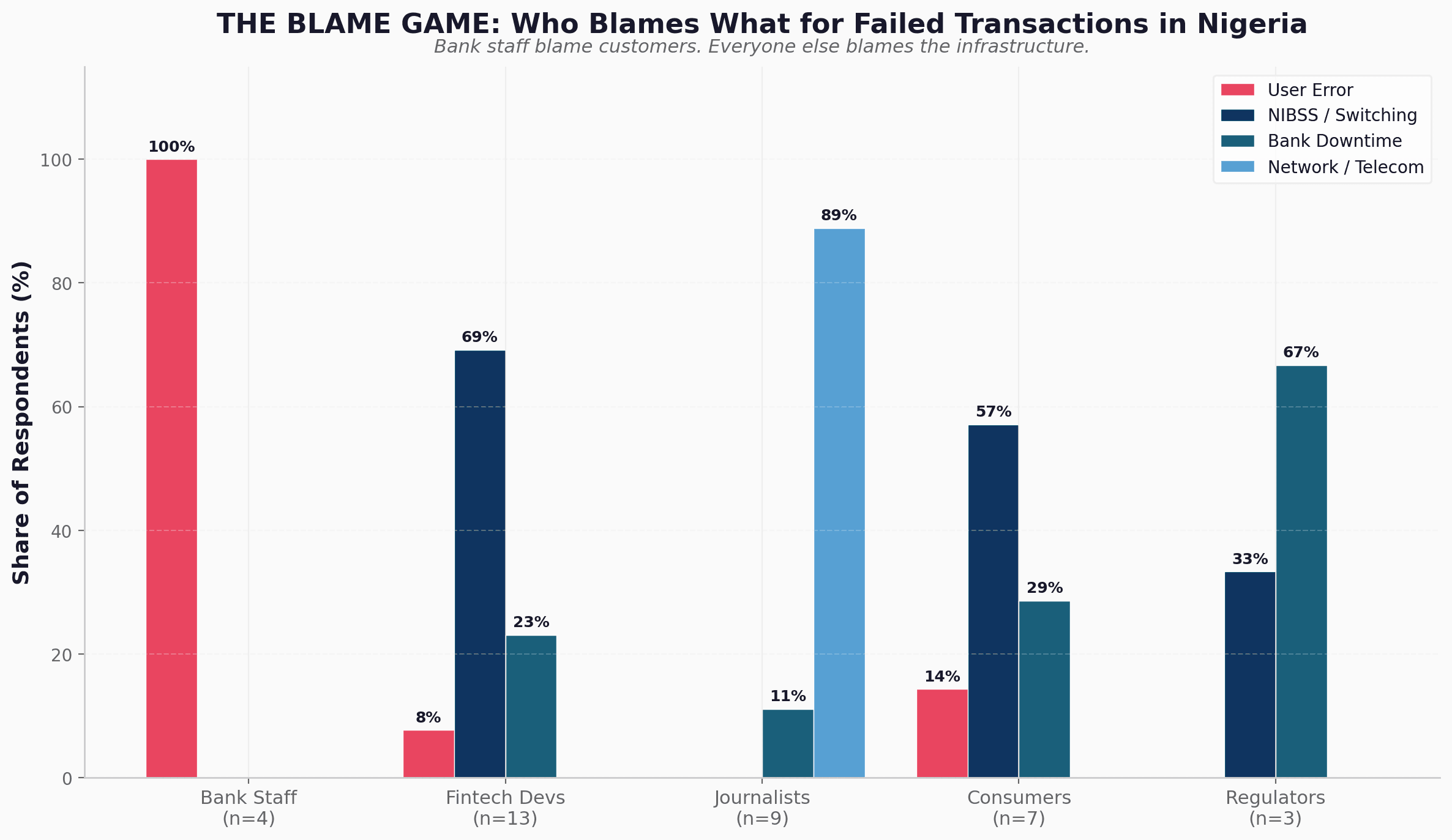
None of these groups is simply picking a side at random. Bank staff inherited a liability framework built around authentication. Developers inherited a switch built for a smaller country and then watched it fail publicly and expensively. Journalists inherited a decade of telecom outages.
Each explanation is a reasonable reading of that group’s own history with the system, which is exactly why the CBN’s 2028 ‘zero failed transactions’ target is aimed at a moving argument rather than a single, agreed-upon problem.
Fix the switch and the developers will feel vindicated. Fix nothing about how banks classify a declined transaction as a failed one, and the ritual at the ATM queue, the frozen screen, the delayed credit, the two-day wait for a reversal, continues regardless of what anyone upgrades.
Read also: 5 ways the new National Payment Stack would improve Nigeria’s payment solutions
