





Nigerians receive unsolicited marketing messages daily, often without questioning how businesses obtain their contact details and how businesses understand data privacy. For one customer, Chukwunweike Araka Akosa, these messages became more than an inconvenience; they became the basis of a legal battle that set a precedent in Nigeria’s data protection landscape.
On February 18, 2025, the Federal High Court in Abuja ruled against Domino’s Pizza, operated by Eat‘n’Go Limited, for violating Akosa’s right to privacy by sending him unsolicited marketing messages without his consent.
The court awarded the customer ₦3 million in damages and ordered the restaurant chain to erase his data and cease all direct marketing communications.
According to a statement by Paradigm Initiative, who are mentioned to have sponsored the case Akosa’s legal battle began on December 14, 2023, when he noticed a promotional message from Domino’s Pizza on his phone. The message, which began with “Hi Jumians”, suggested that his data had been obtained from Jumia Food, the e-commerce platform through which he had previously placed an order.
The messages persisted, totalling 16 instances by May 25, 2024. Frustrated, Akosa contacted Jumia Food, questioning how his personal information had been shared without his consent. Jumia responded but failed to resolve the issue, as the messages from Domino’s Pizza continued.
Seeking justice, Akosa engaged Equibridge Attorneys (EBA) and filed a complaint through Paradigm Initiative’s Ripoti Platform, a digital rights advocacy tool.
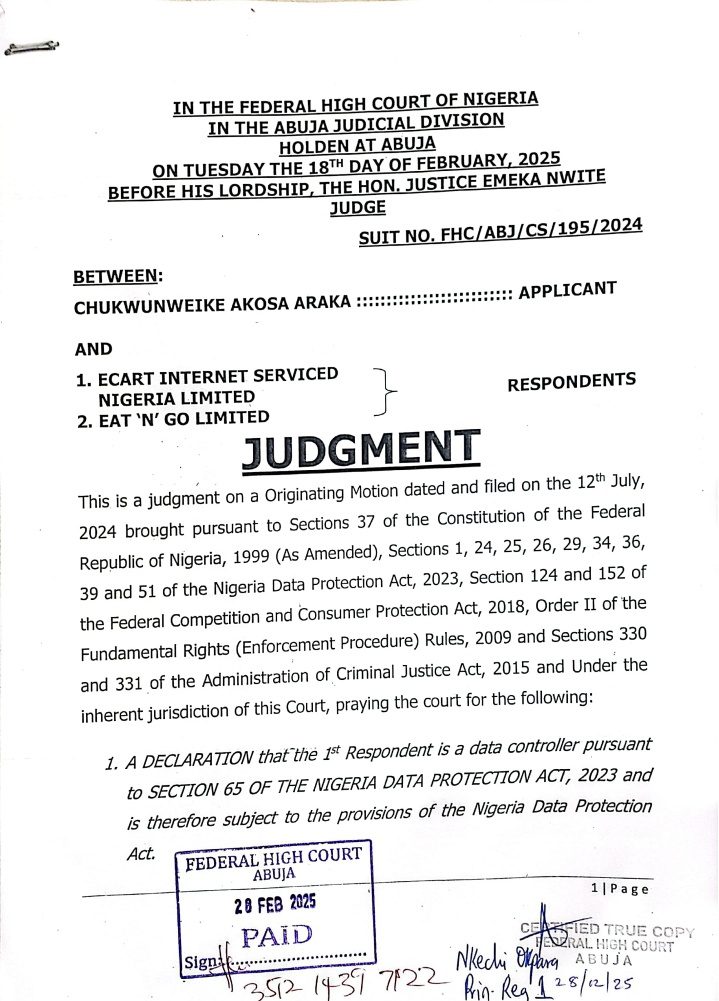
Unlawful data sharing: details of the court verdict
During the hearing, the court learned that Jumia Food had shared Akosa’s details with Domino’s Pizza as part of an On-Demand Service Agreement (ODSA) between both companies. However, Domino’s did not have permission to use that data for marketing purposes.
Justice Emeka Nwite, in his ruling, established that Domino’s Pizza had violated Section 37 of Nigeria’s Constitution and Sections 25 and 26 of the Nigeria Data Protection Act (NDPA) 2023 by processing Akosa’s data unlawfully
The court emphasised that:
- Domino’s Pizza acted as a data processor under the NDPA and had no legal right to repurpose Akosa’s data without consent
- Jumia Food fulfilled its duty of care by warning Domino’s to stop processing the customer’s data.
- Domino’s was solely liable for the continued misuse of Akosa’s information and for ignoring his formal request to be removed from their database.
Speaking on the ruling, Equibridge Attorneys (EBA) called it a significant step for data privacy in Nigeria.
“This judgment underscores the importance of consent in data processing. It sends a strong message to businesses that unauthorized use of personal data will not be tolerated. Every service provider engaged in direct marketing must comply with the Nigeria Data Protection Act, 2023,” the firm stated.
Read also: Personal data of over 840,000 customers allegedly leaked on loan app, iCredit
Reactions
The Paradigm Initiative also applauded the decision, calling it a landmark case for digital rights in Nigeria.
“Through the Ripoti platform, we continue to fight for individuals whose digital rights are violated. This ruling reinforces the importance of enforcing the Nigeria Data Protection Act to hold companies accountable for mishandling customer data,” PIN said.
And, contrary to expectations that legal battles drag on for years, this case moved swiftly. Akosa’s legal team at EBA filed the suit on July 12, 2024, and by February 19, 2025, the court had delivered its judgment, a resolution in just eight months.

Similarly, Oladiupupo Ige, the Managing Partner at EBA sheds light on the legal complexities and broader implications.
When asked whether the customer’s data had been misused beyond unsolicited messages, the lawyer clarified that the unwanted marketing messages constituted a clear violation.
The NDPA 2023 provides for this, and the court affirmed that using personal data without consent, even for marketing, breaches fundamental rights.
Addressing the legal responsibility of Jumia, Domino’s, and Glovo, the lawyer explained that Jumia was identified as the data controller, while Domino’s Pizza was classified as the data processor.
“After Akosa reached out to Jumia, they cautioned Domino’s via an official letter, requesting a stop to further processing of his data. However, Domino’s continued sending messages, making them solely liable”, he explained.
On the duration of the data privacy case, the lawyer praised the efficiency of the legal process and collaboration between EBA and Paradigm Initiative.
“The matter was a very quick one thanks to our team at Equibridge Attorneys (EBA), the effective justice system and the initiative of Ripoti. We commenced the case on the 12th of July, 2024 and got judgment on the 19th of February, 2025. That’s precisely 8 months,” he concluded.
What this means for Nigerian businesses
Following this ruling, the Nigeria Data Protection Commission (NDPC) may take a stricter approach to enforcing compliance across industries. Investigations, penalties, and policy revisions could emerge as businesses adjust to a new era of accountability in data processing.
Companies operating in Nigeria can no longer ignore data protection regulations. The ruling against Domino’s Pizza is a warning to all businesses engaged in direct marketing, unsolicited messaging, and unauthorised data sharing.

Key takeaways for businesses:
1. Consent is non-negotiable – Businesses must seek explicit consent before using customer data for marketing.
2. Data controllers must ensure compliance – Platforms like Jumia Food that collect user data must ensure their partners do not misuse customer information.
3. Legal consequences are real – Companies found violating Nigeria’s data privacy laws can face financial penalties and reputational damage.
The Akosa v. Domino’s Pizza data privacy case is more than just a personal victory, it is a turning point in Nigeria’s legal landscape for data protection. This ruling sends a clear message: data privacy is a fundamental right, and violations will not go unpunished.
