



For most people, a savings account is the default place to park idle money. It is familiar, easy to understand, and built around a simple idea: preserve capital, earn some interest, and access funds when needed.
Crypto savings products appeal to a similar need, but they belong to a very different system. Instead of helping users grow idle fiat cash, they are designed for people who already hold digital assets and want those assets to generate yield rather than sit unused.
Same goal, different system
At a high level, both bank savings accounts and crypto savings products try to solve the same problem: how to make idle assets more productive. The difference is that traditional bank savings accounts are tied to the fiat banking system and monetary policy, while crypto savings products are built around digital assets, exchange infrastructure, and platform-specific yield mechanisms.
That distinction matters because the comparison is not just about interest rates. It is really about what kind of saver you are, how much liquidity you need, and how much platform or market risk you are willing to accept.
How bank savings and crypto savings differ
A traditional bank savings account is primarily a capital-preservation tool. People use it because it is simple, regulated, and generally treated as a safer place for emergency funds or short-term reserves.
Crypto savings, by contrast, is usually better understood as an asset-efficiency tool. It is most relevant for users who already hold crypto and want to earn something on balances they are not actively trading, rather than letting those holdings remain idle.

Yield, liquidity, and trade-offs
One reason crypto savings has gained attention is that it can offer a more attractive yield profile than conventional savings products, especially for users already sitting on stablecoins or long-term crypto holdings. But a higher potential yield does not mean a universally better product, because that extra return comes with a different risk structure and a different access model.
Liquidity is another major factor. Some crypto savings products are flexible, meaning users can redeem when needed, while others are fixed-term, meaning funds are committed for a defined period in exchange for potentially better returns.
Which type of saver each one suits
Traditional bank savings accounts are usually the better fit for people who prioritize simplicity, fiat access, and principal stability above everything else. If the goal is emergency liquidity or preserving cash with minimal complexity, a bank account remains hard to replace.
Crypto savings make more sense for users who already hold digital assets and want those holdings to work harder. In practice, it tends to suit long-term holders, stablecoin users, and investors who do not want to trade actively but still care about capital efficiency.
A practical example: flexible vs fixed crypto savings
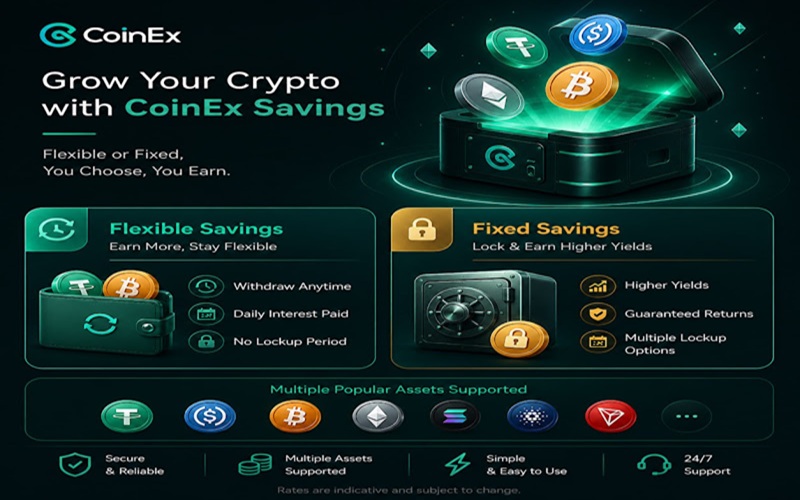
This is where a platform example can be useful. On CoinEx, CoinEx Flexible Savings is positioned as a principal‑protected wealth management product with instant subscription and redemption, where interest starts accruing from the next full hour after subscription, is calculated hourly, and is credited daily.
CoinEx’s has framed Flexible Savings as providing some of the most competitive yields in the sector, even as the industry‑highest APY. For users who value access and flexibility, that structure is easier to understand than a locked‑up product.
For users who do not need immediate liquidity and are comfortable committing funds for a fixed period, CoinEx Fixed Savings can be introduced as the other side of the savings spectrum: less flexible, but often chosen by users who are optimizing for more predictable, term‑based allocation.

How to present the choice honestly
The most useful framing is not “crypto savings beats bank savings” or the reverse. A more honest view is that they serve different roles: bank savings is about stability and convenience in fiat terms, while crypto savings is about improving the productivity of digital assets already held in a portfolio.
For that reason, many readers should not think of crypto savings as a full replacement for a bank account. It is better understood as a complementary tool for idle crypto, especially when flexibility, passive yield, and portfolio efficiency matter more than treating every parked asset like emergency cash.
How CoinEx Flexible Savings works in practice
CoinEx describes a simple path: enter the Earn section, choose Flexible Savings, select a supported asset, review the displayed APY, and subscribe to the desired amount. CoinEx also states that redeemed assets return immediately to the Spot account and stop generating interest after redemption.
That makes the product easier to explain in everyday terms. Instead of telling users to trade more, it offers a way to keep dormant balances productive while still preserving day-to-day options

A balanced takeaway
For readers deciding between the two, the real question is not which product sounds more modern. It is whether they are managing fiat savings that must stay highly secure and immediately usable, or digital assets that would otherwise sit idle without contributing anything to the portfolio.
Used that way, crypto savings can be a thoughtful tool rather than a speculative shortcut. And when the goal is to make idle crypto work without forcing constant trading, products such as CoinEx Flexible Savings can be introduced naturally as one practical example of how that approach works.
Similar read: Unlock your crypto potential: why CoinEx is your trusted gateway to secure trading
